

Myrmica laurae
- Scientific Name
- Myrmica laurae
- Tribe
- Myrmicini
- Subfamily
- Myrmicinae
- Author
- Emery, 1907
- Distribution
- Found in 1 countries
Myrmica laurae Overview
Myrmica laurae is an ant species of the genus Myrmica. It is primarily documented in 1 countries , including Italy. Detailed taxonomic data and occurrence records can be further explored via authoritative databases such as AntWeb or the Global Biodiversity Information Facility (GBIF).
Myrmica laurae
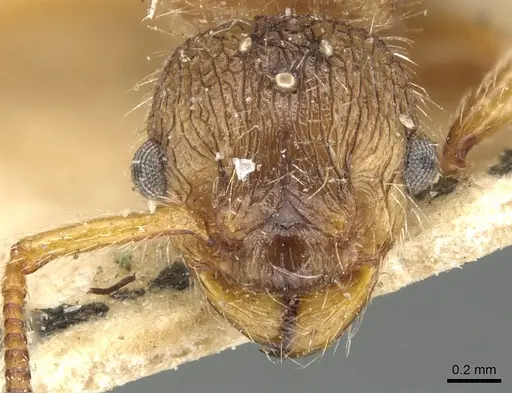
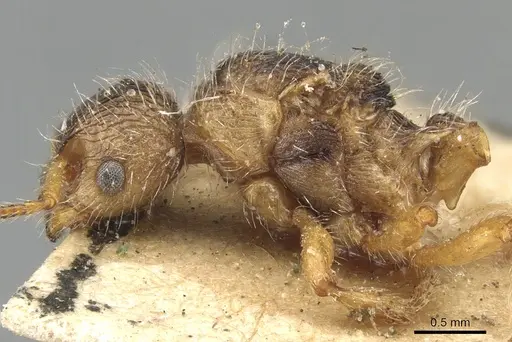
Myrmica laurae is a tiny, workerless social parasite that lives entirely within the nests of host Myrmica species. Queens measure around 5-6mm total length and are covered in long, fine hairs, with distinctive hairy eyes that set them apart from most other Myrmica [1]. The species is native to central Italy and has also been recorded in Serbia, where it parasitizes nests of Myrmica scabrinodis and Myrmica spinosior at higher altitudes [2][3]. Unlike typical ants, this species has no workers, the queens live permanently inside host colonies, laying their eggs to be raised by host workers [2]. This makes M. laurae one of the most challenging ants to keep, as it requires establishing a host colony first before the parasite can be introduced.
Quick Summary
- Difficulty: Expert
- Origin & Habitat: Central Italy and Serbia, found in mountainous areas up to 1400m altitude in Pinus nigra (black pine) forests with shaded clearings [4]. Lives in host ant nests under stones.
- Colony Type: Workerless social parasite (inquiline). Queens live permanently in host Myrmica colonies (M. scabrinodis, M. spinosior, possibly M. sabuleti) and are raised by host workers. No workers of their own caste exist [2][5].
- Queen: Socially parasitic
- Size & Growth:
- Queen: 5-6mm total length (HL 0.95-1.09mm) [6][1]
- Worker: Workerless, no workers exist in this species [2]
- Colony: Unknown, depends on host colony size
- Growth: Unknown, dependent on host colony
- Development: Unknown, development occurs within host colony (Development is handled entirely by host workers)
- Antkeeping:
- Temperature: Keep host colony at normal Myrmica temperatures (15-22°C range). No specific data for M. laurae but host species prefer cooler conditions [4].
- Humidity: Maintain moderate humidity matching host preferences (50-70%). Provide damp substrate in nesting area.
- Diapause: Likely follows host colony cycle. Host Myrmica species require winter hibernation, expect 3-4 months at 5-10°C [4].
- Nesting: Cannot be kept independently. Requires established host colony of Myrmica scabrinodis, M. spinosior, or M. sabuleti. Natural nests found under stones in shaded areas [4].
- Behavior: Extremely docile and passive, queens have no workers to defend them and rely entirely on host colony acceptance. Queens are wingless (ergatoid form) and spend their lives within the host nest. No aggression or defensive behaviors as there are no worker defenders. Escape risk is minimal since queens cannot survive outside a host colony [2].
- Common Issues: Host colony rejection, introduced parasite queens are often killed by host workers if colony acceptance is not achieved, No independent survival, queens cannot establish colonies alone or feed themselves, they require host worker care, Finding suitable host, M. scabrinodis, M. spinosior, and M. sabuleti may be difficult to obtain and establish, Slow integration, even with correct host species, acceptance can take weeks or fail entirely, Workerless means no backup, if host colony fails, the parasite colony also dies
Understanding Workerless Social Parasites
Myrmica laurae belongs to a rare category of ants called workerless social parasites, or inquilines. Unlike typical ants where a queen founding a new colony raises her first workers alone, M. laurae queens cannot do this at all. The queens are physically incapable of founding a colony independently, they have no workers to forage for food, tend to brood, or defend the nest. Instead, these parasitic queens must find an established colony of a compatible host species and integrate into it [2]. Once inside the host nest, the parasite queen lays eggs that are raised by host workers. The host workers care for the parasite brood as if it were their own, completely unaware (or unable to distinguish) that they are raising a different species. This is possible because the parasite has evolved to mimic the chemical signatures and behavioral cues of the host species. Over time, the parasite colony grows while the host colony may decline, as resources are diverted to raise the parasite's young instead of the host's [5].
Host Species Requirements
The success of keeping M. laurae depends entirely on establishing a healthy host colony first. The confirmed host species are Myrmica scabrinodis and Myrmica spinosior, with possible use of Myrmica sabuleti [2][7]. These are all common European Myrmica species that nest under stones in damp, shaded areas. In the wild, M. laurae has been found at altitudes up to 1400m living under stones in Pinus nigra forest clearings [4]. Host colonies should be established for at least 6-12 months before attempting introduction, giving them time to develop a strong worker population and stable colony structure. The host colony must be healthy and queenright, introducing a parasite to a weak or queenless host colony typically results in rejection or colony failure.
Introduction Methods
Introducing a parasitic queen to a host colony is the most challenging step. There are several approaches that keepers have attempted with related species. The most common method involves removing the host queen and introducing the parasite queen immediately after, the host workers are in a state of queenlessness and may accept a new queen more readily. Another method uses a two-queen approach where both host and parasite queens are present, allowing the parasite to gradually integrate while the host queen is still there. Some keepers report success with introducing the parasite queen through a forager entrance while the colony is foraging, reducing initial aggression. Regardless of method, success rates are typically low, and multiple introduction attempts are usually necessary. The introduced queen should be well-fed and in good condition before introduction [4].
Long-Term Care and Maintenance
Once a parasite queen is accepted by a host colony, the challenge shifts to maintaining the balance. The parasite queen will begin laying eggs, and host workers will raise them. Over time, you may notice the parasite population increasing while the host population stabilizes or slowly declines. This is normal, the parasite is essentially 'taking over' the colony resources. However, if the host population drops too low, the entire colony may collapse. Some keepers recommend periodically adding new host workers or even introducing a new host queen to keep the colony sustainable. Monitoring is critical, watch for signs of host worker aggression toward the parasite queen, which can indicate rejection even after initial acceptance. The combined colony should be fed and cared for as you would a normal Myrmica colony, with protein foods and sugar water offered to foragers [4].
Frequently Asked Questions
Can I keep Myrmica laurae like a normal ant colony?
No. Myrmica laurae is a workerless social parasite that cannot survive without a host colony. You cannot keep it independently, you must first establish a host colony (Myrmica scabrinodis, M. spinosior, or M. sabuleti) and then introduce the parasite queen. This is fundamentally different from keeping normal ants [2].
How do I introduce Myrmica laurae to a host colony?
The most reliable method is to remove the host queen first, then introduce the parasite queen within hours while workers are still in a queenless state. Some keepers have had success introducing through the forager entrance during active foraging. Expect multiple attempts may be needed, acceptance is not guaranteed even with correct methods [4].
Will host workers kill the parasite queen?
Yes, this is the primary failure mode. Host workers often attack and kill introduced parasite queens, especially if the host colony is strong and well-established with their original queen. Even queenless colonies may reject introductions. There is no guaranteed method to prevent this, it depends on colony chemistry and individual worker behavior [4].
What happens if the host colony dies?
If the host colony dies, the parasite colony also dies immediately. M. laurae queens cannot survive independently, they cannot forage, cannot raise brood, and have no workers to care for them. The parasite is entirely dependent on the host for survival [2].
Can I keep multiple parasite queens in one host colony?
This has not been documented and would be extremely risky. In the wild, only one parasite queen is typically found per host nest. Multiple introductions would almost certainly result in fighting between the parasite queens, and host workers would likely attack both [4].
Do Myrmica laurae queens need hibernation?
Likely yes, following the host colony's cycle. Host species (M. scabrinodis, M. spinosior) require 3-4 months of winter dormancy at 5-10°C. The parasite queen would likely enter dormancy alongside the host colony [4].
Are Myrmica laurae dangerous or do they sting?
No. M. laurae has no workers, only queens. Queens cannot sting effectively and pose no danger to humans. They are completely harmless but also completely helpless outside a host colony [5].
Where can I obtain Myrmica laurae and its hosts?
M. laurae is rarely available in the antkeeping hobby due to its parasitic nature. Host species M. scabrinodis, M. spinosior, and M. sabuleti can sometimes be found in the trade or collected from the wild in Europe. Always check local regulations before collecting native species. This species is not recommended for beginners due to the complexity of keeping parasitic ants [4].
How long does it take for the parasite to be accepted?
If acceptance will occur, it typically happens within 24-48 hours of introduction. Signs include the parasite queen being carried by workers into the nest chambers rather than being attacked. If workers are attacking or ignoring the queen after 2-3 days, the introduction has failed and the queen should be removed [4].
Is Myrmica laurae a good choice for beginners?
Absolutely not. This species is among the most difficult ants to keep because it requires maintaining a host colony, successfully introducing a parasite, and managing the long-term balance between parasite and host. Even experienced antkeepers struggle with workerless parasites. Start with a straightforward species like Lasius niger or Myrmica rubra before attempting parasitic ants [4].
References

This caresheet is licensed under CC BY-SA 4.0 .
CASENT0904098
View on AntWeb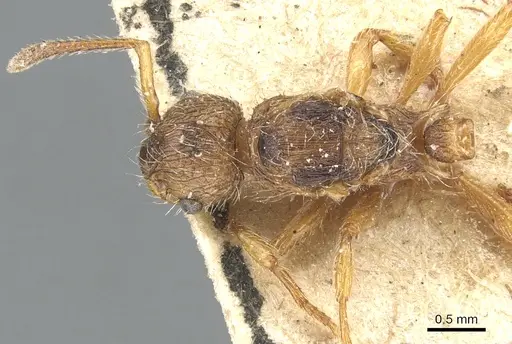
Literature
Loading...Loading products...