

Monomorium santschii
- Scientific Name
- Monomorium santschii
- Tribe
- Solenopsidini
- Subfamily
- Myrmicinae
- Author
- Forel, 1905
- Distribution
- Found in 0 countries
Monomorium santschii Overview
Monomorium santschii is an ant species of the genus Monomorium. It is primarily documented in 0 countries . Detailed taxonomic data and occurrence records can be further explored via authoritative databases such as AntWeb or the Global Biodiversity Information Facility (GBIF).
Monomorium santschii
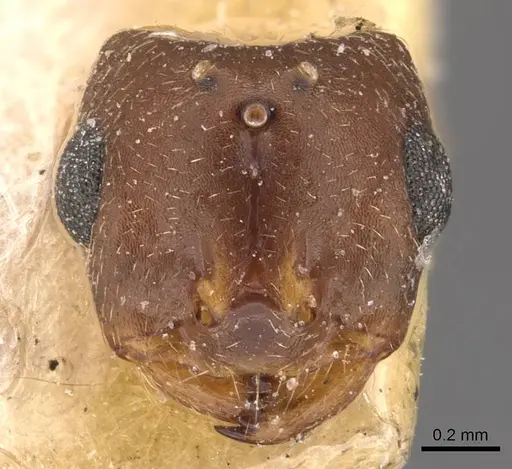
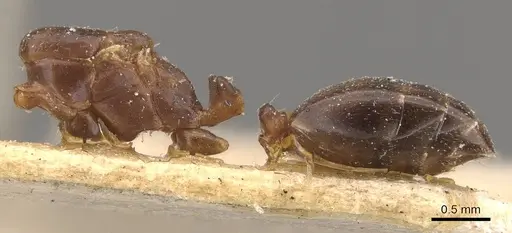
Monomorium santschii is a tiny social parasite from Tunisia, North Africa, with queens measuring 4.3-4.7mm and males 3.8-4mm [1][2]. The species is completely workerless and cannot survive without its host, Monomorium salomonis [3]. Queens are black with yellowish-brown leg joints and have a distinctive concave margin on the back of their head [1]. Based on its subfamily Myrmicinae and tribe Solenopsidini, it likely has a sting with piperidine alkaloids for defense, but no specific literature exists for this species. The parasite queen enters the host nest, the host workers kill their own queen, and then adopt the intruder, which goes on to lay eggs that produce only new queens and males [3][1].
Quick Summary
- Difficulty: Expert
- Origin & Habitat: Tunisia, North Africa, found in nests of Monomorium salomonis [4][1]
- Colony Type: Workerless social parasite, requires host colony (Monomorium salomonis) to survive. Queens cannot feed themselves and rely entirely on host workers [3].
- Size & Growth:
- Queen:{.size-link} 4.3-4.7mm [1][2]
- Worker:{.size-link} Workerless species, no workers exist
- Colony: Cannot be established as independent colony
- Growth: N/A, parasitic species
- Development: N/A, no workers produced. Eggs develop into new queens and males only [3] (This species produces only reproductive castes (queens and males), never workers)
- Antkeeping:
- Temperature: Unknown, cannot be kept independently
- Humidity: Unknown, cannot be kept independently
- Diapause: Unknown, would follow host colony patterns
- Nesting: Lives within host nest, cannot be kept separately
- Behavior: This is an obligate social parasite. Queens approach host nest entrances, wait to be accepted by host workers, then gain entry. Host workers then kill their own queen and adopt the parasite. The parasite queen lays eggs that produce only females and males, the worker caste has been entirely lost. Queens cannot feed themselves and must be fed by host workers [3][1].
- Common Issues: this species cannot be kept independently, it requires a living host colony of Monomorium salomonis., queens cannot feed themselves and starve without host workers to tend them., no workers means the colony cannot forage, expand, or survive without the host., even if you obtain both species, establishing a mixed colony is extremely difficult and not documented., this species is not available in the antkeeping hobby due to its parasitic nature.
Understanding Monomorium santschii
Monomorium santschii is one of the most biologically unusual ants in the world. Unlike almost all other ant species, it has completely lost its worker caste. The species exists only as reproductive queens and males, living entirely within colonies of its host species, Monomorium salomonis. This is called obligate social parasitism, the parasite cannot survive without the host. Queens are unable to feed themselves and must be tended by host workers throughout their lives. When a santschii queen approaches a host nest, she waits at the entrance. Host workers accept her, she enters, and then something remarkable happens: the host workers kill their own queen and adopt the intruder as their new reproductive. The santschii queen then lays eggs that develop exclusively into new queens and males, no workers are ever produced [3][1].
Why This Species Cannot Be Kept in Captivity
This species is NOT suitable for antkeeping and cannot be maintained in captivity for several fundamental biological reasons. First, queens cannot feed themselves, they lack the ability to forage and would starve without host workers to feed them. Second, there are no workers to tend brood, expand the nest, or forage for food. Third, the species is an obligate parasite that requires a living host colony of Monomorium salomonis to survive. Even if you could obtain both species, there is no documented method for successfully establishing a mixed colony. The parasite queen depends on host workers killing their own queen first, a process that cannot be reliably induced in captivity. Additionally, the species has only been found in Tunisia and is not available through any antkeeping sources [3].
The Host Species: Monomorium salomonis
If you are interested in keeping ants from this region, Monomorium salomonis would be the relevant species to research. It is the host species that santschii depends on for survival. Monomorium salomonis is a member of the salomonis species group found across North Africa and the Mediterranean region. It is a small, dark ant that nests in the ground, often under stones or in sandy soil. Unlike its parasite, salomonis has normal workers and can be kept in captivity using standard Myrmicinae care. However, note that santschii has only been documented parasitizing salomonis in Tunisia specifically, it may not accept other Monomorium species as hosts [1][4].
Related Species in the Hobby
For antkeepers interested in parasitic ants, there are other species that are more suitable for captivity. Some Formica species (particularly Formica truncorum and Formica rufa groups) can serve as hosts for temporary social parasites like Formica sanguinea, which is a slave-making ant that can be kept with careful management. However, Monomorium santschii remains one of the most specialized parasitic ants known, it is an extreme example of evolutionary reduction where the entire worker caste has been lost. This makes it biologically fascinating but completely unsuitable for captive keeping. If you want to observe parasitic ant behavior, look into species with documented captive breeding success rather than obligate parasites like M. santschii [3].
Frequently Asked Questions
Can I keep Monomorium santschii in my ant farm?
No. This species cannot be kept in captivity. It is an obligate social parasite that requires a living host colony of Monomorium salomonis to survive. Queens cannot feed themselves and there are no workers to maintain the colony.
What does Monomorium santschii eat?
The queen cannot feed herself and is fed entirely by host workers. In the wild, host workers of Monomorium salomonis forage for food and regurgitate it to the parasite queen. Without host workers, the queen would starve.
Why does Monomorium santschii have no workers?
This species has completely lost its worker caste through evolution, it is a workerless parasite. The queen lays eggs that develop only into new queens and males. This is an extreme adaptation to obligate parasitism, the species relies entirely on host workers for all colony functions except reproduction.
Where does Monomorium santschii live?
Only in Tunisia, North Africa. The species has been documented in Kairouan, Cheri-chera, and Figuig. It lives exclusively within nests of Monomorium salomonis.
How does the parasite take over the host colony?
The santschii queen approaches the host nest entrance and waits. Host workers accept her and allow her inside. Once inside, the host workers kill their own queen and adopt the intruder as the new reproductive. The parasite queen then takes over egg-laying duties [3][1].
Is Monomorium santschii available to buy?
No. This species is not available in the antkeeping hobby and cannot be legally collected or traded. It is only found in Tunisia and is an obligate parasite that cannot survive without its host.
What is the closest species I can keep instead?
Monomorium salomonis (the host species) would be the closest related species, but it is also not commonly available. For antkeepers interested in North African species, research more common Mediterranean ants like Messor, Cataglyphis, or Tapinoma. For parasitic ant behavior, Formica sanguinea is a more manageable slave-making species.
How big is Monomorium santschii?
Queens are 4.3-4.7mm and males are 3.8-4mm. There are no workers in this species, it is completely workerless [1][2].
Report an Issue
The current care sheet is based fully on literature. See inconsistencies, or something that's incorrect? Please , it will be resolved after review from an admin. Contributing to the blogs tab also helps providing information, to make us be able to further improve the caresheets. Thank you for your support!
References

This caresheet is licensed under CC BY-SA 4.0 .
CASENT0908779
View on AntWeb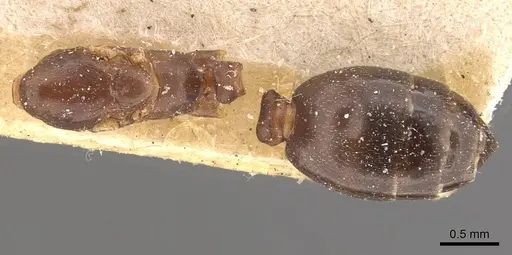
Literature
Loading...Loading products...