

Pheidole loki
- Scientific Name
- Pheidole loki
- Tribe
- Attini
- Subfamily
- Myrmicinae
- Author
- Fischer & Fisher, 2013
- Distribution
- Found in 1 countries
Pheidole loki Overview
Pheidole loki is an ant species of the genus Pheidole. It is primarily documented in 1 countries , including Mayotte. Detailed taxonomic data and occurrence records can be further explored via authoritative databases such as AntWeb or the Global Biodiversity Information Facility (GBIF).
Pheidole loki
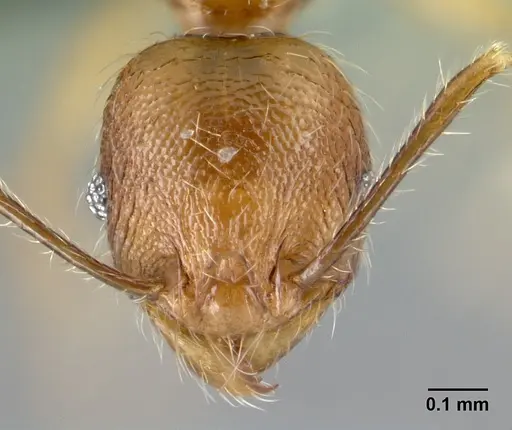
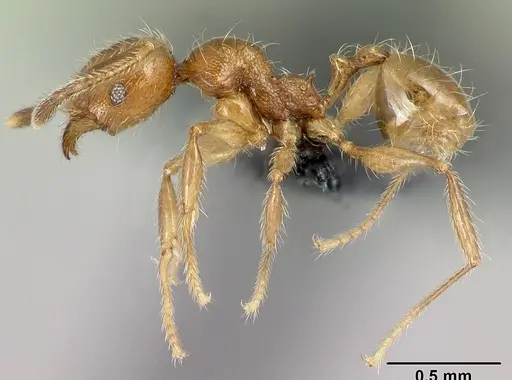
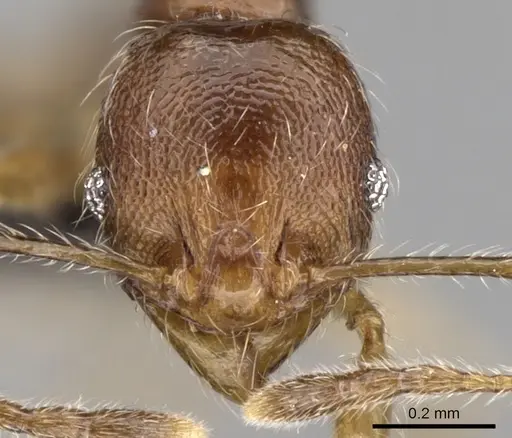
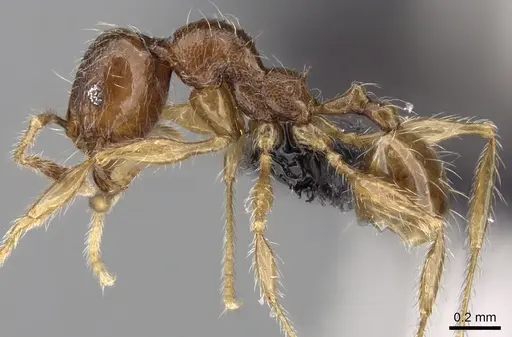
Pheidole loki is an extremely rare tiny ant species known only from two specimens collected in forest leaf litter on Mayotte, a small island in the Indian Ocean between Madagascar and the African mainland [1]. The species was described in 2013 and named after Loki, the Norse god of mischief, fitting for an ant that's managed to stay hidden from science [1]. Only minor workers have been collected, the larger major workers with their characteristic big heads have never been observed [1]. This species is closely related to Pheidole jonas and Pheidole vulcan, sharing their reduced body sculpture and intermediate hair patterns [1]. In the hand, these ants appear as tiny dark orange to brown workers with relatively long postpetioles (the segment behind the waist) and sparse standing hairs [1].
Quick Summary
- Difficulty: Unknown, likely Expert
- Origin & Habitat: Endemic to Mayotte, a tropical island in the Mozambique Channel. Found at 470-630m elevation on Mt. Benara and Mt. Combani in forest leaf litter [1][2].
- Colony Type: Unconfirmed, only minor workers have ever been collected, so colony structure is unknown. Based on typical Pheidole patterns, likely single-queen colonies [3].
- Size & Growth:
- Queen: Unknown, majors have never been collected [1]. Based on related species, estimated 5-7mm.
- Worker: Minor workers: 0.46mm head width,0.62-0.65mm mesosoma length (WL) [2][1]. Total body length approximately 2.5-3mm.
- Colony: Unknown, only two specimens ever collected [1].
- Growth: Unknown, no colony data exists.
- Development: Unknown, no direct observations. Based on typical Pheidole development in tropical conditions, estimated 4-6 weeks at optimal temperature [3]. (No captive colonies or developmental data exists for this species. All timelines are estimates based on related species.)
- Antkeeping:
- Temperature: Based on Mayotte's tropical climate (13°S latitude), likely needs 24-28°C. Provide a warm area around 26°C with a slight gradient [3].
- Humidity: Forest leaf litter species from humid tropical forest, keep nest substrate consistently moist but not waterlogged. Aim for 70-80% humidity [1].
- Diapause: Unlikely, Mayotte has no true winter. This species probably remains active year-round [3].
- Nesting: In captivity, provide a small nest with fine substrate, these tiny ants need tight chambers and humid conditions. A small Y-tong or plaster nest works well. They naturally live in leaf litter, so a naturalistic setup with moist soil and hiding spots mimics their natural environment [1].
- Behavior: Behavior is unobserved in captivity. In the wild, they live in forest floor leaf litter, suggesting they are secretive and ground-nesting [1]. Pheidole species typically have major workers that defend the colony and crack seeds, but majors are unknown for this species so their defensive behavior is unclear [3]. Escape risk is significant given their tiny size, use fine mesh barriers. They likely forage on the ground for seeds and small insects like other Pheidole [3].
- Common Issues: No captive husbandry information exists, this species has never been kept in captivity, Only two wild specimens have ever been collected, making it extremely unlikely to obtain, Tiny size means excellent escape prevention is essential, Unknown whether this species can be kept in captivity at all, May require specific humidity and temperature conditions that are difficult to replicate
Why This Species Is So Difficult to Keep
Pheidole loki presents a unique challenge: it may be one of the rarest ants in the world to keep. Only two minor worker specimens have ever been collected, both from forest leaf litter on Mayotte in 1999 [1]. No queens, no majors, no colonies have ever been found. This means there is zero captive husbandry information available, no one has successfully kept this species in captivity. The species was formally described in 2013 from these two specimens, and it remains known only from them [1]. For these reasons, P. loki is not a species you can realistically obtain or attempt to keep. If you're interested in Pheidole ants, consider more commonly available species like Pheidole megacephala or Pheidole pallidula, which have established captive protocols [3].
What We Know About Their Natural History
From the two known specimens, we can piece together some basic natural history. P. loki lives in tropical forest leaf litter at moderate elevations (470-630m) on the volcanic islands of Mt. Benara and Mt. Combani in Mayotte [1]. The species is closely related to P. jonas and P. vulcan, sharing reduced body sculpture and intermediate hair patterns [1]. The minor workers have a relatively long postpetiole (the segment behind the waist), nearly 1.5 times longer than high, which distinguishes them from close relatives [1]. They have dark orange to brown coloration with lighter legs and mandibles [1]. The fact they were collected using sifted leaf litter extraction suggests they, like many tiny forest ants, live hidden in the forest floor debris rather than in obvious nests [1].
Related Species for Reference
Since P. loki cannot be kept, understanding related species helps explain what captive care might look like. Other Pheidole species are well-established in the antkeeping hobby. Pheidole megacephala (the big-headed ant) is a widespread tropical species known for its rapid growth and seed-harvesting behavior [3]. Most Pheidole are monogyne (single queen) and claustral (queen seals herself in to raise first workers) [3]. They typically accept a varied diet including seeds, small insects, and sugar sources. If P. loki were to be kept, it would likely need conditions similar to other tropical Pheidole: warm temperatures (24-28°C), high humidity, and small prey items [3]. However, this is speculative, the species may have unique requirements that differ from its relatives.
Legal and Ethical Considerations
Mayotte is a French overseas department, and P. loki appears to be endemic to the island, meaning it's found nowhere else on Earth [1][2]. Collecting this species would require research permits from French authorities, and even then, the extreme rarity of the species would make collection ethically questionable. Additionally, since no one has ever kept this ant in captivity, attempting to establish a colony would be essentially experimental with very low chances of success. For antkeepers, it's best to appreciate P. loki as a fascinating natural history curiosity rather than a target species for collection. If you're interested in keeping Pheidole, more common and sustainable alternatives exist in the hobby.
Frequently Asked Questions
Can I keep Pheidole loki ants?
No, this species has never been kept in captivity and only two specimens have ever been collected in the wild. It is not available in the antkeeping hobby and cannot be ethically obtained.
Where does Pheidole loki live?
Only on Mayotte, a small island in the Indian Ocean between Madagascar and Africa. It's found at 470-630m elevation on Mt. Benara and Mt. Combani [1].
What do Pheidole loki ants look like?
Only minor workers are known. They are tiny (about 2.5-3mm total), dark orange to brown, with relatively long postpetioles and sparse standing hairs. The larger major workers have never been observed [1].
Are there major workers for Pheidole loki?
Unknown, no major workers have ever been collected. This is one of the mysteries of this species. The major caste may exist but has not been discovered, or this species may be polymorphic in an unusual way [1].
What temperature do Pheidole loki need?
Not directly studied, but based on Mayotte's tropical climate, they would likely need 24-28°C. This is an estimate only, no captive data exists [3].
How big do Pheidole loki colonies get?
Unknown, only two individual workers have ever been found. No colony size data exists for this species [1].
What should I keep instead of Pheidole loki?
Consider more commonly available Pheidole species like Pheidole megacephala, Pheidole pallidula, or Pheidole nodus. These have established captive protocols and are available from reputable suppliers. They offer the classic Pheidole experience with major workers and active colonies.
Is Pheidole loki endangered?
The conservation status has not been assessed. However, with only two known specimens from a limited geographic range, it could be considered data deficient. Its habitat in Mayotte's forests may be threatened by deforestation [1].
Why is it called Pheidole loki?
It was named after Loki, the Norse god of mischief and chaos. The researchers chose this name because the species has remained hidden and mysterious, much like a trickster [1].
References

This caresheet is licensed under CC BY-SA 4.0 .
CASENT0059114
View on AntWeb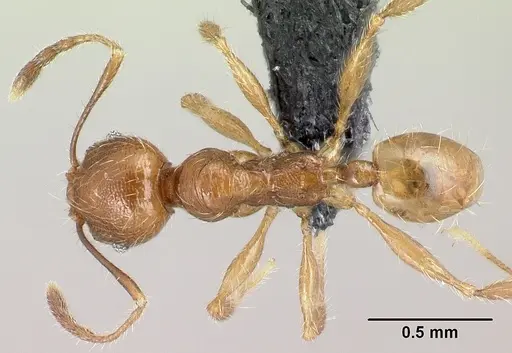
CASENT0059150
View on AntWeb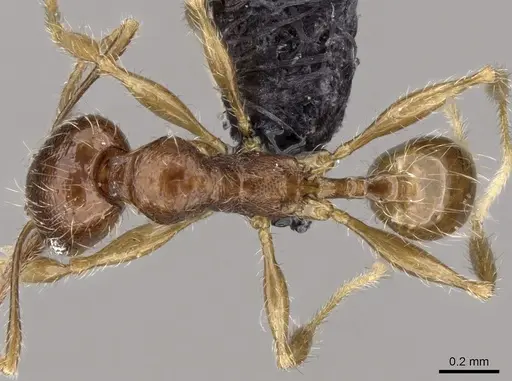
Literature
Loading...Loading products...