

Azteca quadraticeps
- Scientific Name
- Azteca quadraticeps
- Tribe
- Leptomyrmecini
- Subfamily
- Dolichoderinae
- Author
- Longino, 2007
- Distribution
- Found in 1 countries
Azteca quadraticeps Overview
Azteca quadraticeps is an ant species of the genus Azteca. It is primarily documented in 1 countries , including Costa Rica. Detailed taxonomic data and occurrence records can be further explored via authoritative databases such as AntWeb or the Global Biodiversity Information Facility (GBIF).
Azteca quadraticeps
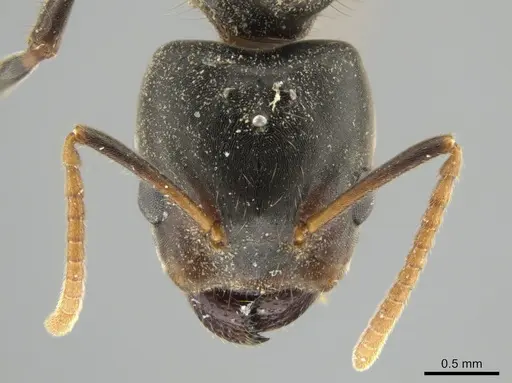
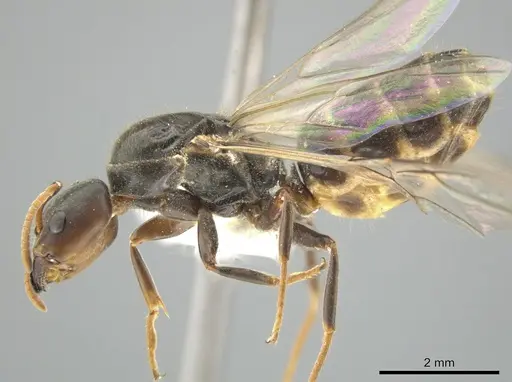
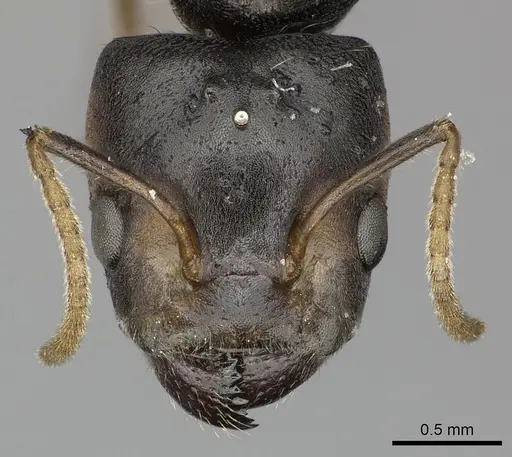
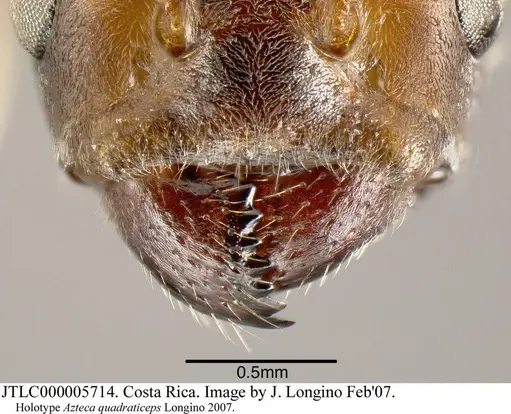
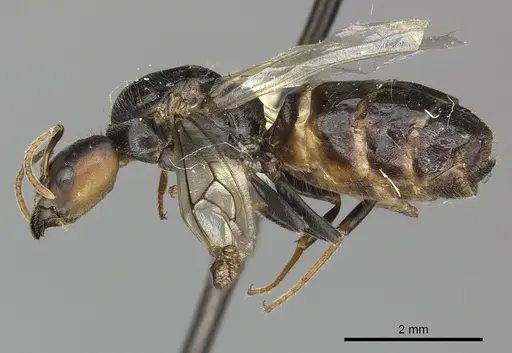
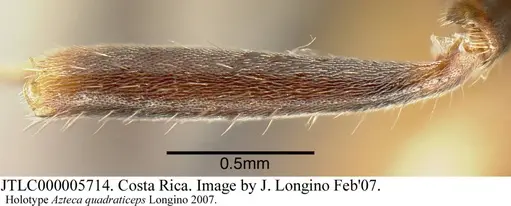
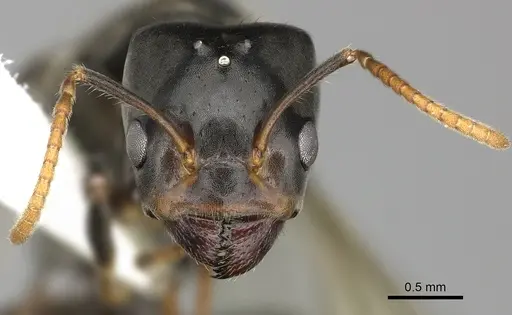
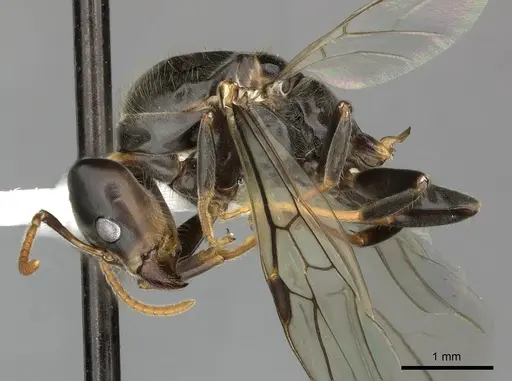
Azteca quadraticeps is a relatively newly described arboreal ant species from the Neotropics. The species was formally described by John Longino in 2007 and is known only from queen specimens, workers have never been collected or described [1]. Queens are relatively large, measuring 1.70-1.84mm in head length, with a distinctive subquadrate (somewhat square-shaped) head that gives the species its name. The face is mostly dark brown with lighter orange coloration around the mandible area [1]. This species is part of a complex of similar species including Azteca flavigaster, Azteca velox, and Azteca nigra, making identification challenging without the unknown worker caste [1]. The species has been recorded in Costa Rica's Atlantic lowlands, Nicaragua, and recently in northern Colombia (Santa Marta), representing a significant range extension of over 1000km from the type locality [2].
Quick Summary
- Difficulty: Expert
- Origin & Habitat: Lowland to mid-elevation rainforest in the Atlantic lowlands of Costa Rica (up to 700m), with records from Nicaragua and northern Colombia. Found in moist tropical forest edges and adjacent pasture areas [1][2].
- Colony Type: Unknown, this species is only known from collected queens, workers have never been described. Based on typical Azteca patterns, likely forms colonies in arboreal locations such as plant stems, carton nests, or myrmecophytic plants.
- Size & Growth:
- Queen: 1.70-1.84mm head length (HLA),1.62-1.79mm head width (HW) [1]
- Worker: Unknown, workers have never been described [1]
- Colony: Unknown, no colony collections have been documented
- Growth: Unknown, no development data available
- Development: Unknown, no direct observations of colony development exist (This species is known only from collected queens, no worker-producing colonies have been documented in the scientific literature)
- Antkeeping:
- Temperature: Inferred: 24-28°C based on Neotropical lowland rainforest origin. Provide a warm, stable temperature gradient. Monitor colony activity and adjust as needed.
- Humidity: Inferred: High humidity (60-80%) typical of rainforest habitats. Keep nest substrate consistently moist but not waterlogged.
- Diapause: Unknown, no data on overwintering requirements. Neotropical species may not require true hibernation but may have seasonal activity patterns.
- Nesting: Inferred: Arboreal nesting preferred. Based on typical Azteca behavior, they likely occupy plant stems, construct carton nests, or inhabit myrmecophytic plants. Provide vertical/naturalistic setups with access to plant material or stems.
- Behavior: Behavior is poorly documented since only queens have been collected. Based on genus-level information, Azteca ants are typically arboreal and can be aggressive defenders of their nesting sites. They have complex relationships with scale insects (coccoid Hemiptera) for honeydew collection [3]. Some Azteca species are specialized plant-ants with Cecropia trees. Escape prevention is important given their small size, use fine mesh barriers. Temperament likely similar to other Azteca species: defensive of nest but not typically aggressive toward keepers.
- Common Issues: Workers have never been described, this species may not be established in antkeeping at all, No colony development data exists, founding and growth timelines are completely unknown, Identification is difficult, queens are similar to several other Azteca species, Distribution is poorly known, wild colonies have rarely been observed, Arboreal nesting requirements may be challenging to replicate in captivity
Species Overview and Identification
Azteca quadraticeps is one of the more recently described Azteca species, officially named in 2007 by ant taxonomist John Longino. The species name refers to its somewhat quadrate (square-shaped) head, which distinguishes it from close relatives like Azteca velox that have more rounded head sides [1]. This is a challenging species to identify because only queen specimens exist, the worker caste has never been collected or described. It's possible that workers have been collected but misidentified as other similar species like A. flavigaster, A. velox, or A. nigra [1]. The known range includes Costa Rica's Atlantic lowlands, with a recent record in Santa Marta, Colombia representing a significant 1020km eastern range extension [2]. Queens collected in Costa Rica were found in lowland to mid-elevation rainforest at elevations up to 700m.
Why This Species is Extremely Difficult to Keep
Azteca quadraticeps presents extraordinary challenges for antkeepers that set it apart from most commonly kept species. First and most critically, workers have never been described, this means no established colonies exist in the antkeeping hobby, and no one has successfully raised a colony from a founding queen through to workers. The species is only known from queens collected during nuptial flights or from flight traps [1][4]. Second, even if you obtain a newly mated queen, there is absolutely no development timeline data, no information about what they eat in captivity, and no guidance on their specific temperature or humidity needs. Third, identification is extremely difficult, even expert taxonomists struggle to distinguish this species from related Azteca species without the worker caste for comparison. For these reasons, Azteca quadraticeps is recommended only for expert antkeepers with specific research goals who understand they are pioneering captive husbandry for a species with zero established protocols.
Inferred Care Based on Genus Biology
While no specific care information exists for A. quadraticeps, we can make educated inferences from what is known about the Azteca genus as a whole. Azteca ants are arboreal (tree-dwelling) insects found throughout Neotropical regions from Mexico to Argentina [3]. They typically nest in three main ways: constructing carton nests (papery material made from plant fibers and wax), occupying hollow plant stems, or forming ant gardens in tree branches [3]. Many Azteca species have mutualistic relationships with Cecropia trees and other myrmecophytic plants, while others maintain complex relationships with scale insects (coccoid Hemiptera) that provide honeydew [3]. In captivity, you would likely need to provide a naturalistic or arboreal-style setup with access to plant material or stems. Temperature should be warm (24-28°C) matching their lowland rainforest origin, and humidity should be high (60-80%).
Feeding and Diet
Direct feeding observations for A. quadraticeps do not exist. However, Azteca genus members are typically omnivorous with a strong reliance on honeydew from tending scale insects and aphids, plus they forage for small insects and arthropods [3]. A newly caught queen would likely need protein food during founding if she does not seal herself away completely (claustral behavior is typical for Dolichoderinae but not confirmed for this species). Offer small live prey like fruit flies, pinhead crickets, or mealworm pieces. Sugar sources like honey water or sugar water may be accepted once workers emerge, but this is speculative. Given the complete lack of data, you should experiment carefully and document any acceptance or rejection of foods. Do not rely on sugar sources as a primary food until acceptance is confirmed.
Legal and Ethical Considerations
Before attempting to keep Azteca quadraticeps, verify the legal status in your jurisdiction. This species is native to Costa Rica, Nicaragua, and Colombia, if you are in these countries or elsewhere in the Neotropical range, collection may be regulated. If you are outside the native range (such as in North America or Europe), this species would almost certainly not be available through legal channels, and releasing any ant colony into non-native ecosystems can cause serious ecological damage. Azteca species are not known to be invasive outside their native range, but introducing any non-native ant species is strongly discouraged. Additionally, given how rare this species is in scientific collections, ethical collection practices should be followed, only take individuals you genuinely need for study and avoid over-collecting from populations. [2][1]
Frequently Asked Questions
Can I keep Azteca quadraticeps ants?
Technically yes, but this is not a species for beginners or even intermediate antkeepers. Workers have never been described, no captive colonies exist, and there is zero established husbandry information. You would essentially be pioneering all captive care methods from scratch. This is an expert-level species only suitable for those with specific research interests.
Where can I get Azteca quadraticeps?
This species is extremely rare in the antkeeping hobby. It is only known from a handful of queen specimens collected in Costa Rica, Nicaragua, and recently Colombia. There are no established captive colonies, and workers have never been described. Unless you are conducting field research in these regions, obtaining this species would be nearly impossible through legal channels.
How do I identify Azteca quadraticeps?
Identification is extremely difficult and requires expert taxonomic knowledge. Only queens are known, and they closely resemble several other Azteca species including A. flavigaster, A. velox, and A. nigra. The main distinguishing feature is the somewhat quadrate (square-ish) head shape compared to the more rounded heads of relatives. Without workers for comparison, even professional entomologists struggle with identification.
What do Azteca quadraticeps workers look like?
This is one of the fundamental mysteries of this species, workers have never been scientifically described or collected. They may exist in museum collections but have likely been misidentified as other similar Azteca species. We genuinely do not know what the workers look like, their size, or any morphological characteristics.
Do Azteca quadraticeps queens need to forage during founding?
This is unknown. Most Dolichoderinae (the subfamily Azteca belongs to) are claustral, meaning the queen seals herself in a chamber and lives off stored fat reserves until first workers emerge. However, this has not been directly observed for A. quadraticeps. Some Azteca species may exhibit semi-claustral behavior where the queen must occasionally leave to hunt for food.
What temperature do Azteca quadraticeps need?
No specific data exists. However, as a Neotropical species from lowland rainforest in Costa Rica, they almost certainly require warm conditions. Inferred range is 24-28°C. Provide a temperature gradient and monitor colony activity. Avoid temperatures below 20°C or above 32°C.
How long does it take for Azteca quadraticeps to produce first workers?
This is completely unknown. No one has documented a colony going from founding queen to worker production for this species. Development timelines for related Azteca species typically range from 6-12 weeks at warm temperatures, but this is a rough estimate with no direct data for A. quadraticeps.
Are Azteca quadraticeps dangerous?
Azteca species can be defensive and will bite if their nest is threatened, but they are not considered dangerous to humans. Their small size means any sting would be minimal even if they possess a stinger (which is typical for Dolichoderinae but not confirmed for this species). The main concern is escape prevention due to their very small size.
Can I keep multiple Azteca quadraticeps queens together?
This has not been studied. In the wild, only single queens have been collected (no multi-queen colonies documented). Azteca species vary in their colony structure, some are single-queen (monogyne), others accept multiple queens (polygyne). Without any data on this specific species, pleometrosis (multiple queen founding) is not recommended.
Do Azteca quadraticeps need hibernation?
This is unknown. As a Neotropical species from Costa Rica (near the equator), true hibernation is unlikely. However, they may experience seasonal activity changes related to wet/dry seasons rather than cold. Do not force hibernation without evidence the species requires it.
References

This caresheet is licensed under CC BY-SA 4.0 .
CASENT0627786
View on AntWeb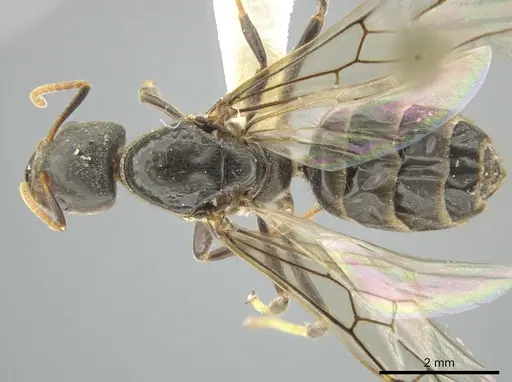
INBIOCRI000065859
View on AntWeb
JTLC000005714
View on AntWeb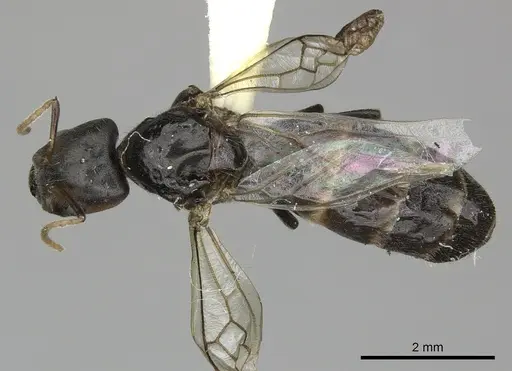
JTLC000009422
View on AntWeb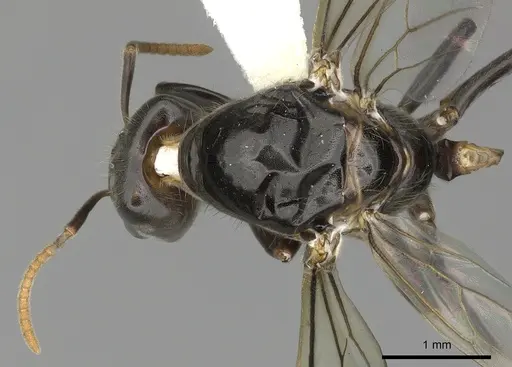
Literature
Loading...Loading products...