

Oxyepoecus bruchi
- Scientific Name
- Oxyepoecus bruchi
- Tribe
- Solenopsidini
- Subfamily
- Myrmicinae
- Author
- Santschi, 1926
- Distribution
- Found in 2 countries
Oxyepoecus bruchi Overview
Oxyepoecus bruchi is an ant species of the genus Oxyepoecus. It is primarily documented in 2 countries , including Argentina, Brazil. Detailed taxonomic data and occurrence records can be further explored via authoritative databases such as AntWeb or the Global Biodiversity Information Facility (GBIF).
Oxyepoecus bruchi
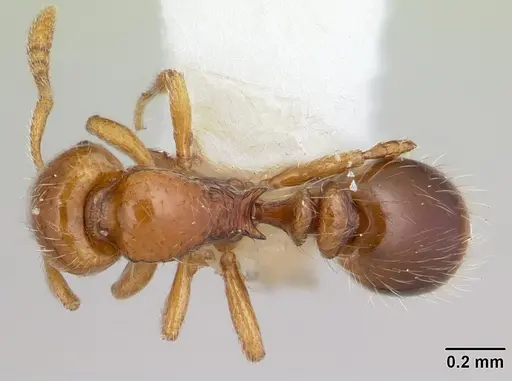
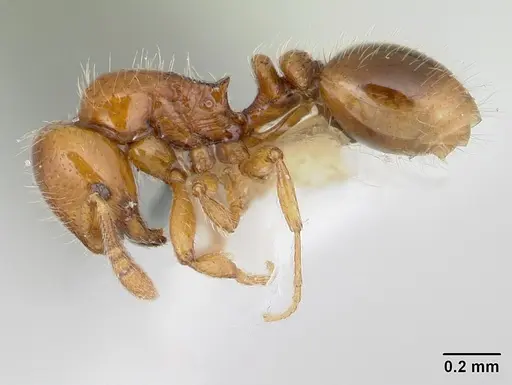
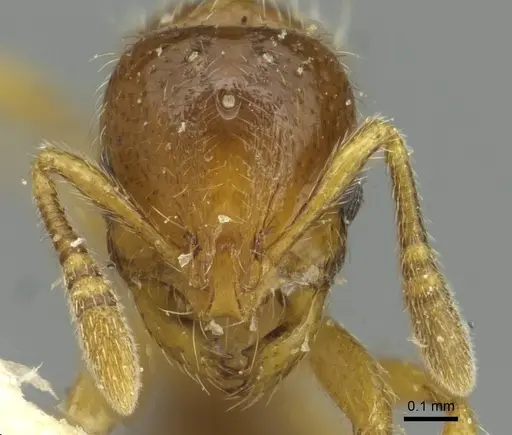
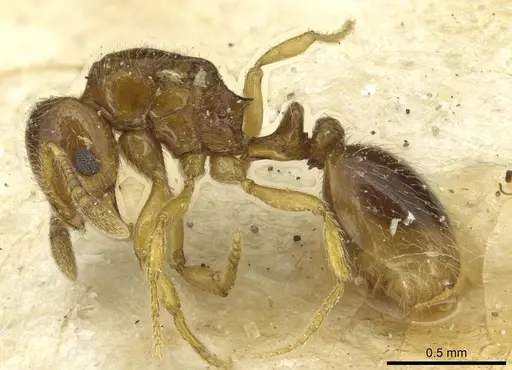
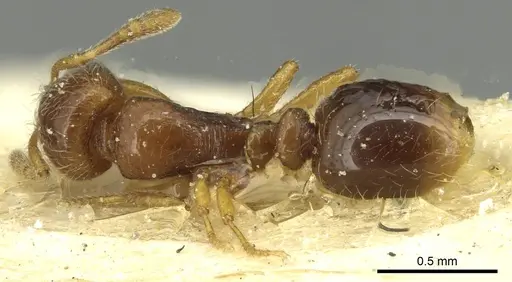
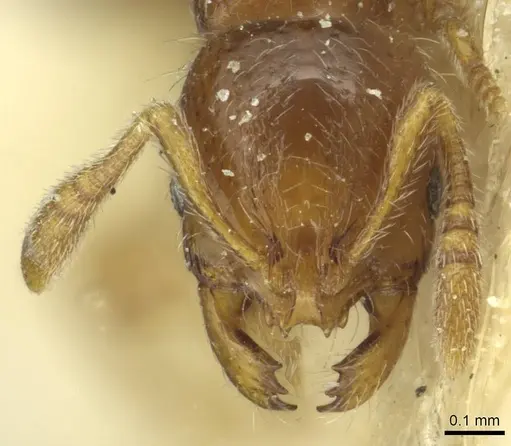
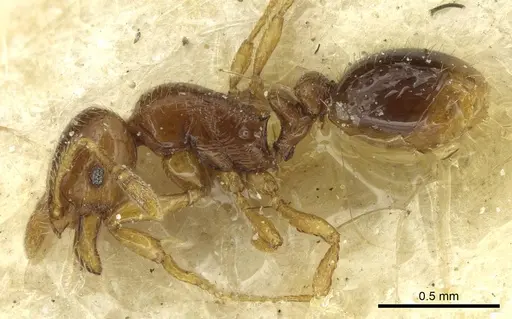
Oxyepoecus bruchi is an extraordinarily rare tiny ant measuring just 2.1-2.3mm for workers and 2.4-2.5mm for queens [1]. Workers are yellowish brown with a chestnut brown gaster (abdomen) [1]. This species belongs to the Solenopsidini tribe and has only ever been collected living within the nests of Pheidole ants, specifically Pheidole obtusopilosa and Pheidole rosae [1][2]. It is known from only a handful of specimens collected in Argentina (Córdoba and Tucumán provinces), Brazil (Santa Catarina State), and Paraguay [2][1]. The most distinctive feature is the extremely elongated anterior portion of the subpetiolar process (a small tooth-like structure under the petiole), which is more than twice as long as the posterior portion [1]. This ant is considered an obligate inquiline, a social parasite that cannot survive independently of its host Pheidole colony [2]. The IUCN lists this species as Vulnerable due to its extreme rarity and limited distribution [2][3].
Quick Summary
- Difficulty: Expert
- Origin & Habitat: Found in the Neotropical region of South America, specifically Argentina (Córdoba, Tucumán), Brazil (Santa Catarina), and Paraguay (Central). It lives as an inquiline within nests of Pheidole ants in forested areas [2][1].
- Colony Type: Obligate inquiline, only found living within Pheidole ant colonies. The colony structure when independent is unknown, as no free-living colonies have ever been documented [2][1].
- Queen: Socially parasitic
- Size & Growth:
- Antkeeping:
- Temperature: Unknown, no captive colonies have ever been established to determine optimal conditions
- Humidity: Unknown, dependent on host colony conditions within Pheidole nests
- Diapause: Unknown
- Nesting: This species has never been found nesting independently. All specimens have been collected from within Pheidole colonies, suggesting it cannot establish self-sufficient nests [1][2]
- Behavior: Extremely rare and poorly documented. Workers are small and likely foraged within the host nest. Escape risk is minimal given their obligate parasitic lifestyle, they cannot survive independently [2]. No aggression data available, but as an inquiline, they likely avoid confrontation with hosts while exploiting their resources.
- Common Issues: This species cannot be kept by hobbyist antkeepers, it is an obligate inquiline that has never been found living independently, No method exists for establishing captive colonies, the founding behavior is completely unknown, The required host species (Pheidole obtusopilosa or Pheidole rosae) may not be available or suitable for keeping, Even if a host colony is obtained, successfully introducing Oxyepoecus has never been documented, This species may be protected in some regions due to its Vulnerable conservation status
The Inquiline Lifestyle
Oxyepoecus bruchi represents one of the most challenging ant species to understand from an antkeeping perspective, it is an obligate inquiline, meaning it has never been found living independently of its host colony [2]. Every specimen ever collected has been found within nests of Pheidole ants, specifically Pheidole obtusopilosa and Pheidole rosae [1]. This is not a case of a species that sometimes lives with other ants, this appears to be a species that cannot survive without a host colony. Inquilines are social parasites that integrate into host colonies, often mimicking the host's chemical signatures to avoid detection. They exploit the host's resources (food, brood care, nest maintenance) without contributing to the colony's survival. The relationship between O. bruchi and its Pheidole hosts is not fully understood, researchers do not know if the host queen is killed, if the parasite is tolerated, or how the colony integration works [2]. What is clear is that this ant has evolved to depend entirely on Pheidole colonies for its survival, making it fundamentally different from most ant species that hobbyists keep. [1][2]
Why This Species Cannot Be Kept
Before considering keeping any ant species, you must understand that Oxyepoecus bruchi cannot be maintained in captivity by any known method. This is not a matter of difficulty or advanced skill, it is biologically impossible with current knowledge. Unlike typical ants where you can establish a queen in a test tube and raise her first workers, O. bruchi queens appear to require direct introduction into an established Pheidole colony. The founding behavior is completely unstudied, no one has ever observed how these queens establish themselves or what triggers them to leave the host [2]. Additionally, the host species (Pheidole obtusopilosa and Pheidole rosae) have specific habitat requirements and may not be readily available. Even if you obtained both the host species and the parasite, there is no documented method for successfully introducing the inquiline. The species has only been collected a handful of times across nearly a century of research, demonstrating how extraordinarily difficult it is to find and study [3]. This is a species to appreciate through scientific literature and museum specimens, not through captive keeping. [2][3]
Distribution and Rarity
Oxyepoecus bruchi is known from an extremely limited geographic range in South America. Specimens have been collected from only three localities in Argentina (Córdoba: Alta Gracia and La Granja, Tucumán: Quebrada Cainzo), one location in Brazil (Santa Catarina State, specifically Palhoça), and a single worker collected in Paraguay (San Lorenzo, Central Department) in 1979 [1][2][3]. The species is considered locally rare, despite extensive ant surveys in the region, very few specimens have ever been found [3]. The IUCN Red List classifies this species as Vulnerable D2,meaning it faces a high risk of extinction in the wild due to its limited distribution and small number of known populations [2][3]. The rarity makes field collection extremely difficult, and the dependence on specific host Pheidole species further limits where these ants can survive. This is not a species that can be sustainably collected for the antkeeping hobby, doing so would likely push an already vulnerable species closer to extinction. [2][3]
Identification and Distinction
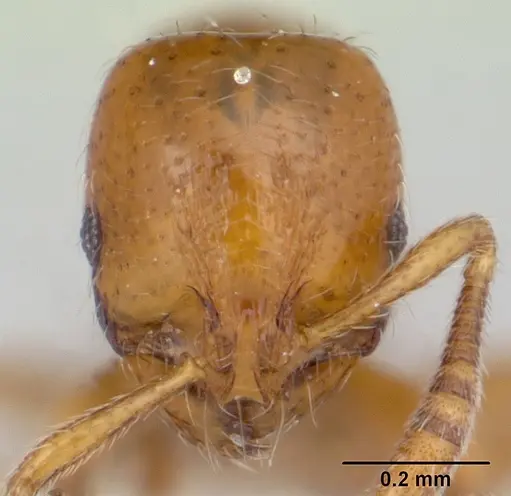
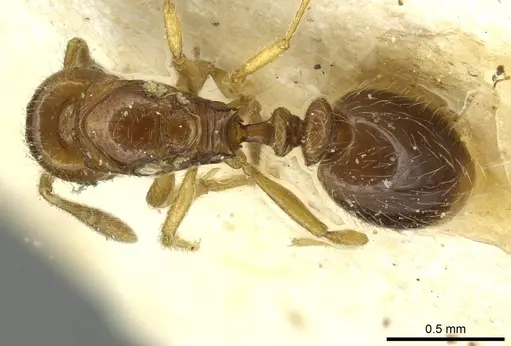
Identifying Oxyepoecus bruchi requires careful examination under magnification. Workers measure approximately 2.1-2.3mm in total length and are yellowish brown in color with a distinctly darker chestnut brown gaster [1]. The most reliable diagnostic feature is the subpetiolar process, a small structure beneath the petiole (the narrow waist segment). In O. bruchi, the anterior portion of this process is extremely elongated, being more than twice as long as the posterior portion, this is the exclusive character that distinguishes this species from all others in the genus [1]. The head has two patches of fine longitudinal rugulae (grooves) that do not reach the posterior margin or the compound eyes. Eyes are relatively small with approximately 15 ommatidia (individual lens units) [1]. Queens are slightly larger at 2.4-2.5mm and are dealate (wingless), which is unusual for newly mated queens of most ant species and suggests they may be ergatoid (born without wings) or have a different reproductive strategy [1]. Distinguishing this species from related Oxyepoecus vezenyii requires examining these subtle morphological differences. [1]
Frequently Asked Questions
Can I keep Oxyepoecus bruchi as a pet ant?
No. This species is an obligate inquiline that has never been found living independently of Pheidole ant colonies. There is no known method to establish a captive colony, and the species cannot be kept by hobbyist antkeepers. This is not a matter of difficulty, the biology of this species makes independent colony establishment impossible with current knowledge.
How do I start an Oxyepoecus bruchi colony?
You cannot. The founding behavior of this species is completely unstudied and unknown. No researcher has ever observed how queens establish themselves within host colonies. Unlike typical ants where you can cage a queen in a test tube, this species likely requires direct introduction into an established Pheidole colony, a process that has never been documented or attempted successfully.
What do Oxyepoecus bruchi eat?
This is unknown. As an inquiline living within Pheidole nests, they likely scavenge from the host colony's food stores or are fed by host workers through trophallaxis (mouth-to-mouth feeding). Their specific dietary requirements have never been studied because no captive colony has ever been established.
What temperature and humidity do they need?
This has never been determined. No captive colonies have existed to measure optimal conditions. The species lives within Pheidole nests in forested areas of Argentina, Brazil, and Paraguay, so they likely prefer humid, tropical to subtropical conditions, but this is purely speculative.
Are Oxyepoecus bruchi dangerous or do they sting?
Given their tiny size (workers are only 2.1-2.3mm), any sting would be negligible even if present. However, their defensive behavior is completely unstudied. As an inquiline, their primary defense is likely chemical mimicry to avoid detection by hosts rather than physical confrontation.
Can I collect Oxyepoecus bruchi from the wild?
You should not. The species is listed as Vulnerable by the IUCN due to its extreme rarity, with specimens collected only a handful of times across nearly a century. Additionally, the host species (Pheidole obtusopilosa and Pheidole rosae) may have specific ranges that do not overlap with where most hobbyists live. This species is best appreciated through scientific literature rather than attempted collection.
References

This caresheet is licensed under CC BY-SA 4.0 .
Literature
Loading...Loading products...