

Myrmica divergens
- Scientific Name
- Myrmica divergens
- Tribe
- Myrmicini
- Subfamily
- Myrmicinae
- Author
- Karavaiev, 1931
- Distribution
- Found in 1 countries
Myrmica divergens Overview
Myrmica divergens is an ant species of the genus Myrmica. It is primarily documented in 1 countries , including Mongolia. Detailed taxonomic data and occurrence records can be further explored via authoritative databases such as AntWeb or the Global Biodiversity Information Facility (GBIF).
Myrmica divergens
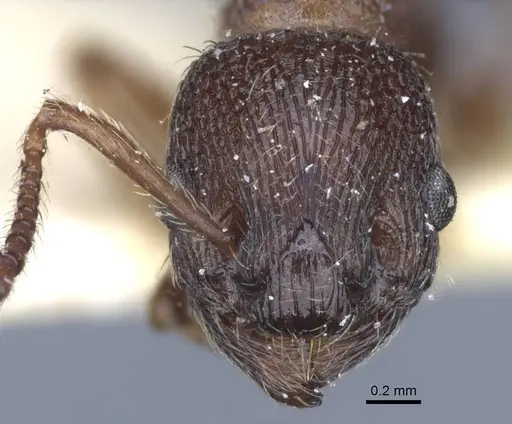
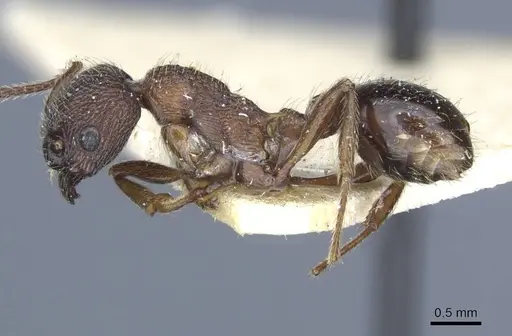
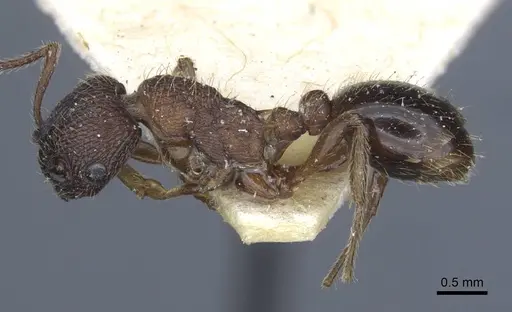
Myrmica divergens is a small to medium-sized Myrmica ant native to Siberia and Mongolia. Workers are bicolored with a dark brown to blackish brown head and gaster, while the mesosoma, antennae, and legs are brown to reddish brown. They belong to the scabrinodis species group and have distinctive features including strongly bent antennal scapes near the base and propodeal spines that broaden at the base. This species is found across a wide elevational range from 600 to 2,400 meters in habitats ranging from riparian woodlands to dry meadows and forest steppes [1][2].
What makes M. divergens particularly interesting is its unusual taxonomic placement. While females show features that could place them in either the scabrinodis or lobicornis groups, genetic analysis clusters them with the lobicornis group despite their different morphology. Additionally, this species represents the most easterly distribution of Myrmica in the scabrinodis complex, positioned basally in evolutionary trees [3][4]. Colonies appear to have relatively few queens, as very few dealate queens have been found in nest samples [5].
Quick Summary
- Difficulty: Medium
- Origin & Habitat: Native to South and East Siberia (west to Altai Mountains) and Mongolia. Found in intrazonal woodland between riparian meadows and steppe, typically at elevations of 600-2,400 meters. Nests are constructed in soil, under stones, in grass and moss tussocks, and sometimes in wet peat bogs in river valleys [1][2][5].
- Colony Type: Likely monogyne (single-queen colonies). Very few dealate queens have been found in nest samples, suggesting colonies are not highly polygynous [5].
- Colony: Monogyne
- Founding: Claustral
- Size & Growth:
- Queen: Estimated 5-6mm based on genus typical size for scabrinodis group species
- Worker: Head width 0.94-1.10mm (mean 1.02mm) [1]
- Colony: Estimated moderate size, likely several hundred workers based on typical Myrmica scabrinodis group patterns
- Growth: Moderate, typical Myrmica development rates
- Development: Estimated 6-10 weeks based on related Myrmica species development [1] (Development time inferred from genus-level data for scabrinodis group species. Temperature-dependent, cooler temperatures slow development.)
- Antkeeping:
- Temperature: Keep at 20-24°C. As a species from Siberia and Mongolia with wide elevation range, they can tolerate cooler temperatures than tropical ants. Provide a gentle temperature gradient allowing workers to self-regulate.
- Humidity: Moderate humidity needs. In nature they inhabit both dry meadows and wet peat bogs, suggesting adaptability. Keep nest substrate moderately moist but not waterlogged. Provide a moisture gradient with both damp and drier areas.
- Diapause: Yes, as a species from Siberia and Mongolia, they require a winter dormancy period. Provide hibernation at 5-10°C for 3-4 months during winter months.
- Nesting: Will readily use test tubes, Y-tong nests, or plaster nests. In nature they nest in soil, under stones, and in grass tussocks. Provide soil or sand substrate for nesting chambers. Accepts both horizontal and vertical nest orientations.
- Behavior: Myrmica divergens has a typical Myrmica temperament, not particularly aggressive but will defend the nest if threatened. Workers are active foragers, primarily hunting for small insects and tending aphids for honeydew. They have a functional stinger but their small size means stings are rarely noticeable to humans. Escape risk is moderate, use standard test tube barrier methods but they are not particularly prone to escaping compared to other Myrmica species.
- Common Issues: colonies may fail if not given proper hibernation, this is a cold-adapted species requiring winter dormancy, test tube setups can flood if water reservoirs are overfilled, use proper cotton-to-water ratios, slow founding period may cause beginners to abandon colonies before first workers arrive, humidity control is important, both overly dry and overly wet conditions can cause colony decline, wild-caught colonies may contain parasites that can devastate captive colonies
Nest Preferences and Housing
Myrmica divergens nests in soil in nature, often under stones or in grass and moss tussocks. They show flexibility in habitat choice, being found in everything from dry meadows to wet peat bogs in river valleys. For captive care, test tube setups work well for founding colonies. Once established, they readily accept Y-tong nests, plaster nests, or naturalistic setups with soil substrate. Provide a nest chamber sized appropriately for the colony size, Myrmica prefer snugger quarters than some genera. A humidity gradient within the nest allows workers to choose optimal moisture conditions. Because they come from elevations up to 2,400m in Mongolia, they tolerate a range of conditions but prefer cooler temperatures than many ant species [1][5].
Feeding and Diet
Like other Myrmica species, M. divergens is omnivorous with a preference for protein foods. Workers hunt small insects and arthropods in nature. They also tend aphids for honeydew and will collect sugary secretions. For captive colonies, offer protein sources such as small crickets, mealworms, fruit flies, and other small insects. Sugar water, honey, or diluted honey water should be available at all times. Feed protein prey 2-3 times per week depending on colony size, and replace sugary foods every few days. Fresh killed prey is preferred over dried. Remove uneaten prey after 24-48 hours to prevent mold. During founding, queens do not forage, they survive on stored fat reserves until first workers emerge (claustral founding). [5]
Temperature and Seasonal Care
M. divergens comes from Siberia and Mongolia where winters are severe, so they require a proper hibernation period. Keep active colonies at 20-24°C during the warm season. They can tolerate temperatures as low as 15°C without issues. During winter (roughly November through March in the Northern Hemisphere), reduce temperature to 5-10°C and stop feeding. Place the colony in a cold garage, basement, or refrigerator during hibernation. Ensure the test tube has adequate water but not excess moisture during this period. Do not feed during hibernation. After hibernation, gradually warm the colony back to room temperature over several days before resuming feeding. This species is eurytopic, meaning it tolerates a wide range of conditions from steppe to meadow formations [6].
Behavior and Colony Dynamics
Workers of M. divergens are active foragers that search for prey and sugary sources. They are not particularly aggressive but will sting if the nest is disturbed, though due to their small size, the sting is rarely noticeable to humans. Colonies appear to be primarily monogyne with single founding queens, as evidenced by the very few dealate queens found in nest samples [5]. Sexual production occurs in late summer, sexuals (males and new queens) have been found in nests at the end of July and August. Males have been observed participating in mating swarms in early August. The species shows some flexibility in colony structure across its range, which spans from Yakutia in the north to Mongolia in the south [5].
Frequently Asked Questions
How long does it take for Myrmica divergens to raise first workers?
Expect 6-10 weeks from egg to first worker under optimal conditions (around 22-24°C). This is typical for Myrmica species. The claustral queen seals herself in and raises the first brood alone using stored fat reserves. Be patient, founding colonies often appear inactive but the queen is working hard underground.
Do Myrmica divergens ants sting?
Yes, they have a functional stinger, but due to their small size (workers around 1mm head width), the sting is rarely noticeable to humans. They are not considered dangerous and are less aggressive than some Myrmica species.
Do Myrmica divergens need hibernation?
Yes, absolutely. As a species native to Siberia and Mongolia, they require a winter dormancy period of 3-4 months at 5-10°C. Without proper hibernation, colonies will weaken and may not produce sexuals in subsequent years. This is essential for their health and reproductive cycle.
Can I keep multiple Myrmica divergens queens together?
Not recommended. While very few dealate queens have been found in wild colonies suggesting they are primarily single-queen species, combining unrelated foundress queens has not been documented and likely results in fighting. Start with a single claustral queen for best success.
What do Myrmica divergens eat?
They are omnivorous but prefer protein. Feed small insects like fruit flies, pinhead crickets, and mealworms. Provide constant access to sugar water, honey, or diluted honey water. Remove uneaten prey after 24-48 hours to prevent mold.
Are Myrmica divergens good for beginners?
They are intermediate in difficulty. While harder than common species like Lasius niger, they are not as challenging as some tropical ants. The main challenges are providing proper hibernation and being patient through the slow founding period. Their moderate size and flexible habitat requirements make them manageable for those with some antkeeping experience.
What temperature should I keep Myrmica divergens at?
Keep active colonies at 20-24°C. They can tolerate cooler temperatures down to about 15°C. As a cold-adapted species from high elevations in Mongolia and Siberia, they do not need the high temperatures that tropical ants require. A room temperature of around 22°C is ideal.
How big do Myrmica divergens colonies get?
Based on typical scabrinodis group patterns, colonies likely reach several hundred workers. They are not among the largest Myrmica species but can still form substantial colonies over several years.
When do Myrmica divergens have nuptial flights?
Sexual production occurs in late summer. Males and sexuals have been found in nests at the end of July and August in Mongolia. Mating swarms have been observed in early August.
References

This caresheet is licensed under CC BY-SA 4.0 .
CASENT0916879
View on AntWeb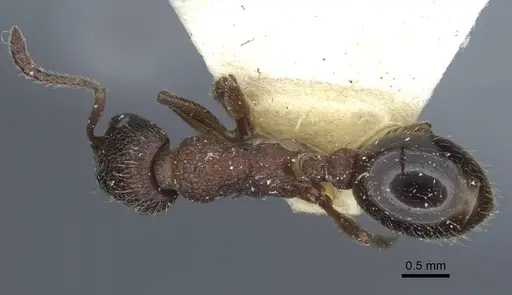
Literature
Loading...Loading products...