

Myrmica colax
- Scientific Name
- Myrmica colax
- Tribe
- Myrmicini
- Subfamily
- Myrmicinae
- Author
- Cole, 1957
- Distribution
- Found in 1 countries
Myrmica colax Overview
Myrmica colax is an ant species of the genus Myrmica. It is primarily documented in 1 countries , including United States of America. Detailed taxonomic data and occurrence records can be further explored via authoritative databases such as AntWeb or the Global Biodiversity Information Facility (GBIF).
Myrmica colax
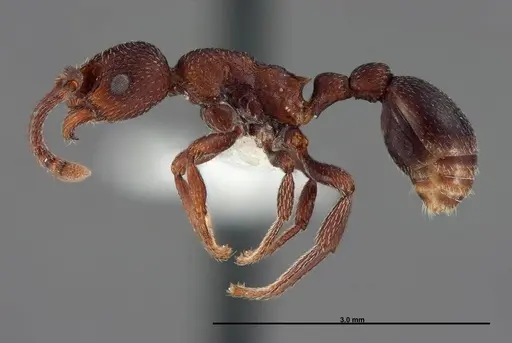
Myrmica colax is an extremely rare social parasite ant known from only a single collection in the Davis Mountains of Texas. This inquiline species lives exclusively in nests of its host, Myrmica striolagaster, making it one of the most difficult Myrmica species to study, let alone keep. Workers measure around 5.5mm and queens about 5.8mm, with a dark reddish-brown to black coloration similar to their host species. The species was originally described in 1957 by A.C. Cole and later transferred to the genus Myrmica by Bolton in 1988. The single known mixed colony had roughly four M. colax workers for every host worker, suggesting the association had existed for a considerable time. The species bears close resemblance to M. striolagaster but can be distinguished by its more pronounced striations and the absence of the basal keel on the scape that characterizes its host.
Quick Summary
- Difficulty: Expert
- Origin & Habitat: Davis Mountains of Texas, USA (Nearctic Region). The type colony was found nesting in soil beneath a stone in a grassy, sparsely wooded, moist, level area at approximately 1,500m elevation [1].
- Colony Type: Inquiline social parasite, lives permanently in colonies of its host species Myrmica striolagaster. The mixed colony showed roughly 4:1 ratio of M. colax to host workers, indicating a long-established association [2].
- Queen: Socially parasitic
- Size & Growth:
- Queen: 5.79mm (from type description) [2]
- Worker: 5.51mm overall (head 1.16mm, thorax 1.77mm) [2]
- Colony: Unknown, only known from single mixed colony [2]
- Growth: Unknown
- Development: Unknown, no captive colonies have ever been established (Development is unstudied due to the species' extreme rarity)
- Antkeeping:
- Temperature: Unknown, no captive data exists. Based on its Texas mountain habitat, likely tolerates moderate temperatures similar to other Myrmica species in the region [1].
- Humidity: Unknown, the type collection notes indicate a moist habitat. Recommend moderate humidity similar to M. striolagaster if attempting care [2].
- Diapause: Unknown, no data on overwintering requirements exists
- Nesting: In nature, found in soil beneath stones alongside host colonies. A naturalistic setup with soil and stones would be appropriate if ever obtained, but this species has never been kept in captivity [2].
- Behavior: This is an obligate social parasite, M. colax cannot establish its own colonies and requires a host colony of Myrmica striolagaster to survive. Workers are similar in behavior to typical Myrmica but have evolved to live within host nests. No captive behavioral observations exist. Escape risk is moderate given worker size around 5.5mm, but the primary concern is obtaining both parasite and host species.
- Common Issues: obtaining this species is virtually impossible, it is only known from a single collection made in 1956, requires a host colony of Myrmica striolagaster, which itself has a limited Texas distribution, no captive breeding has ever been documented for this species, mixed colonies may face aggression from host workers if the parasite ratio becomes too high, the species may have specific seasonal requirements tied to its host that are completely unknown
Species Overview and Rarity
Myrmica colax is one of the rarest North American ants, known from only a single collection made by A.C. Cole on June 11,1956 in the Davis Mountains of Texas. This species is an obligate inquiline social parasite, meaning it cannot form its own colonies and must live permanently within nests of its host species, Myrmica striolagaster. The type colony was discovered when Cole removed a covering stone, revealing M. colax workers scurrying out while the host workers were found only during deeper excavation of the nest extending about 300mm into soil. A pure colony of M. striolagaster was found within 3 meters of the mixed nest. Despite diligent searching, no other mixed colonies or pure M. colax colonies have ever been discovered [2].
Host Species Requirements
Keeping Myrmica colax would require first obtaining and maintaining a healthy colony of Myrmica striolagaster, its only known host. M. striolagaster itself is found only in the Davis Mountains region of far West Texas. This creates a nearly insurmountable barrier for antkeepers, as both species have extremely limited natural distributions and M. colax has never been observed establishing in a host colony in captivity. The type colony showed approximately a 4:1 ratio of parasite to host workers, suggesting the association was long-standing. In established inquiline relationships, the parasite typically reduces its reproductive output compared to free-living species and relies on host workers for all colony maintenance tasks [1][3].
Identification and Morphology
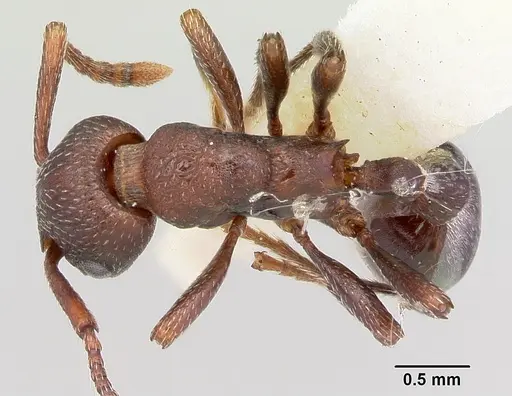
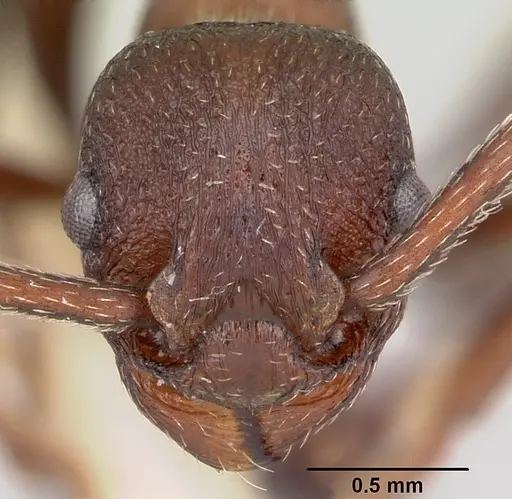
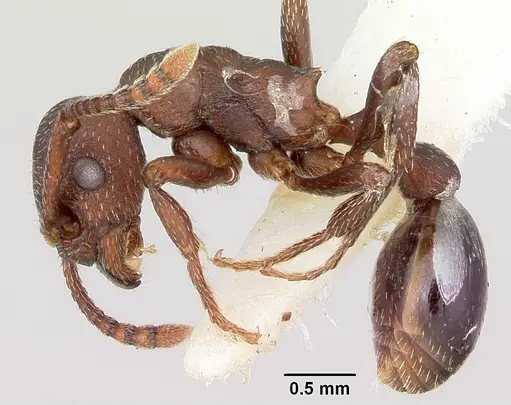
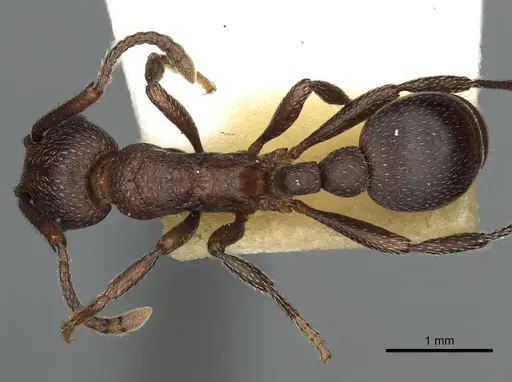
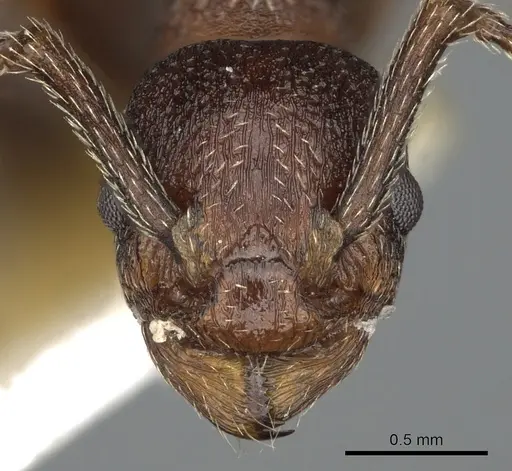
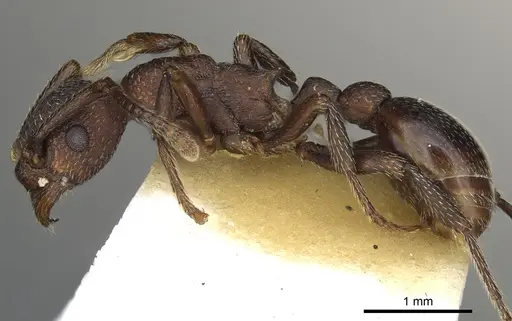
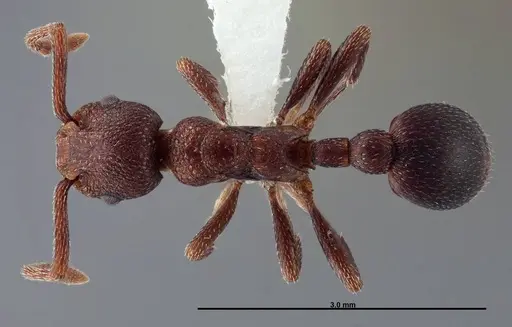
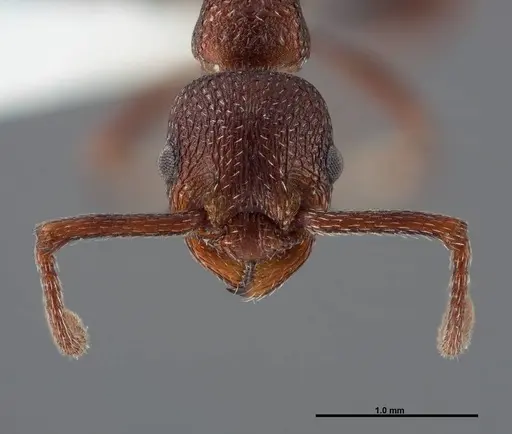
Myrmica colax workers closely resemble their host M. striolagaster, which is thought to be an adaptation for social parasitism, the more similar the parasite appears to the host, the less likely host workers will detect and reject it. Key distinguishing features include more pronounced striations on the head and body, the absence of the prominent basal keel on the scape that characterizes M. striolagaster, and a stronger recticulo-rugose sculpture. Workers are approximately 5.5mm total length with a dark reddish-brown to black coloration. The queen is slightly larger at 5.79mm and has prominent ocelli. The species was originally described as Myrmica colax before being transferred to Myrmica by Bolton in 1988 [2].
Why This Species Is Not Recommended for Keepers
Myrmica colax is not a species that can be ethically or practically kept in captivity. It has never been documented in the antkeeping hobby, and the species is known from only a single collection made nearly 70 years ago. Even if somehow obtained, it would require an established colony of its specific host M. striolagaster, which itself has a very limited range in the Davis Mountains of Texas. There is no captive breeding data, no established protocols for maintaining the parasite-host relationship, and no information on diet, temperature preferences, or any other care requirements. For antkeepers interested in parasitic ants, more accessible species like Myrmica rubra (which can occasionally have social parasites) or species with documented captive populations would be far more appropriate choices. The scientific value of the few known specimens far outweighs any potential benefit from attempting to keep this extremely rare species [2].
Frequently Asked Questions
Can I keep Myrmica colax as a pet ant?
No. Myrmica colax is virtually impossible to obtain and keep. It is only known from a single collection made in 1956,has never been documented in the antkeeping hobby, and would require a host colony of Myrmica striolagaster to survive. This species should be appreciated only in scientific literature, not captivity.
What does Myrmica colax eat?
This is completely unknown. As an inquiline parasite, it likely receives food from host workers through trophallaxis (mouth-to-mouth food sharing), similar to other social parasites. No captive feeding observations exist.
Where does Myrmica colax live?
Only in the Davis Mountains of Texas, USA. The single known colony was found at Limpia Canyon at an elevation around 1,500m in a moist, grassy, sparsely wooded area beneath a stone.
Is Myrmica colax dangerous?
No more so than typical Myrmica ants. Workers are about 5.5mm and have the typical stinger found in Myrmica species, but no specific defensive behavior has been documented for this rare species.
How big do Myrmica colax colonies get?
Unknown. The single known mixed colony had roughly a 4:1 ratio of M. colax to host workers, but the total colony size was not specified. No pure colonies have ever been found.
Do I need to hibernate Myrmica colax?
Unknown. No captive colonies have ever been maintained, so diapause requirements are unstudied. Based on its Texas mountain habitat, it likely experiences cooler winters but may not require prolonged hibernation like northern Myrmica species.
What is the difficulty level for keeping Myrmica colax?
Expert/Impossible. This species is not suitable for captivity under any circumstances. It is one of the rarest ants in North America, known from a single collection, and is an obligate social parasite requiring a specific host species that has never been successfully maintained in captivity.
Can I catch Myrmica colax in the wild?
Extremely unlikely. Despite repeated searches, no additional colonies have been found since the type collection in 1956,even in the immediate vicinity where it was first discovered. The species may be extinct or exist at such low densities as to be effectively uncatchable.
What is the host species for Myrmica colax?
Myrmica striolagaster. This is the only known host species, and M. colax cannot establish independent colonies without access to a host colony.
How do I identify Myrmica colax?
It closely resembles its host M. striolagaster but has more pronounced striations, lacks the basal keel on the scape, and has stronger recticulo-rugose sculpture. Given its extreme rarity, any Myrmica in the Davis Mountains area would more likely be M. striolagaster or another common species.
References

This caresheet is licensed under CC BY-SA 4.0 .
Literature
Loading...Loading products...