

Monomorium vonatu
- Scientific Name
- Monomorium vonatu
- Tribe
- Solenopsidini
- Subfamily
- Myrmicinae
- Author
- Bolton, 1987
- Distribution
- Found in 5 countries
Monomorium vonatu Overview
Monomorium vonatu is an ant species of the genus Monomorium. It is primarily documented in 5 countries , including Burkina Faso, Ghana, Gambia. Detailed taxonomic data and occurrence records can be further explored via authoritative databases such as AntWeb or the Global Biodiversity Information Facility (GBIF).
Monomorium vonatu
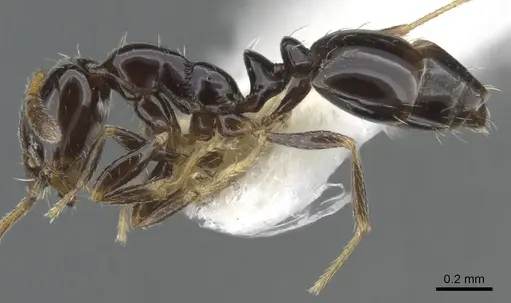
Monomorium vonatu is a tiny glossy black ant measuring just 2mm in total length. This West African species belongs to the Monomorium monomorium species group and is found across Gambia, Ghana, Nigeria, Burkina Faso, and Senegal [1]. The species is immediately recognizable by its distinctive petiole and postpetiole structure, a high, narrow node that tapers to a point with sharp edges running around both the dorsum and sides. One collection was recorded from savanna forest habitat [2]. The only other West African member of this complex, Monomorium occidentale, is also dark but lacks the characteristic petiolar configuration and has a pair of elongated teeth on the clypeus.
Quick Summary
- Difficulty: Unknown, limited data available
- Origin & Habitat: West Africa (Gambia, Ghana, Nigeria, Burkina Faso, Senegal) in savanna forest habitats [1][2]
- Colony Type: Colony structure is unconfirmed. Based on typical Monomorium genus patterns, likely single-queen colonies.
- Size & Growth:
- Queen: Unknown, not described in available literature
- Worker: 2.0mm total length (TL)
- Colony: Unknown, no colony size data available
- Growth: Unknown
- Development: Unknown, no direct development data. Based on typical small Myrmicinae, estimate 4-8 weeks at optimal temperature. (Estimate based on genus patterns rather than species-specific data)
- Antkeeping:
- Temperature: Likely needs warm conditions (24-28°C) as a tropical West African species. Start in this range and observe colony activity.
- Humidity: Moderate to high humidity likely preferred given savanna forest collection. Keep substrate consistently moist but not waterlogged.
- Diapause: Unknown, tropical species may not require formal hibernation, but may slow down during cooler periods.
- Nesting: Use small, tight-fitting chambers scaled to their tiny 2mm size. Test tubes or Y-tong nests work well for small Myrmicinae. Keep nest material slightly moist.
- Behavior: Temperament and detailed behavior are unconfirmed. As a tiny Monomorium species, they are likely relatively docile and not aggressive. Their very small size means escape prevention is critical, they can squeeze through extremely tiny gaps. Use fine mesh barriers and tight-fitting lids.
- Common Issues: tiny size makes escape likely without fine mesh barriers, limited biological data means care requirements are estimates based on genus, slow growth may frustrate keepers expecting rapid colony development, wild-caught colonies may have parasites that affect survival in captivity, overheating or drying out is likely fatal given small size and moisture needs
Appearance and Identification
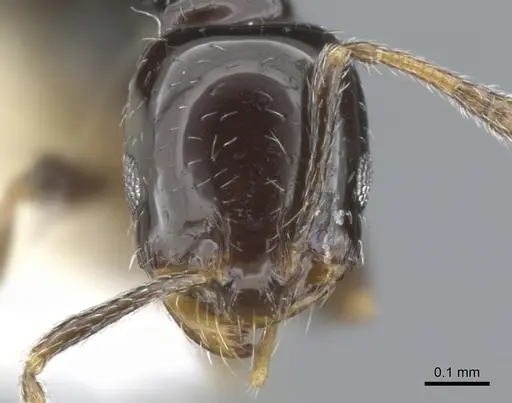
Monomorium vonatu workers are tiny at just 2mm total length, making them one of the smaller ant species you might keep. They are a glossy black color throughout, with no distinctive markings. The most reliable identification feature is the petiole and postpetiole structure, in profile, the petiole has a high, narrow node that tapers to a sharp point, with the anterior and posterior faces meeting in a continuous sharp edge around both the top and sides. The eyes are relatively large for their size, occupying about 24% of head width, with 6-7 ommatidia in the longest row. Antennal scapes are short, falling well short of the occipital margin when laid straight back. This combination of features separates them from related West African species like M. occidentale, which has distinctive teeth on the clypeus. [1]
Natural History and Distribution
This species has a West African distribution spanning Gambia, Ghana, Nigeria, Burkina Faso, and Senegal [1]. The type locality is Mampong, Ghana, where the holotype was collected in February 1970. One documented collection came from savanna forest habitat [2], suggesting they prefer forested or woodland areas rather than open grassland. The species was originally described by Bolton in 1987 from Ghana, and subsequent surveys have expanded the known range northward and eastward across the region [1]. Very little is known about their specific biology, nesting habits, or colony structure in the wild. As with most tropical ant species, they likely remain active year-round without a formal hibernation period.
Housing and Nest Setup
Given their tiny 2mm size, housing Monomorium vonatu requires attention to escape prevention. Use test tubes with cotton plugs or Y-tong nests with very fine mesh barriers. Standard ant keeping setups may have gaps too large for these tiny ants, check all connections and lid edges carefully. A small outworld connected to the nest works well for feeding. Because they are so small, they can easily become trapped in water barriers or sugar water droplets, so use shallow feeding dishes with cotton or paper wicks. The nest material should remain slightly moist but never waterlogged, these ants are not aquatic and need access to dry areas within the nest. A small water test tube connected to the nest provides humidity without flooding.
Feeding and Diet
While specific dietary studies are lacking for M. vonatu, Monomorium species are typically omnivorous and will accept small insects, honeydew, and sugar sources. Their tiny size means prey items should be appropriately scaled, fruit flies, pinhead crickets, and small mealworms are likely suitable. Live prey is probably preferred, matching their likely predatory behavior in the wild. Offer a constant source of sugar water or honey diluted with water. Given their small colony sizes (inferred), feed small amounts frequently rather than large prey items that may go uneaten. Remove uneaten prey promptly to prevent mold issues in the humid nest environment.
Temperature and Humidity
As a West African tropical species, Monomorium vonatu likely prefers warm conditions in the range of 24-28°C. Room temperature in most homes (20-24°C) may be acceptable, but a heating cable on one side of the nest can create a gentle gradient if your colony seems sluggish. Avoid direct heat that could dry out the nest. Humidity should be moderate to high, the savanna forest collection location suggests they tolerate and likely prefer humid conditions. Keep the nest substrate moist but not saturated, with some slightly drier areas available so ants can self-regulate. A water tube connected to the nest helps maintain humidity through evaporation.
Growth and Development
No specific development timeline has been documented for this species. Based on typical patterns for small Myrmicinae ants, expect 4-8 weeks from egg to first worker at optimal temperature. The first workers (nanitics) will likely be smaller than mature workers. Growth rate is unknown but likely moderate, not as fast as some tropical species but not extremely slow either. Colonies probably remain relatively small, potentially reaching only dozens to low hundreds of workers based on typical Monomorium colony sizes. Patience is essential, as small colonies develop slowly and stress easily from environmental changes.
Frequently Asked Questions
How long does it take for Monomorium vonatu to produce first workers?
The exact timeline is unknown for this species. Based on typical small Myrmicinae development, expect approximately 4-8 weeks from egg to first worker at optimal warm temperatures (around 24-28°C).
What do Monomorium vonatu ants eat?
While not specifically studied, Monomorium species typically accept small insects, sugar water, and honey. Feed small live prey like fruit flies and tiny crickets, plus sugar water or diluted honey as a constant energy source.
How big do Monomorium vonatu colonies get?
Colony size data is not available for this species. Based on typical Monomorium patterns, colonies likely remain relatively small, probably under a few hundred workers at maximum.
What temperature do Monomorium vonatu ants need?
Likely needs warm conditions around 24-28°C as a tropical West African species. Room temperature (20-24°C) may be acceptable, but warmer conditions likely support better growth.
Are Monomorium vonatu good for beginners?
Difficulty level is unknown due to limited biological data. Their tiny size actually makes them slightly more challenging than larger ants because escape prevention is critical. They may not be the best choice for complete beginners until you have experience with small ant species.
Can I keep multiple Monomorium vonatu queens together?
Colony structure is unconfirmed for this species. Combining unrelated queens is not recommended since it has not been documented and could result in fighting.
Do Monomorium vonatu need hibernation?
Hibernation requirements are unknown. As a tropical West African species, they likely do not require formal hibernation but may slow down during cooler periods.
Why are my Monomorium vonatu escaping?
Their tiny 2mm size means they can squeeze through extremely small gaps. Use fine mesh (0.5mm or smaller), check all lid seals carefully, and ensure any gaps around tubing connections are sealed.
When should I move Monomorium vonatu to a formicarium?
Wait until the colony has at least 20-30 workers before considering a move. Their small size means they do well in test tubes or small setups for quite some time. Moving too early can stress small colonies.
References

This caresheet is licensed under CC BY-SA 4.0 .
CASENT0902248
View on AntWeb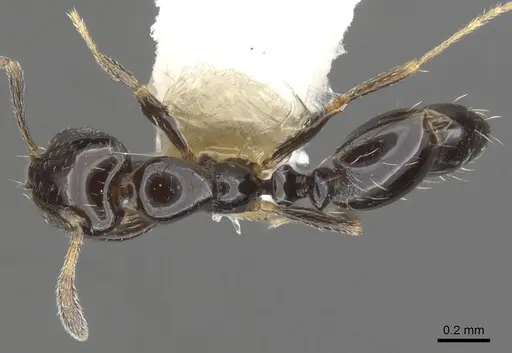
Literature
Loading...Loading products...