

Monomorium occidentale
- Scientific Name
- Monomorium occidentale
- Tribe
- Solenopsidini
- Subfamily
- Myrmicinae
- Author
- Bernard, 1953
- Distribution
- Found in 2 countries
Monomorium occidentale Overview
Monomorium occidentale is an ant species of the genus Monomorium. It is primarily documented in 2 countries , including Côte d'Ivoire, Liberia. Detailed taxonomic data and occurrence records can be further explored via authoritative databases such as AntWeb or the Global Biodiversity Information Facility (GBIF).
Monomorium occidentale
Monomorium occidentale is a tiny dark brown ant species native to West Africa, found in Guinea and Sierra Leone. Workers measure just 1.8-2.1mm, making them among the smaller ant species kept in captivity. The species belongs to the Monomorium monorium species group and is immediately recognizable by its distinctive clypeal teeth, a pair of elongated forward-projecting structures on the face that give it a unique appearance among African Monomorium. The head and body are covered in standing hairs, and the gaster tends toward blackish brown. This is a critically understudied species with no published biology data, so much of what we know comes from genus-level patterns and related species [1].
Quick Summary
- Difficulty: Unknown, likely Easy to Medium based on genus patterns
- Origin & Habitat: West Africa, Guinea and Sierra Leone in the Afrotropical region. Found at elevations around 850m in savanna habitat.
- Colony Type: Unconfirmed colony structure. Most Monomorium species are monogyne (single queen) but some can be polygyne. No specific data for this species.
- Size & Growth:
- Queen: Unconfirmed, related species typically 4-6mm
- Worker: 1.8-2.1mm
- Colony: Unknown, likely under 500 workers based on typical Monomorium colony sizes
- Growth: Unknown, likely moderate based on genus patterns
- Development: Estimated 5-8 weeks based on typical Monomorium development at warm temperatures (No direct data for this species. Estimates based on genus-level patterns for small Myrmicinae in tropical conditions.)
- Antkeeping:
- Temperature: Aim for 24-28°C, warm tropical conditions. A gentle gradient allowing workers to self-regulate is ideal.
- Humidity: Moderate humidity around 50-70%. Keep substrate slightly moist but not waterlogged. These ants likely prefer conditions similar to savanna-edge habitats.
- Diapause: Likely minimal or none, West African species from a region without harsh winters. Some reduction in activity during cooler months may occur.
- Nesting: Likely nests in soil or under stones in nature. Test tubes work well for founding colonies. Provide a shallow water reservoir and keep the nest area humid.
- Behavior: Temperament is unconfirmed but most Monomorium are relatively docile and not aggressive. Workers are small and likely forage individually or in small groups. Escape prevention should be excellent given their tiny 2mm size, they can easily slip through standard barrier setups. They are likely generalist foragers accepting both sugar and protein sources, though specific diet data is unavailable.
- Common Issues: tiny size makes escape likely without fine mesh barriers, no published biology means care is based on genus inference, expect to experiment, slow colony growth can frustrate beginners, wild-caught colonies may carry parasites given no captive breeding history, limited information means keeper should be prepared to adjust care based on colony response
Appearance and Identification
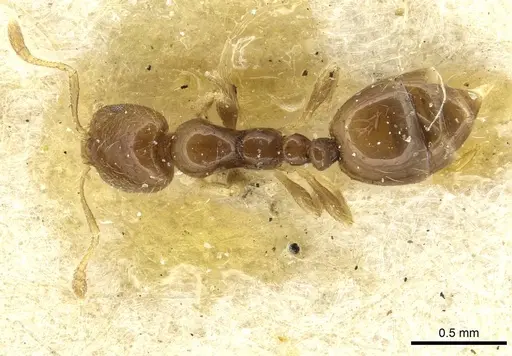
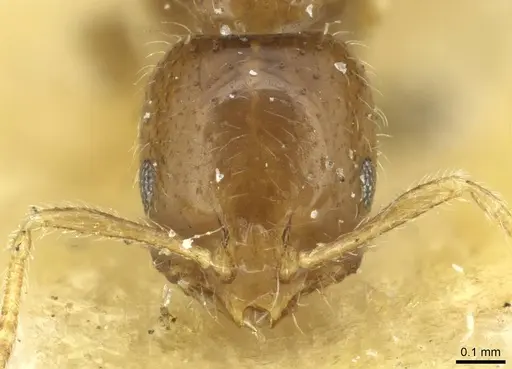
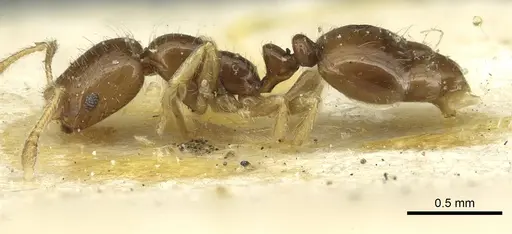
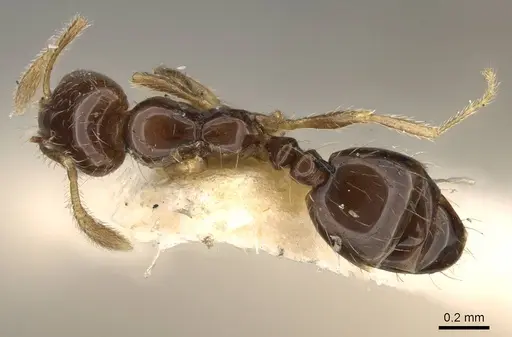
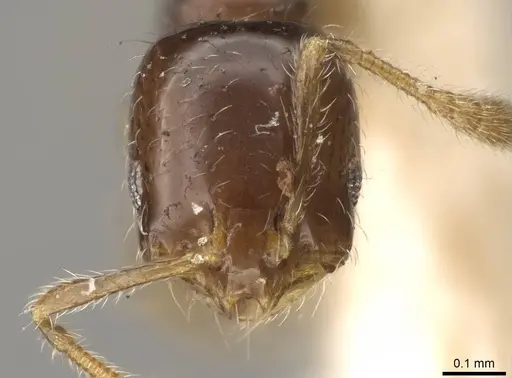
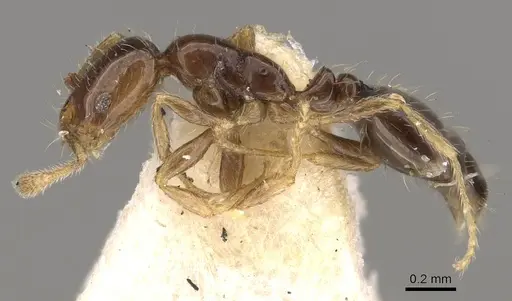
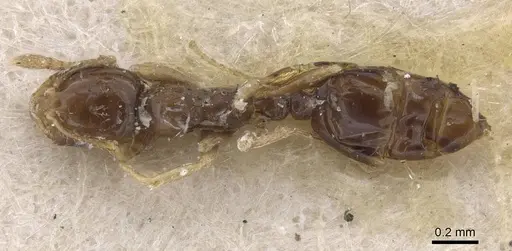
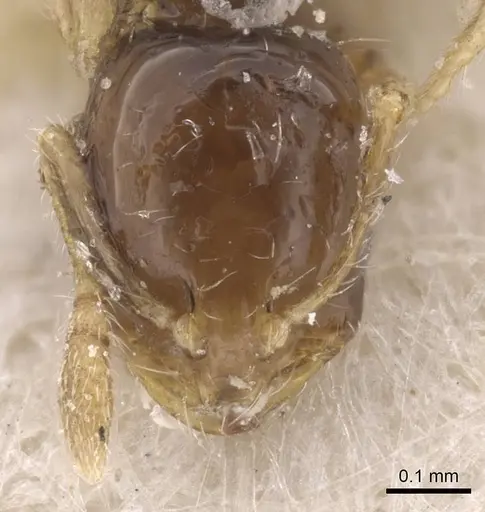
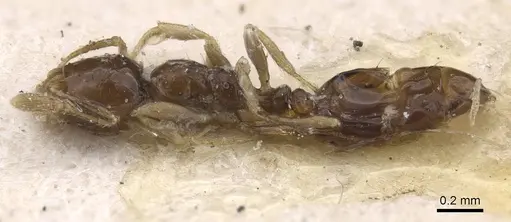
Monomorium occidentale workers are tiny at just 1.8-2.1mm total length. They are dark brown overall, with the gaster tending toward blackish brown in some specimens. The most distinctive feature is the pair of elongated teeth projecting forward from the clypeus (the face area between the mandibles and antennae). These teeth are usually slightly curved toward the midline and are unique among Afrotropical Monomorium species. The eyes are relatively large for their size, occupying about 0.20-0.23 times the head width. The body is covered in standing hairs, with the promesonotum having 7 or more pairs and the propodeum usually having 5 pairs. Unlike many ants, they lack significant sculpture, surfaces are mostly smooth except for tiny hair-pits and the metanotal cross-ribs.
Natural History and Distribution
This species is known only from Guinea and Sierra Leone in West Africa. The type locality is at approximately 850m elevation in the Ziéla Savano-To area of Guinea. The region features savanna habitat, suggesting these ants prefer warmer, seasonal tropical conditions rather than deep rainforest. No published biology or ecology data exists for this species, the AntWiki entry explicitly states nothing is known about its biology. This makes it one of the more challenging species to keep simply because we have no direct observations of their behavior, diet preferences, or colony dynamics in the wild. What we know comes from placement within the Monomorium genus and the altinode species complex[1].
Nest Preferences and Housing
In nature, Monomorium species typically nest in soil, under stones, or in rotting wood. For M. occidentale, a simple test tube setup works well for founding colonies, a small water reservoir at one end with cotton separating it from the ants, kept humid but not flooded. The tiny 2mm worker size means you should use tight-fitting barriers and consider fine mesh on any ventilation. Once the colony reaches 20-30 workers, you can move them to a small formicarium or keep them in a larger test tube setup with an outworld. A small foraging area makes it easier to observe their behavior and monitor food consumption. Based on genus patterns, they likely prefer discrete chambers rather than large open spaces [1].
Feeding and Diet
The specific diet of M. occidentale is unstudied. Most Monomorium species are generalist omnivores that readily accept sugar sources (honey, sugar water) and protein (small insects, frozen fruit flies, mealworm pieces). Given their tiny size, prey items should be appropriately small, flightless fruit flies, pinhead crickets, or similar micro-prey work well. They likely forage individually or in small groups rather than forming large raiding parties. Offer a constant sugar source and protein 2-3 times per week, adjusting based on colony consumption. Remove uneaten protein after 24-48 hours to prevent mold. The small colony size means they will not consume large quantities [1].
Temperature and Seasonal Care
As a West African species from Guinea and Sierra Leone, M. occidentale likely prefers warm conditions in the range of 24-28°C. The region experiences tropical climate with minimal temperature variation, no true winter. Therefore, strong diapause is unlikely unnecessary. You might observe reduced activity during cooler months (roughly November to February in the Northern Hemisphere), but full hibernation is not recommended. A heating cable on one side of the nest can create a gentle gradient, allowing workers to choose their preferred temperature. Avoid temperatures below 20°C for extended periods. Room temperature in a heated home (22-26°C) is likely suitable for year-round keeping [1].
Colony Development and Growth
No published data exists on the development timeline of M. occidentale. Based on typical Monomorium patterns and small Myrmicinae in tropical conditions, expect 5-8 weeks from egg to first worker (nanitic) at optimal warm temperatures. The queen likely seals herself in a small chamber (claustral founding) and raises the first brood alone, living off stored fat reserves until workers emerge. Early colonies will grow slowly, the first dozen workers may take several months. Once established with 20-30 workers, growth typically accelerates. Maximum colony size is unknown but is likely under 500 workers based on typical Monomorium colony sizes. Patience is essential with this species given the limited available information [1].
Frequently Asked Questions
How long does it take for Monomorium occidentale to produce first workers?
No specific data exists for this species. Based on typical Monomorium development patterns, expect 5-8 weeks from egg to nanitic worker at warm temperatures (around 26°C). The first workers will be smaller than normal workers and may take several months to emerge after founding.
What do Monomorium occidentale ants eat?
Specific diet data is unavailable, but Monomorium species are generalist omnivores. Offer sugar water or honey constantly, and protein sources like fruit flies, small mealworm pieces, or pinhead crickets 2-3 times weekly. Adjust based on what your colony accepts.
Can I keep multiple Monomorium occidentale queens together?
The colony structure of this species is unconfirmed. Most Monomorium are monogyne (single queen), but some can be polygyne. It is not recommended to combine unrelated foundress queens, they typically fight. If you obtain a colony, assume single-queen structure unless you observe multiple egg-laying queens.
What temperature should I keep Monomorium occidentale at?
Aim for 24-28°C as a West African tropical species. Room temperature in a heated home (22-26°C) is likely suitable. A gentle heat gradient allows self-regulation. Avoid temperatures below 20°C for extended periods.
Does Monomorium occidentale need hibernation?
Likely no. As a species from Guinea and Sierra Leone with no winter, strong diapause is unnecessary. You may observe reduced activity during cooler months, but full hibernation is not recommended.
How big do Monomorium occidentale colonies get?
Colony size is unconfirmed for this species. Based on typical Monomorium patterns, they likely reach 200-500 workers at maturity. Growth is slow, expect several months to reach 20-30 workers.
Are Monomorium occidentale good for beginners?
This is a challenging species for beginners because no published biology data exists, all care is based on genus-level inference. Beginners may struggle with the experimental nature of keeping this species. If you want a well-documented Monomorium, consider M. pharaonis or M. minimum instead.
How do I prevent Monomorium occidentale from escaping?
Excellent escape prevention is critical due to their tiny 2mm size. Use fine mesh on all ventilation, tight-fitting lids, and reliable barrier methods like fluon. Standard ant keeping setups may have gaps large enough for them to squeeze through.
When should I move Monomorium occidentale to a formicarium?
Wait until the colony has at least 30-50 workers and the test tube setup feels cramped. A small formicarium or enlarged setup with a proper outworld works well. They prefer small chambers scaled to their tiny size.
References

This caresheet is licensed under CC BY-SA 4.0 .
Literature
Loading...Loading products...