

Linepithema anathema
- Scientific Name
- Linepithema anathema
- Tribe
- Leptomyrmecini
- Subfamily
- Dolichoderinae
- Author
- Wild, 2007
- Distribution
- Found in 1 countries
Linepithema anathema Overview
Linepithema anathema is an ant species of the genus Linepithema. It is primarily documented in 1 countries , including Brazil. Detailed taxonomic data and occurrence records can be further explored via authoritative databases such as AntWeb or the Global Biodiversity Information Facility (GBIF).
Linepithema anathema
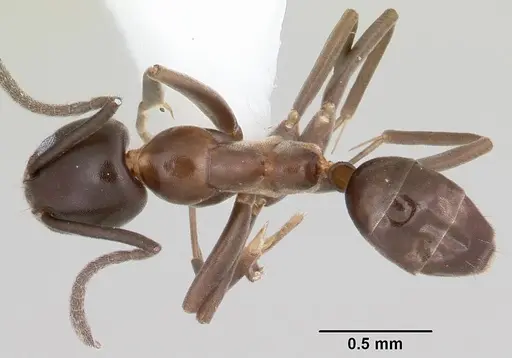
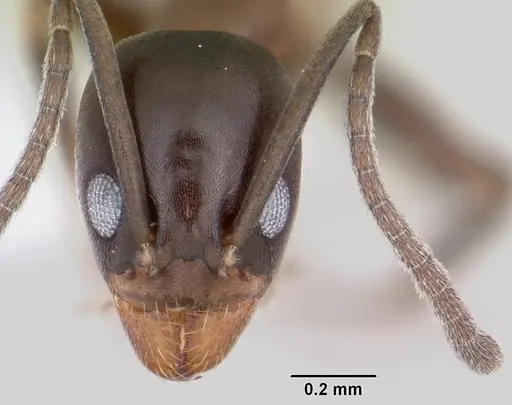
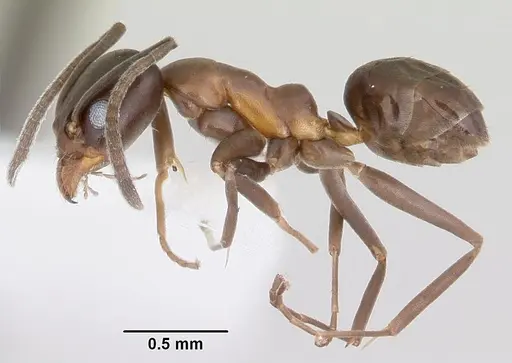
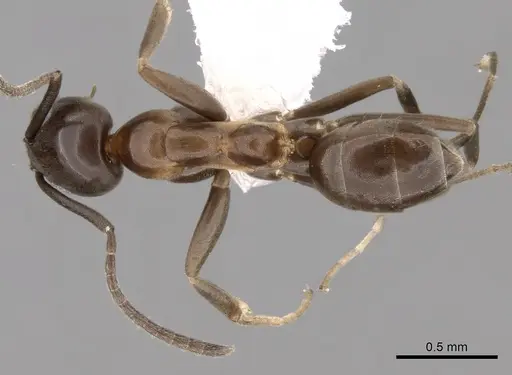
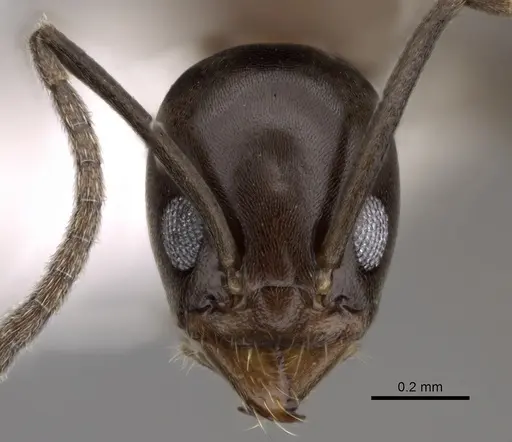
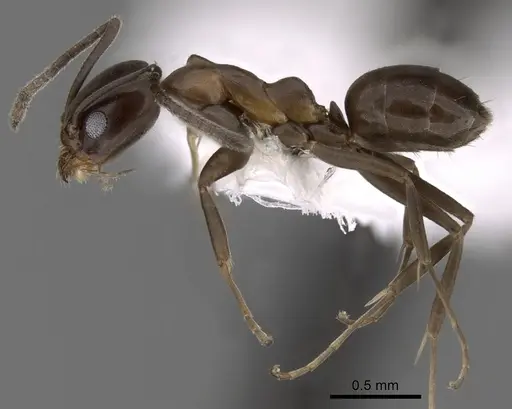
Linepithema anathema is a small, slender ant native to southeastern Brazil. Workers measure just 0.62-0.68mm in head length, making them among the smaller ant species you'll encounter. They have a distinctive narrow head, long antennal scapes, and a bicolored appearance, dark brown on the head, mesosomal dorsum, and gaster, with light reddish brown on the mandibles, mesopleura, and metapleura. A key identifying feature is the presence of standing hairs on gastric tergites 2-3,which helps distinguish them from the similar and more famous invasive Argentine ant (Linepithema humile) [1].
This species was only described in 2007 and remains poorly studied in the wild. What we know comes from a handful of specimens collected in high-elevation shrubland (1900m) in Minas Gerais, Brazil, and a few records from bromeliads in Atlantic forest areas. They appear to be ground-nesting ants that can climb into vegetation, as they've been found living in bromeliads. The name 'anathema' means 'accursed thing' in Latin, chosen because their long scapes and large eyes complicate identification alongside the problematic invasive L. humile [1].
Quick Summary
- Difficulty: Unknown, Insufficient data for assessment
- Origin & Habitat: Southeastern Brazil, primarily Minas Gerais and Paraná states. Found in high-elevation shrubland at 1900m, also recorded in Atlantic forest bromeliads and grassland areas in Rio Grande do Sul [1][2].
- Colony Type: Colony structure unconfirmed, queen has not been described. Based on related Linepithema species, likely single-queen colonies but this needs confirmation.
- Size & Growth:
- Queen: Unknown, queen has not been described [1]
- Worker: 0.62-0.68 mm head length,0.51-0.56 mm head width [1]
- Colony: Unknown, no colony size data available
- Growth: Unknown, no development data available
- Development: Unknown, no direct development data. Based on typical Linepithema patterns, estimate 4-8 weeks at warm temperatures. (This is a rough estimate based on genus-level patterns. No species-specific development studies exist.)
- Antkeeping:
- Temperature: Unconfirmed, no thermal studies exist. Based on Brazilian distribution (southeastern highlands), likely prefers moderate temperatures. Start around 20-24°C and observe colony activity.
- Humidity: Unconfirmed, no humidity data. Found in bromeliads suggests tolerance for higher humidity. Keep nest substrate moderately moist with some dry areas available.
- Diapause: Unknown, no seasonal data. High-elevation origin (1900m) suggests potential for cooler winter conditions, but diapause requirements unconfirmed.
- Nesting: Natural nesting: under stones in shrubland, in bromeliads. For captivity, standard small-ant setups work, test tubes, Y-tong, or acrylic nests with appropriately scaled chambers. Avoid large open spaces.
- Behavior: Unconfirmed, no behavioral studies exist. Likely similar to other Linepithema species: active foragers, possibly tending honeydew-producing insects. Their small size means excellent escape prevention is critical. No documented aggression or stinging behavior, but related L. humile can be aggressive when disturbed.
- Common Issues: queen and colony structure completely unknown, no documented queen morphology or colony founding behavior, no development data makes it impossible to predict growth timeline accurately, escape prevention critical due to tiny worker size (under 1mm), very limited wild distribution data makes proper habitat simulation difficult, no information on diet acceptance, what to feed is entirely unknown
Identification and Distinction from Related Species
Linepithema anathema can be distinguished from its more famous relative the Argentine ant (Linepithema humile) by several key features. The most important is the presence of standing hairs (setae) on gastric tergites 2-3, L. humile workers typically lack these standing hairs. L. anathema also has a narrower head (cephalic index 80-85) and longer antennal scapes (scape index 119-126) compared to L. humile. Additionally, the propodeum (the rear portion of the mesosoma) is more upright and less anteriorly inclined than in L. humile [1].
Another similar species is Linepithema oblongum, found in the high Andes of Bolivia and northern Argentina. This species normally has at least some specimens with more dilute (sparser) pubescence on gastric tergites 2-4,which helps separate it from L. anathema which has dense pubescence throughout [1]. For antkeepers, the practical takeaway is that if you're in North America and find what looks like this species, it's almost certainly L. humile, L. anathema has never been documented outside southeastern Brazil.
Natural History and Distribution
Linepithema anathema is known from a relatively small geographic range in southeastern Brazil. The type series was collected in Minas Gerais state at 1900m elevation, under a stone in shrubland habitat [1]. This high-elevation origin is notable as it suggests the species may be adapted to cooler conditions than typical tropical ants.
Beyond the type locality, the species has been recorded in Paraná state and more recently in Rio Grande do Sul, expanding its known range [3][2]. One interesting finding is their association with bromeliads in Atlantic forest agroecosystems, researchers found L. anathema in 2 out of 52 bromeliads examined on a single tree in Ilhéus, Brazil. They were specifically associated with the suspended soil and litter that accumulates in these plants [1]. This suggests they can be arboreal as well as ground-nesting.
The species is a member of the fuscum species group within Linepithema, which helps place it evolutionarily alongside other Neotropical members of this genus [4].
Keeping Linepithema anathema - What We Don't Know
Honest assessment requires acknowledging how little we know about this species. The queen has never been described, we don't know her size, whether she claustrally seals herself in to found a colony, or anything about her morphology. We have no data on colony size, growth rate, development time, or what foods they accept. There are no published studies on their temperature or humidity preferences, no information about nuptial flight timing, and no data on overwintering requirements [1].
This makes L. anathema one of the least documented species you could choose to keep. If you're interested in this species, you would essentially be pioneering its captive care with almost no guidance. The best approach would be to start with conditions suitable for other Brazilian Dolichoderinae ants, moderate temperatures around 20-24°C, moderately humid nests, and a varied diet of sugar sources and protein. Document your observations carefully so the antkeeping community can learn from your experience.
On the positive side, their small size means they can be housed in standard test tube setups or small acrylic nests. They are unlikely to be aggressive or dangerous. And their limited distribution means they're unlikely to be established invasive populations anywhere that would complicate legal acquisition.
Legal and Collection Considerations
Linepithema anathema is native to Brazil and has not been documented as established anywhere outside its native range. There are no reports of it being invasive or causing ecological problems anywhere. This is in stark contrast to its close relative L. humile, which has become one of the world's most widespread invasive ants.
If you obtain this species, it should NOT be released in North America, Europe, or anywhere outside southeastern Brazil. Even though there's no evidence L. anathema could become invasive, the precautionary principle applies, never release any non-native ant species. The species is not listed in CITES or any major trade restrictions that I'm aware of, but you should verify the legal status of Brazilian ant exports in your jurisdiction before attempting to acquire specimens.
Frequently Asked Questions
How do I identify Linepithema anathema workers?
Workers are very small (0.62-0.68mm head length) with a narrow head, long antennal scapes, and bicolored body, dark brown on top, light reddish brown underneath. The key identifying feature is standing hairs on gastric tergites 2-3,which most similar species like L. humile lack. They also have dense pubescence covering the body [1].
What do Linepithema anathema eat?
Unknown, no feeding studies exist. Based on related Linepithema species, they likely accept sugar sources (honey, sugar water) and small protein items (insects). Their association with bromeliads in the wild suggests they may tend honeydew-producing insects. Start with standard ant foods and observe what they accept.
How long does it take for Linepithema anathema to develop from egg to worker?
No development data exists for this species. Based on typical Linepithema genus patterns, estimate roughly 4-8 weeks at warm temperatures (around 24°C). This is a rough guess, actual development time is unconfirmed.
Are Linepithema anathema good for beginners?
No, this is not a recommended species for beginners. Almost nothing is known about their captive care requirements. There is no queen description, no development data, no confirmed temperature/humidity preferences, and no established feeding protocols. You'd be pioneering their care entirely from scratch.
What temperature should I keep Linepithema anathema at?
Unconfirmed, no thermal studies exist. Based on their high-elevation Brazilian origin (1900m in Minas Gerais), they likely prefer moderate temperatures. Start around 20-24°C and monitor colony behavior. Adjust based on activity levels, if they seem sluggish, warm slightly, if they avoid heated areas, cool down.
Do Linepithema anathema need hibernation?
Unknown, no seasonal data exists. Their high-elevation origin suggests they may tolerate or require cooler winter conditions, but whether this constitutes true diapause is unconfirmed. Observe colony behavior through seasonal changes and adjust accordingly.
How big do Linepithema anathema colonies get?
Unknown, no colony size data has been published. Related Linepithema species can form large colonies, but L. anathema may be a smaller, less populous species given its limited distribution and small worker size. Expect colonies probably under a few hundred workers based on typical patterns for this genus.
Can I keep multiple Linepithema anathema queens together?
Unknown, colony structure has not been documented. The queen has never been described, so we don't know if they're monogyne (single queen) or polygyne (multiple queens). Do not attempt combining unrelated queens without data to guide you.
Where does Linepithema anathema live in the wild?
Southeastern Brazil, primarily Minas Gerais and Paraná states. Type specimens collected at 1900m elevation under stones in shrubland. Also found living in bromeliads in Atlantic forest areas and in grassland habitats in Rio Grande do Sul [1][2].
Is Linepithema anathema invasive?
No, this species has never been documented as invasive. It has a limited native range in southeastern Brazil and has not been reported established anywhere outside this region. This contrasts sharply with its relative L. humile (Argentine ant), which is one of the world's worst invasive species.
Why is this ant called 'anathema'?
The name means 'accursed thing' in Latin. It was chosen because the long scapes, large eyes, and relatively sparse pilosity of this ant complicate the diagnosis of the morphologically similar pest species L. humile (Argentine ant). Taxonomists found it 'accursed' to distinguish from the problematic invasive [1].
References

This caresheet is licensed under CC BY-SA 4.0 .



Literature
Loading...Loading products...