

Leptomyrmex niger
- Scientific Name
- Leptomyrmex niger
- Tribe
- Leptomyrmecini
- Subfamily
- Dolichoderinae
- Author
- Emery, 1900
- Distribution
- Found in 1 countries
Leptomyrmex niger Overview
Leptomyrmex niger is an ant species of the genus Leptomyrmex. It is primarily documented in 1 countries , including Papua New Guinea. Detailed taxonomic data and occurrence records can be further explored via authoritative databases such as AntWeb or the Global Biodiversity Information Facility (GBIF).
Leptomyrmex niger
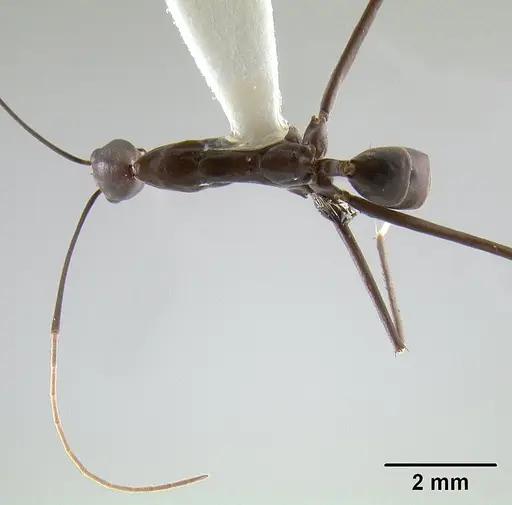
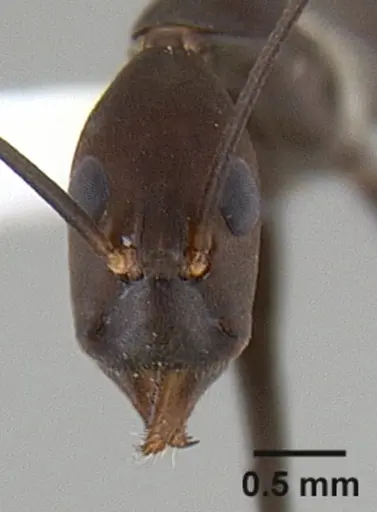
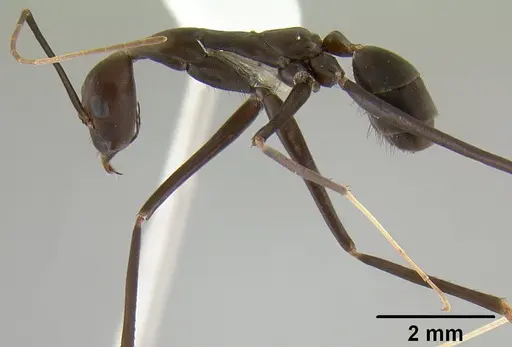
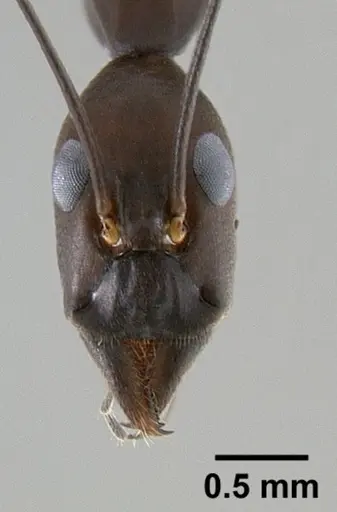
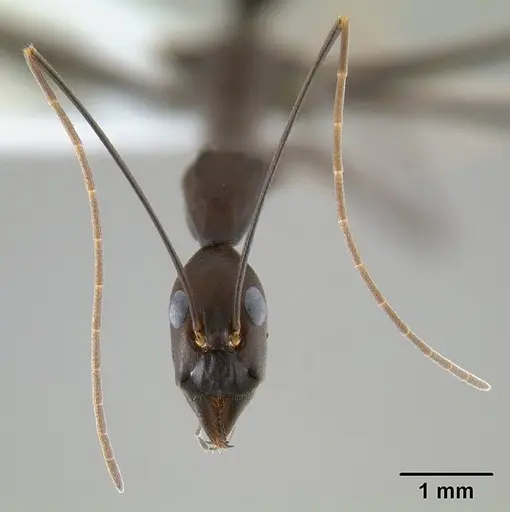
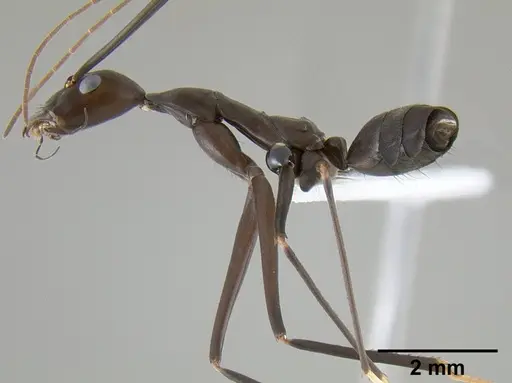
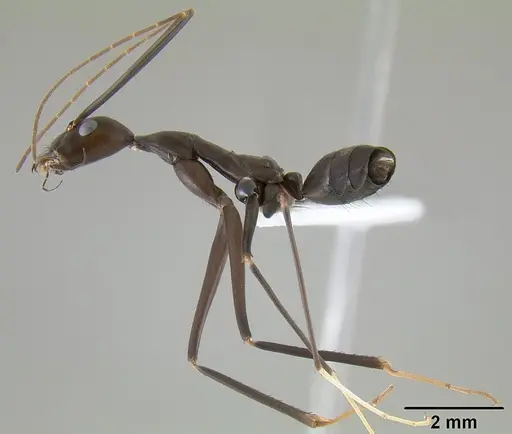
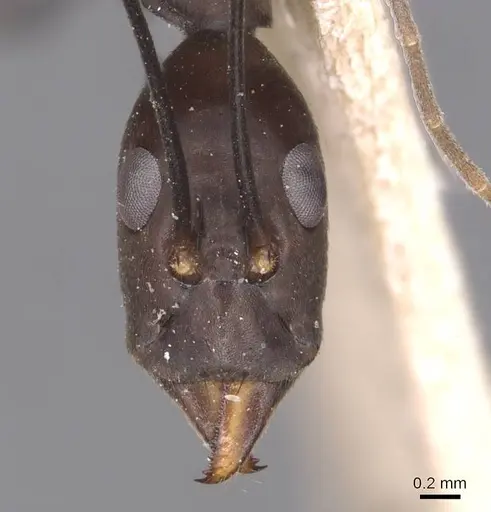
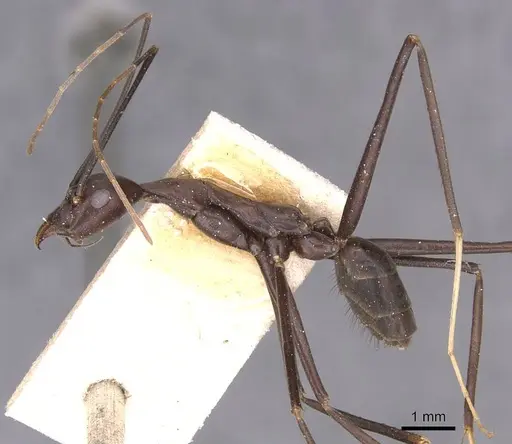
Leptomyrmex niger is a small, slender ant native to New Guinea, found in both Papua New Guinea and Indonesian Irian Jaya [1]. Workers measure 1.76-1.89mm in head length and are mostly black throughout, with pale yellow markings on the mandibles, tarsi, joints, and antennal funiculus [1]. This species belongs to the Dolichoderinae subfamily and is known for its elongated legs and somewhat spider-like appearance, which gives the genus its common name. The head is relatively wide (CI 0.57-0.69) with large, oblong eyes that reach the lateral margins, and the antennae have scapes that extend well beyond the back of the head [1]. Unlike some related species, L. niger lacks dense pubescence and has a distinctly angular junction between the dorsal and declivitous faces of the propodeum [1].
This species is notable for being one of the most poorly documented ants in the hobby. Queens have never been collected in the wild, meaning we have no information about colony founding, queen size, or colony structure [2]. Additionally, their exact nesting habits remain unknown, they've only been collected from rainforest habitats but never from nests [1]. This makes them a challenging species to keep with significant gaps in basic biological knowledge.
Quick Summary
- Difficulty: Expert
- Origin & Habitat: New Guinea (Papua New Guinea and Indonesia Irian Jaya), exclusively in primary rainforest [1][3]
- Colony Type: Unknown, queens have never been collected [2]
- Size & Growth:
- Queen: Unknown, queens have never been collected [2]
- Worker: 1.76-1.89mm head length,1.01-1.25mm head width [1]
- Colony: Unknown, no colony size data available
- Growth: Unknown
- Development: Unknown, no development data available (Based on related Leptomyrmex species and Dolichoderinae patterns, expect 6-10 weeks at optimal temperature, but this is an estimate)
- Antkeeping:
- Temperature: Keep at 24-28°C as a starting point, adjust based on colony activity. This is a tropical rainforest species from New Guinea, so warmth and humidity are important [1].
- Humidity: High humidity is essential, rainforest habitat indicates 70-85% relative humidity. Keep the nest substrate consistently moist but not waterlogged.
- Diapause: Unknown, no data on overwintering requirements. As a tropical species from near-equatorial New Guinea, they likely do not require a diapause period.
- Nesting: Nesting habits are unknown in the wild [1]. For captive care, use a naturalistic setup with moist substrate (like a terrarium-style formicarium) or a Y-tong nest with high humidity chambers. Their small size and elongated legs suggest they may be surface-active foragers.
- Behavior: Behavior is poorly documented. Based on genus patterns, they are likely active foragers that search for honeydew and small insects. Their large eyes and elongated legs suggest good vision and active foraging behavior. Escape risk is moderate due to their small size, use standard barriers. Temperament is unknown but Dolichoderines are typically not aggressive toward keepers.
- Common Issues: queen unavailability, queens have never been collected, making captive breeding essentially impossible, unknown nesting habits, we don't know how they nest in the wild, making it hard to provide ideal captive conditions, no development data, without knowing egg-to-worker timeline, proper care is difficult, rainforest specialist, primary forest dweller that may not tolerate captive conditions well [3], very limited data, this is one of the least-studied ant species in captivity, so care recommendations are largely estimates
Availability and Acquisition
This is one of the most difficult ant species to acquire for antkeeping. Queens have never been collected in the wild, meaning there are no established captive colonies and no documented nuptial flight times [2]. The only specimens available for study are workers collected from rainforest habitats in Papua New Guinea and Irian Jaya [1]. Unless a queen is discovered and documented in the scientific literature, this species will remain essentially unavailable to antkeepers. For keepers interested in Leptomyrmex, related species with documented queens (such as Leptomyrmex fragilis or other Australian species) would be far more practical choices.
Natural Habitat and Distribution
Leptomyrmex niger is endemic to New Guinea, specifically found in Papua New Guinea and the Indonesian province of Irian Jaya [1]. All specimens have been collected from primary rainforest environments, this species is a habitat specialist that has never been found in secondary forest or human-modified landscapes like rubber plantations [3]. The New Guinea rainforest provides a warm, humid, and stable environment year-round. This specialization to primary forest habitats suggests this species may be sensitive to environmental changes and may not adapt well to captive conditions that differ significantly from their natural habitat.
Taxonomy and Identification
L. niger is one of three unicolorous black species found in New Guinea. It can be distinguished from similar species by several key features: it lacks the dense pubescence seen in the hairy Leptomyrmex flavitarsus, and unlike Leptomyrmex melanoticus, it lacks a narrow conical neck and has a relatively stout head (CI 0.57-0.69 versus 0.53-0.56 in L. melanoticus) [1]. The species has relatively large, elongate eyes (EL 0.38-0.47mm) that are generally larger than the small, round eyes of L. melanoticus. The antennal scapes are relatively shorter (SI 2.96-3.89) compared to L. melanoticus (SI 4.02-4.05). Additionally, the propodeum has a distinctly angular junction between the dorsal and declivitous faces, unlike the gradual rounding seen in related species [1]. Workers are generally black with pale yellow markings on the mandibles, tarsi, joints, and antennal funiculus.
Phylogenetic Position
Molecular phylogenetic studies place L. niger within the Leptomyrmex fragilis species group, nested within the macro clade characterized by large, elongate body morphology [4][5]. There is some conflicting evidence regarding its exact monophyletic status, with nuclear and mitochondrial data providing different levels of support [4]. The genus Leptomyrmex is known for its spider-like appearance due to elongated legs and body, and L. niger follows this general morphology despite being one of the smaller species in the genus.
Recommended Care Approach
Since no captive husbandry information exists for this species, care recommendations must be based on related species patterns and the known habitat requirements. Provide a warm, humid environment similar to New Guinea rainforest conditions, aim for temperatures around 24-28°C and humidity around 75-85%. Use a naturalistic setup with moist substrate that allows for some burrowing, as their elongated legs suggest active foraging behavior. Feed sugar water or honey as a carbohydrate source, and offer small live insects for protein. However, given the complete lack of queen specimens and unknown colony structure, attempting to keep this species is not recommended for any keeper. The practical impossibility of establishing a colony makes this a species to appreciate from a distance through scientific literature rather than a species to attempt keeping.
Frequently Asked Questions
Can I keep Leptomyrmex niger ants?
No. Queens have never been collected in the wild, making it impossible to establish a captive colony. This species remains one of the most poorly documented ants with no queen specimens ever described [2].
Where does Leptomyrmex niger live?
They are found only in New Guinea, specifically Papua New Guinea and Indonesian Irian Jaya, exclusively in primary rainforest habitats [1][3].
How big are Leptomyrmex niger workers?
Workers are small and slender, with head lengths of 1.76-1.89mm and head widths of 1.01-1.25mm [1].
What do Leptomyrmex niger eat?
Diet is unconfirmed for this species, but based on genus patterns, they likely feed on honeydew from aphids and scale insects, plus small insects for protein. Offer sugar water/honey and small live prey.
Are Leptomyrmex niger good for beginners?
No. This species is rated Expert difficulty due to complete lack of queen specimens, unknown colony structure, and no captive husbandry data. Even experienced antkeepers cannot obtain or keep this species.
Do Leptomyrmex niger need hibernation?
Unknown. As a tropical species from near-equatorial New Guinea, they likely do not require a diapause period, but no specific data exists for this species.
What is the colony size of Leptomyrmex niger?
Unknown. No colony size data has been documented in scientific literature, and without queen specimens, colony structure remains completely unstudied [2].
Why can't I find Leptomyrmex niger for sale?
Queens have never been scientifically collected or described. Without queens, there are no captive colonies, and no nuptial flights have been documented to allow for wild collection [2].
What makes Leptomyrmex niger unique?
This species is unique for being one of the least-documented ants in the world, no queen has ever been collected, nesting habits are completely unknown, and it is a primary forest specialist found only in New Guinea [1][3].
References

This caresheet is licensed under CC BY-SA 4.0 .
CASENT0012085
View on AntWeb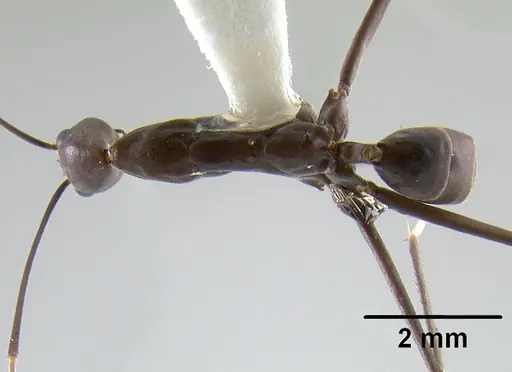
CASENT0012086
View on AntWeb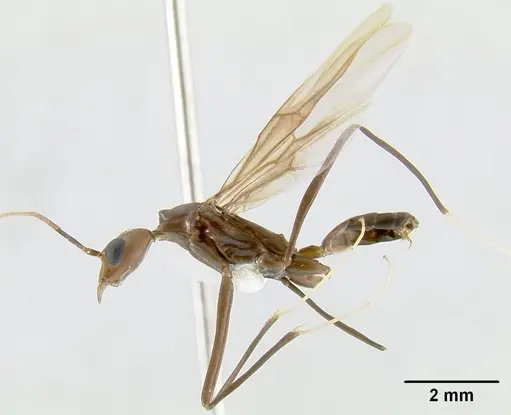
CASENT0127002
View on AntWeb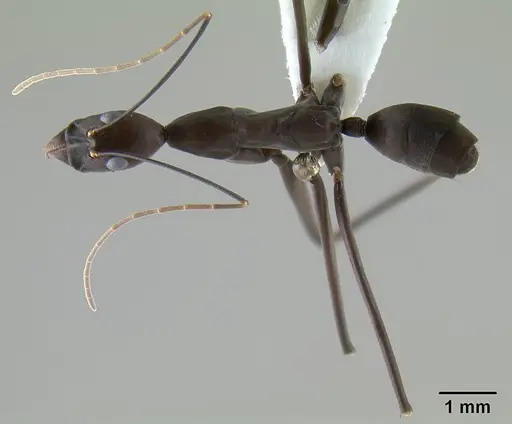
CASENT0127396
View on AntWeb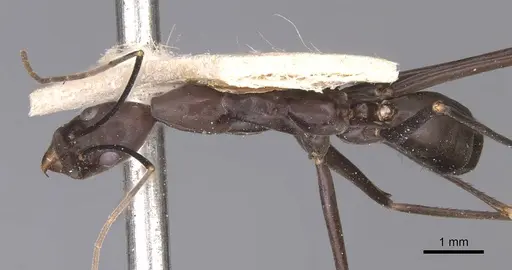
Literature
Loading...Loading products...