

Hypoponera surda
- Scientific Name
- Hypoponera surda
- Tribe
- Ponerini
- Subfamily
- Ponerinae
- Author
- Bolton & Fisher, 2011
- Distribution
- Found in 1 countries
Hypoponera surda Overview
Hypoponera surda is an ant species of the genus Hypoponera. It is primarily documented in 1 countries , including Kenya. Detailed taxonomic data and occurrence records can be further explored via authoritative databases such as AntWeb or the Global Biodiversity Information Facility (GBIF).
Hypoponera surda
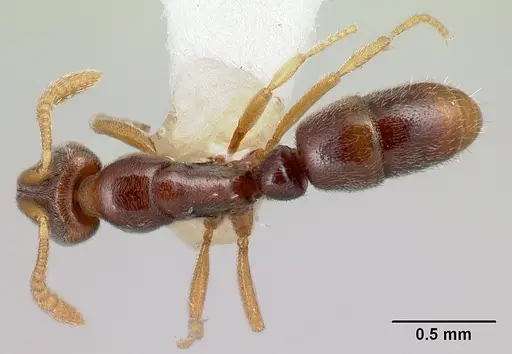
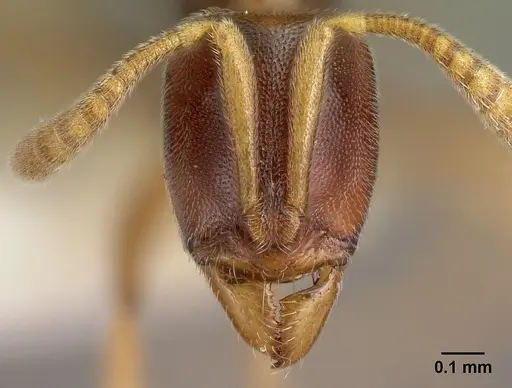
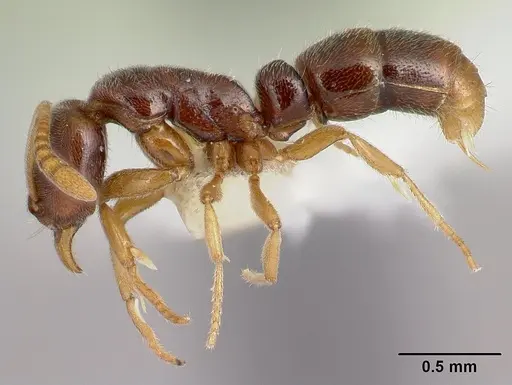
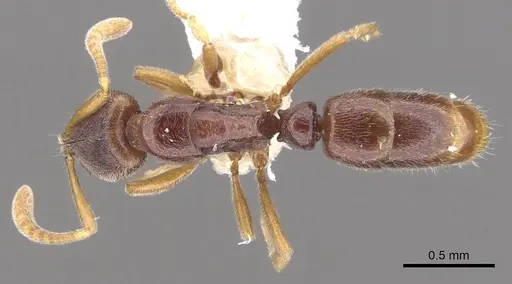
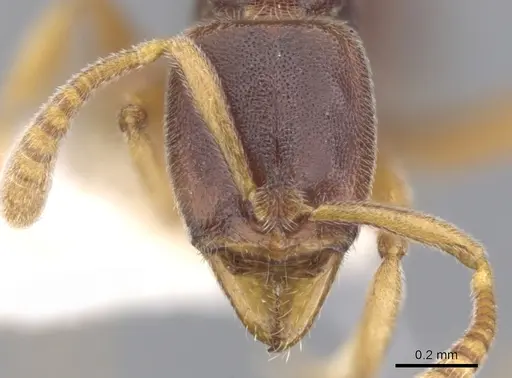
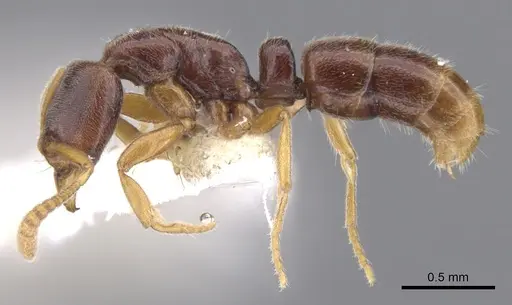
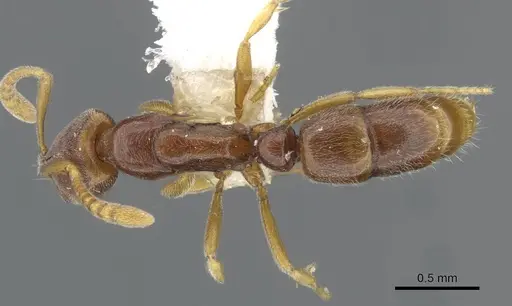
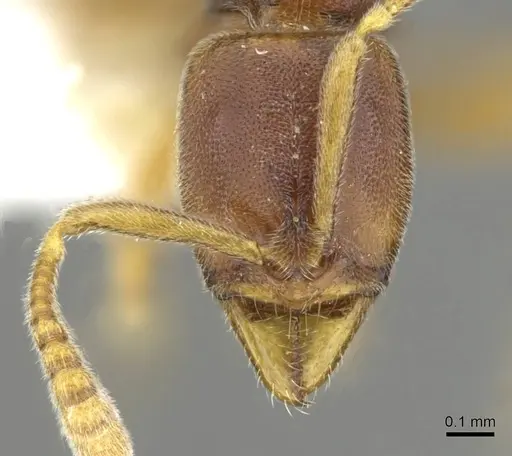
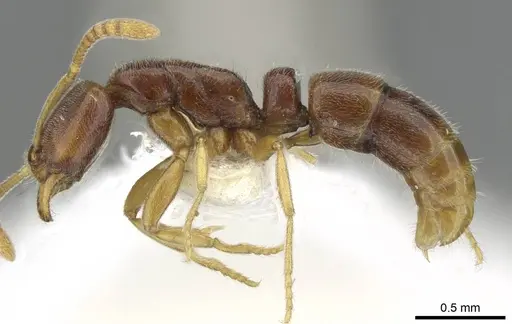
Hypoponera surda is a tiny, cryptic ponerine ant described from Kenya in 2011. Workers measure a mere 0.63-0.68mm in head length, making them one of the smaller ant species in the genus [1]. The most striking physical feature is the complete absence of eyes, indicating a fully subterranean lifestyle adapted to life in darkness [1]. They belong to the Hypoponera abeillei species group and can be identified by the distinctive series of very short cuticular ridges on the posterior face of the petiole node, along with fine cephalic sculpture and almost smooth pronotum [1].
This species is known only from type specimens collected in Kirimiri Forest at 1550m elevation in Embu, Kenya [1]. Nothing has been documented about their biology, colony structure, or behavior in the wild. Like other Hypoponera species, they likely live in small, cryptic colonies in soil or rotting wood, but this remains speculative.
Quick Summary
- Difficulty: Unknown, biology unstudied
- Origin & Habitat: Kenya, East Africa, found in highland forest at 1550m elevation in Kirimiri Forest near Runyenje [1]
- Colony Type: Unconfirmed, only known from worker specimens, no colony structure data exists
- Size & Growth:
- Queen: Unknown, only workers have been described [1]
- Worker: 0.63-0.68mm head length,0.52-0.56mm head width [1]
- Colony: Unknown, no colony data exists
- Growth: Unknown
- Development: Unknown, no development data exists for this species (Based on related Hypoponera species, development likely takes 2-4 months at optimal temperature, but this is a rough estimate)
- Antkeeping:
- Temperature: Unknown, no thermal studies exist. Based on Kenyan highland origin (1550m elevation), likely prefers moderate temperatures around 20-24°C. Start in this range and observe colony activity.
- Humidity: Unknown, no humidity data exists. As a likely subterranean species, moderate to high humidity is probable. Keep nest substrate consistently moist but not waterlogged.
- Diapause: Unknown, no seasonal data exists. Kenyan highland species may experience cooler periods but true hibernation is unlikely.
- Nesting: No nesting data exists. Based on genus patterns, they likely nest in soil, under stones, or in rotting wood. A naturalistic setup with moist substrate or a Y-tong/plaster nest would be appropriate starting points.
- Behavior: Completely unstudied. Based on genus patterns, Hypoponera ants are typically slow-moving, cryptic predators that hunt small soil invertebrates. The complete absence of eyes strongly suggests a subterranean, blind-foraging lifestyle. They are unlikely to be aggressive or defensive. Escape prevention should be excellent given their tiny size, they can easily squeeze through standard mesh barriers.
- Common Issues: no documented biology means all care is speculative, expect a learning curve, tiny size makes escape prevention critical, use fine mesh barriers, colony may fail if conditions don't match their unknown natural requirements, no information on acceptable foods, start with small live prey and observe, slow growth or colony decline may occur without anyone understanding why
Discovery and Taxonomy
Hypoponera surda was described in 2011 by Barry Bolton and Brian Fisher as part of a comprehensive taxonomic revision of Afrotropical Hypoponera species [1]. The type series consists of workers collected in October 1977 from Kirimiri Forest in Embu, Kenya, at an elevation of 1550 meters [1]. The species name 'surda' means deaf or silent in Latin, likely referring to the complete absence of eyes, a sensory deprivation parallel to deafness [1]. The species belongs to the Hypoponera abeillei group, which is characterized by specific morphological features including cuticular ridges at the base of the petiole node [1]. Only the worker caste has been described, queens and males remain unknown.
Identification and Morphology
This species is relatively distinctive within its group. The complete absence of eyes immediately sets it apart from most Hypoponera species, which typically have small but visible eyes [1]. The cephalic sculpture is fine and reticulate-punctate, while the pronotum is almost smooth, much less strongly sculptured than the head [1]. The petiole node is thickly D-shaped in dorsal view, with a series of very short cuticular ridges radiating upward from the peduncle on the posterior face [1]. Workers measure 0.63-0.68mm in head length and 0.52-0.56mm in head width, placing them among the smaller Hypoponera species [1]. The first gastral tergite is wider than the second, and the disc of the second tergite has small, widely spaced punctures with glossy cuticle between them [1].
Known Distribution
Hypoponera surda is currently known only from its type locality in Kirimiri Forest, western Runyenje, in Embu County, Kenya [1]. This is a highland forest area at approximately 1550 meters elevation in the central highlands of Kenya [1]. The Afrotropical region of Kenya has diverse ant fauna, and Hypoponera surda represents one of the more poorly known species in the genus [1]. It is possible the species has a wider distribution that has not been documented, as many cryptic subterranean ants are rarely encountered due to their hidden habits.
Inferred Care Requirements
Since no biological data exists for this species, all care recommendations must be based on genus-level patterns and inference. Hypoponera ants are typically predatory, feeding on small soil invertebrates such as springtails, mites, and other micro-arthropods. Start by offering small live prey like springtails or fruit fly larvae and observe acceptance. The complete absence of eyes strongly suggests a fully subterranean lifestyle, they likely forage through soil and leaf litter rather than on open surfaces. Keep nest substrate consistently moist. Colony sizes are likely small (likely under 100 workers based on genus patterns), so avoid overfeeding. Be patient, with no known biology, establishing this species may require experimentation.
Challenges in Keeping This Species
Hypoponera surda presents unique challenges for antkeepers. First and most importantly, absolutely no biological information exists, everything about their care must be inferred from related species and guessed at. This makes them unsuitable for beginners who need documented care guides. The complete absence of eyes suggests they are highly specialized for subterranean life and may be sensitive to light, vibrations, and surface conditions. Their tiny size (under 1mm) means escape prevention must be excellent, standard test tube setups may need additional barriers. Finding appropriate prey for such small ants can also be challenging. If you obtain this species, document your observations carefully as any information would be scientifically valuable.
Frequently Asked Questions
How do I care for Hypoponera surda ants?
No documented care guide exists for this species. Based on genus patterns, provide a moist naturalistic or plaster nest, keep temperatures around 20-24°C, and offer small live prey like springtails. Be prepared to experiment with conditions.
What do Hypoponera surda ants eat?
Unknown for this specific species. Other Hypoponera are predatory on small soil invertebrates. Start with tiny live prey like springtails, fruit fly larvae, or small mites and observe what they accept.
Are Hypoponera surda good for beginners?
No. This species has no documented biology, all care is speculative. Beginners should start with species that have established care guides like Lasius niger, Camponotus species, or Myrmica rubra.
How big do Hypoponera surda colonies get?
Unknown, no colony data exists. Based on genus patterns, colonies are likely small, probably under 100 workers. Many Hypoponera species maintain relatively small, cryptic colonies.
Do Hypoponera surda ants have eyes?
No, they completely lack eyes, which is unusual in the genus. This indicates a fully subterranean, blind-foraging lifestyle adapted to life in darkness [1].
Where is Hypoponera surda found in the wild?
Only known from Kirimiri Forest in Embu, Kenya at 1550m elevation [1]. The species has not been documented anywhere else.
What is the founding behavior of Hypoponera surda?
Unknown, no founding behavior has been documented. Related Hypoponera species may be semi-claustral or claustral, but this is unconfirmed for surda.
When do Hypoponera surda nuptial flights occur?
Unknown, no nuptial flight data exists for this species. Even the queen caste has not been described.
Can I keep multiple Hypoponera surda queens together?
Unknown, no colony structure data exists. Do not attempt combining unrelated queens without documented evidence that this species tolerates polygyny.
What temperature should I keep Hypoponera surda at?
No specific data exists. Based on Kenyan highland origin (1550m elevation), moderate temperatures around 20-24°C are a reasonable starting point. Adjust based on colony activity.
Is Hypoponera surda safe to handle?
These are tiny ants (under 1mm) that would be difficult to handle. Their sting is not documented but likely present. Due to their specialized care requirements and scientific value, they should be kept for observation rather than casual handling.
References

This caresheet is licensed under CC BY-SA 4.0 .
Literature
Loading...Loading products...