

Discothyrea aisnetu
- Scientific Name
- Discothyrea aisnetu
- Tribe
- Proceratiini
- Subfamily
- Proceratiinae
- Author
- Hita-Garcia & Lieberman, 2019
- Distribution
- Found in 1 countries
Discothyrea aisnetu Overview
Discothyrea aisnetu is an ant species of the genus Discothyrea. It is primarily documented in 1 countries , including Tanzania, United Republic of. Detailed taxonomic data and occurrence records can be further explored via authoritative databases such as AntWeb or the Global Biodiversity Information Facility (GBIF).
Discothyrea aisnetu
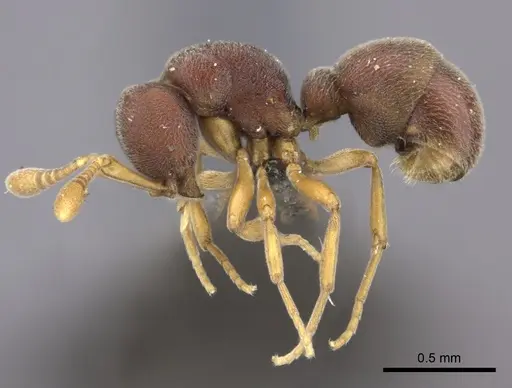
Discothyrea aisnetu is a tiny, cryptic ant species native to the montane rainforests of northern Tanzania. Workers measure just 0.80-0.90 mm in total length, making them among the smaller ants you might encounter [1]. They belong to the Proceratiinae subfamily and feature a distinctive highly convex, rounded mesosoma that sets them apart from other African Discothyrea species. Their coloration ranges from luteous-orange to deep iron-red, with yellow appendages. This species was only recently described in 2019 and is known exclusively from the Kindoroko Forest Reserve at 1739 meters elevation, a montane rainforest environment in the Afrotropical region [1]. The species name 'aisnetu' comes from the Latin phrase 'Aisne tu?' meaning 'Could it be?', reflecting the authors' surprise upon first examining this unusual ant.
Quick Summary
- Difficulty: Unknown, likely Expert
- Origin & Habitat: Kindoroko Forest Reserve in Tanzania, a montane rainforest at 1739m elevation. Collected from leaf litter in primary forest [1].
- Colony Type: Unconfirmed, colony structure has not been documented in the scientific literature.
- Size & Growth:
- Queen: Unknown, only worker caste has been described [1]
- Worker: 0.80-0.90 mm total length (WL), head width 0.57-0.61 mm [1]
- Colony: Unknown, no colony samples have been studied
- Growth: Unknown
- Development: Unconfirmed, no development data exists for this species (Based on related Discothyrea species and general Proceratiinae patterns, development likely takes several months but this is an estimate.)
- Antkeeping:
- Temperature: Unconfirmed, the montane rainforest habitat suggests cooler conditions than lowland tropical species. Based on similar montane leaf-litter ants, aim for roughly 20-24°C with a gentle gradient. Monitor colony activity and adjust accordingly.
- Humidity: Unconfirmed, the leaf-litter collection site indicates they prefer damp, humid conditions. Keep the nest substrate consistently moist but not waterlogged, with some drier areas available for the ants to regulate their own humidity.
- Diapause: Unknown, no seasonal data exists for this species. The montane location at 1739m may experience cooler temperatures seasonally, but whether this triggers diapause is unconfirmed.
- Nesting: Based on their leaf-litter collection, they likely prefer tight, humid spaces with minimal light exposure. Test tubes with cotton-plug water reservoirs work well for tiny cryptic ants. A naturalistic setup with moist soil and hiding structures can also work. Avoid dry, open environments.
- Behavior: Discothyrea ants are typically cryptic, slow-moving, and spend most of their time hidden in leaf litter or soil crevices. They are not aggressive and likely have minimal defensive capabilities due to their tiny size. Escape prevention is critical, their small size means they can squeeze through standard test tube openings. Use fine mesh and tight-fitting barriers. Foraging style is unknown but likely involves slow, deliberate searching rather than rapid recruitment.
- Common Issues: escape prevention is critical, their tiny size allows them to squeeze through standard gaps, slow growth and cryptic behavior make it difficult to monitor colony health, lack of documented care information means you're essentially pioneering husbandry for this species, wild-caught colonies may have parasites or pathogens that can decimate captive colonies, overheating or drying out is likely fatal given their montane leaf-litter origin
Discovery and Taxonomy
Discothyrea aisnetu was only described in 2019 by Hita-Garcia and Lieberman, making it one of the most recently described ant species in the hobby. It was discovered during conservation fieldwork in the Kindoroko Forest Reserve in Tanzania's Kilimanjaro Region. The species belongs to the Discothyrea traegaordhi species complex, which is known for highly specialized morphological adaptations. What makes D. aisnetu particularly distinctive is its extremely convex, high-rounded mesosomal profile, a shape not seen in any other African Discothyrea species. Only three worker specimens have ever been documented, all collected between September 5-8,2005,from leaf litter samples in primary forest [1].
Identification and Morphology
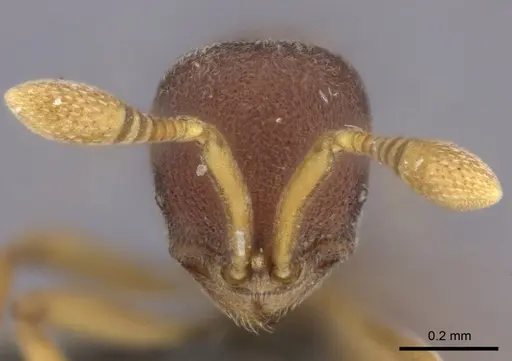
This is a relatively large species within the genus Discothyrea, with workers measuring 0.57-0.61 mm in head width and 0.80-0.90 mm in Weber's length. The most distinctive feature is the extremely convex, high-rounded mesosoma that appears swollen in profile. Unlike many related species, D. aisnetu lacks a mesotibial spur, an important diagnostic character. The antenna has nine true antennomeres with a relatively narrow apical club. The first mesotarsomere is very elongated, nearly as long as all remaining tarsomeres combined. Coloration ranges from luteous-orange to deep iron-red, with entirely yellow appendages. The eyes are small but visible, comprising just a few ommatidia [1].
Natural History and Habitat
This species is known only from its type locality in the Kindoroko Forest Reserve, a montane rainforest at 1739 meters elevation in northern Tanzania. All specimens were collected from leaf litter in primary forest using Winkler extraction methods. The montane rainforest environment suggests they prefer cooler, humid conditions with stable temperatures. As leaf-litter dwellers, they likely nest in the upper soil layers, under decaying leaves, or within rotting wood fragments on the forest floor. Their tiny size and cryptic habits make them extremely difficult to find in the wild, most Discothyrea species are rarely encountered by collectors despite being potentially widespread [1].
Keeping Discothyrea aisnetu in Captivity
Keeping this species represents a true challenge because virtually no captive husbandry information exists. Based on their natural history, provide a humid, tightly enclosed nesting environment. Test tubes with cotton-plug water reservoirs work well for tiny ants, the small diameter helps maintain humidity and provides the tight spaces these cryptic ants prefer. Keep temperatures moderate (roughly 20-24°C) and avoid overheating. The montane origin suggests they may not tolerate the high temperatures that work well for lowland tropical species. Feed small, soft-bodied prey items, their tiny size limits what they can handle. Given how little we know about this species, expect a steep learning curve and be prepared to experiment with conditions. Document your observations carefully as any successful colony establishment would be a significant contribution to antkeeping knowledge.
Related Species in the Genus
Discothyrea is a small, specialized genus of cryptic ants with around 30 described species globally. Most species are tiny, leaf-litter dwelling ants that are rarely observed. The genus is part of the Proceratiinae subfamily, which includes the well-known trap-jaw ants (Odontomachus) but Discothyrea lacks any such dramatic defensive adaptations. Within the traegaordhi species complex, D. aisnetu shares some morphological similarities with Discothyrea poweri, particularly the long limbs and narrow apical antennal club. However, D. aisnetu lacks the mesotibial spur present in D. poweri. Many Discothyrea species remain known only from their type localities, reflecting both their rarity and the difficulty of collecting such tiny, cryptic ants [1][2].
Frequently Asked Questions
How long does it take for Discothyrea aisnetu to develop from egg to worker?
This is unconfirmed, no development data exists for this species. Based on related Discothyrea species and general Proceratiinae patterns, expect development to take several months, possibly 3-6 months at optimal temperature. The lack of any documented development timeline is one of the major knowledge gaps for this species.
What do Discothyrea aisnetu ants eat?
Unconfirmed, no feeding observations have been documented for this species. Based on related Discothyrea species, they likely prey on tiny soft-bodied arthropods like springtails, mites, and other micro-fauna found in leaf litter. Their tiny size limits what prey they can handle. Offer small live prey items and observe acceptance.
Can I keep Discothyrea aisnetu in a test tube setup?
Yes, a test tube setup is likely appropriate given their tiny size and preference for tight, humid spaces. Use a small-diameter test tube to maintain humidity and provide the enclosed environment these cryptic ants prefer. Ensure excellent escape prevention, their small size means they can squeeze through gaps that larger ants cannot.
What temperature should I keep Discothyrea aisnetu at?
Unconfirmed, no thermal studies exist for this species. Based on their montane rainforest origin at 1739m elevation, aim for moderate temperatures around 20-24°C. Avoid the high temperatures that work for lowland tropical species. Start in the lower part of this range and observe colony activity to find the optimal temperature.
Do Discothyrea aisnetu ants sting?
Unknown, no defensive behavior has been documented. Given their extremely small size (under 1mm), any sting would likely be imperceptible to humans. They are not considered dangerous and likely rely onCryptic behavior rather than active defense.
Are Discothyrea aisnetu good for beginners?
No, this species is not recommended for beginners. It is one of the least studied ant species in existence, with virtually no captive husbandry information available. Keeping this species successfully would require advanced antkeeping experience and a willingness to experiment. There are many better-documented species available for beginners.
How big do Discothyrea aisnetu colonies get?
Unknown, no colony size data exists. Based on related Discothyrea species, colonies are likely small, possibly under 100 workers. Many Discothyrea species have relatively small colony sizes compared to more common ant genera.
Does Discothyrea aisnetu need hibernation or diapause?
Unknown, no seasonal data exists for this species. The montane location suggests they may experience cooler seasonal temperatures, but whether this triggers true diapause is unconfirmed. Do not assume hibernation is required without evidence.
Why is my Discothyrea aisnetu colony dying?
Without documented care information, diagnosing problems is extremely difficult. Common issues likely include: temperature stress (too hot or too cold), humidity problems (drying out or flooding), escape-related losses, and stress from disturbance. Their montane origin and cryptic nature make them particularly sensitive to environmental changes. Document your conditions carefully and experiment cautiously.
Can I keep multiple Discothyrea aisnetu queens together?
Unconfirmed, no information exists on colony founding or queen behavior for this species. Do not attempt to combine unrelated queens without evidence that this is safe. Many ant species are aggressive toward unrelated queens.
References

This caresheet is licensed under CC BY-SA 4.0 .
CASENT0235475
View on AntWeb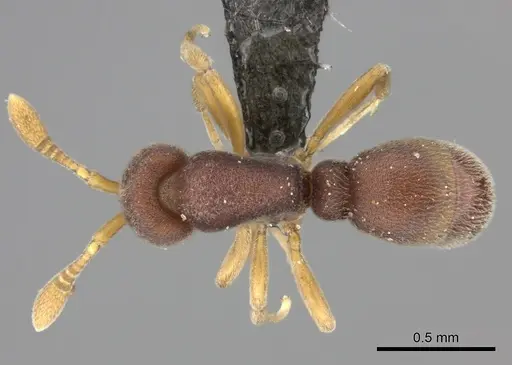
Literature
Loading...Loading products...