

Camponotus thadeus
- Scientific Name
- Camponotus thadeus
- Tribe
- Camponotini
- Subfamily
- Formicinae
- Author
- Shattuck, 2005
- Common Name
- Punk Ant
- Distribution
- Found in 1 countries
Camponotus thadeus Overview
Camponotus thadeus (commonly known as the Punk Ant) is an ant species of the genus Camponotus. It is primarily documented in 1 countries , including Australia. Detailed taxonomic data and occurrence records can be further explored via authoritative databases such as AntWeb or the Global Biodiversity Information Facility (GBIF).
Camponotus thadeus - "Punk Ant"
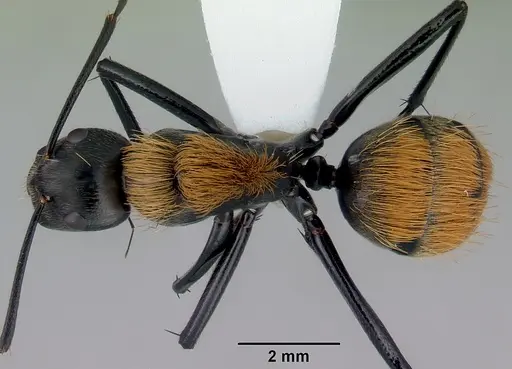
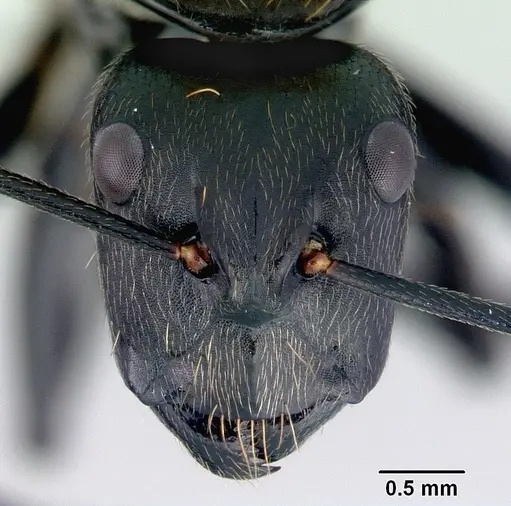
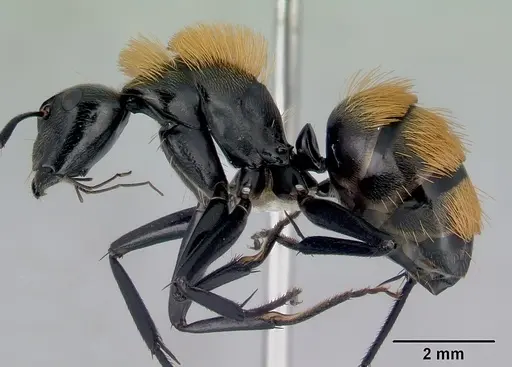
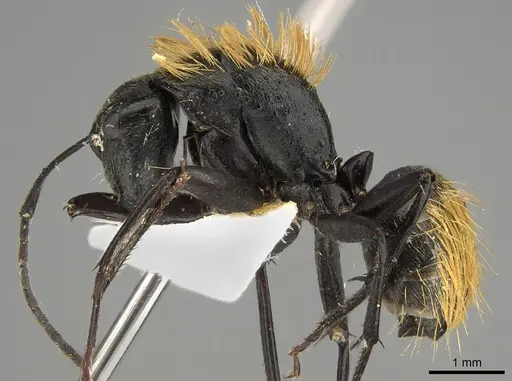
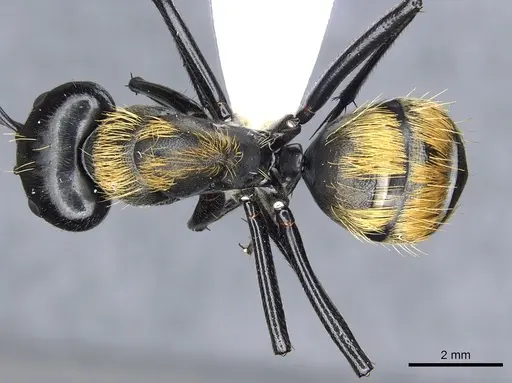
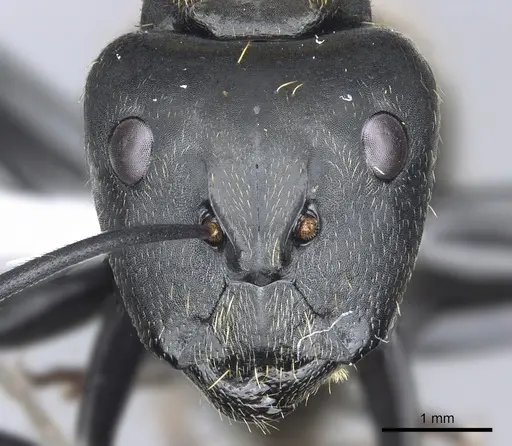
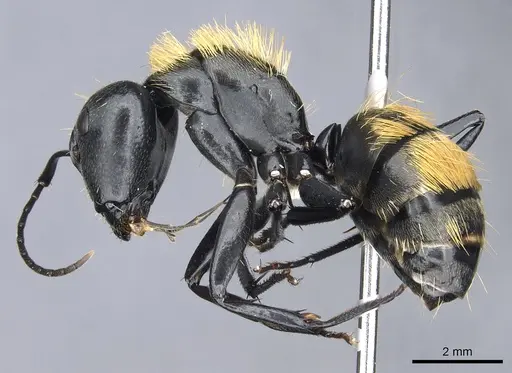
Camponotus thadeus is a small, distinctive ant native to the high-elevation rainforests of Queensland, Australia. Workers are dark red-black to black, measuring 1.57-2.08mm in head width, with a striking feature: abundant bright yellow enlarged hairs on the dorsum of their mesosoma (the middle body section). This species is incredibly rare in the ant-keeping world, it is only the second Camponotus species ever discovered with a metapleural gland, a specialized structure that most ants lost during evolution. The gland opening is unusually large and visible. These ants are arboreal, nesting in hollow tree cavities at elevations above 880m, and are found running up trees and across the rainforest floor in high numbers when conditions are right [1][2].
Quick Summary
- Difficulty: Expert
- Origin & Habitat: High-elevation rainforest in Queensland, Australia. Found at elevations around 880m and higher, never in lowland rainforest. Nests arboreally in hollow tree cavities [1][2].
- Colony Type: Single-queen colonies (monogyne) are typical for Camponotus species, though colony structure has not been directly studied for this species.
- Colony: Monogyne
- Founding: Claustral
- Size & Growth:
- Queen: Not described in available literature, estimates based on Camponotus genus suggest 8-12mm. Signal as estimated.
- Worker: 1.57-2.08mm head width,1.86-2.29mm head length [1].
- Colony: Unknown, no colony size data available. Likely moderate for Camponotus, possibly several hundred workers.
- Growth: Unknown, signal as estimated. Likely moderate, typical of Camponotus genus.
- Development: 6-10 weeks, estimated based on typical Camponotus development at warm temperatures. Signal as estimated. (Development time is unconfirmed for this species. Based on related Camponotus species, expect 6-10 weeks from egg to first worker at 24-28°C.)
- Antkeeping:
- Temperature: High-elevation rainforest origin suggests they prefer cooler, stable conditions compared to most ants. Aim for 20-24°C, avoid overheating. Signal as inferred from habitat.
- Humidity: High humidity is essential, rainforest species. Keep nest substrate consistently moist but not waterlogged. Provide a humidity gradient with a damp side and slightly drier area.
- Diapause: Unknown, their high-elevation rainforest habitat suggests they may not need a strong diapause, but cool season slowing should be expected. Signal as unknown.
- Nesting: Arboreal species, they naturally nest in hollow tree cavities. In captivity, a Y-tong (AAC) or plaster nest with good humidity works well. Provide narrow chambers scaled to their small size. Avoid dry, substrate-based nests.
- Behavior: Workers are active foragers, found running up trees and across the rainforest floor. They are not aggressive and likely avoid confrontation. Their small size (under 2mm) means escape prevention must be excellent, use fine mesh and tight-fitting barriers. The metapleural gland may produce defensive secretions, though this is not well studied.
- Common Issues: high elevation rainforest origin means they are sensitive to overheating, keep temperatures below 25°C, escape prevention is critical due to their very small worker size, arboreal nesting means they need humidity control, dry nests will cause colony failure, limited availability makes this species extremely rare in the hobby, no captive breeding data exists, wild-caught colonies may have high mortality
The Metapleural Gland - What Makes This Species Special
Camponotus thadeus is one of the rarest ants in the world in terms of a single anatomical feature: it possesses a metapleural gland, a structure that was lost in most ant evolution. Only one other Camponotus species (the giant Dinomyrmex gigas from Southeast Asia) has this gland. The gland opening is remarkably large and visible, as large as any known in ants [1]. This gland typically produces antibiotic secretions that help protect the colony from fungi and bacteria. In most ant species, including almost all other Camponotus, this gland disappeared during evolution. Its presence in C. thadeus appears to be an independent re-evolution, not a retained ancestral feature. This makes them a fascinating species for antkeepers interested in ant biology, though it also suggests they may have specific hygiene needs that other ants don't require.
Natural History and Habitat
This species is found only in the high-elevation rainforests of Queensland, Australia, primarily around Mount Finnigan. They have never been found below approximately 880m elevation, and never in lowland rainforest areas [1]. Their arboreal nature means they nest in hollow cavities within trees, not in the ground. In the wild, workers can be found running up trees along trails and scattered across the rainforest floor, especially when weather conditions are favorable [1]. The high-elevation rainforest environment is cool, humid, and stable, these conditions are critical to replicate in captivity. Their restricted distribution and specialized habitat make them a challenging species to keep, as they are not adaptable to typical room conditions.
Housing and Nest Setup
Because C. thadeus is arboreal and comes from a humid rainforest environment, they need a setup that provides both humidity control and appropriate chamber sizes. A Y-tong (acrylic ant castle) or plaster nest works well, both allow you to maintain consistent humidity. The chambers should be small and narrow, scaled to their tiny worker size (under 2mm). Keep the nest substrate consistently moist but not flooded, these ants will not tolerate dry conditions. Provide a water tube for drinking access. Because they are small and active, excellent escape prevention is essential, use fine mesh on any openings. A small outworld with some vertical structures (cork, branches) will allow natural foraging behavior. [1]
Feeding and Diet
Like most Camponotus species, C. thadeus is likely omnivorous, accepting both sugar sources and protein. Offer sugar water, honey, or diluted maple syrup as a constant energy source. For protein, provide small insects like fruit flies, small mealworms, or other tiny arthropods. Their small size means prey items should be appropriately sized, avoid large insects that could overwhelm workers. The metapleural gland suggests they may have heightened hygiene needs, so keep food clean and remove uneaten prey promptly to prevent mold. Feed protein 2-3 times per week and provide sugar water constantly. [1]
Temperature and Seasonal Care
This is the most critical aspect of keeping C. thadeus. Coming from high-elevation Australian rainforests, they are adapted to cool, stable conditions. Keep temperatures between 20-24°C, avoid anything above 25°C, which could stress or kill the colony. Room temperature is often suitable, but monitor closely during summer. Unlike many temperate ants, they likely do not require a true hibernation period. However, you may observe reduced activity during cooler months. Use a digital thermometer to monitor nest temperature. If your room is too warm, consider moving the nest to a cooler location or using a small fan for air circulation. Never use heating cables with this species. [1][2]
Acquiring This Species
Camponotus thadeus is extremely rare in the ant-keeping hobby. They have only been described scientifically in 2005 and are known only from a few high-elevation locations in Queensland. You are unlikely to find them from commercial breeders. If available at all, they would likely be wild-caught colonies collected by permitted researchers. Be extremely cautious about purchasing wild-caught colonies, they often have high mortality rates due to stress, parasites, and adaptation to wild conditions. Support conservation efforts and only purchase from ethical sources with proper permits. Given their specialized needs and rarity, this species is recommended only for experienced antkeepers who can provide the specific conditions they require. [1]
Frequently Asked Questions
Can I keep Camponotus thadeus in a test tube?
A test tube setup can work for founding colonies, but you will need to maintain high humidity around the tube. However, test tubes dry out quickly and require frequent monitoring. A Y-tong or plaster nest with built-in water reservoirs is more suitable for established colonies. The key is maintaining constant humidity without flooding the nest.
When should I move Camponotus thadeus to a formicarium?
Wait until the colony has at least 20-30 workers before moving to a formicarium. These ants are small and slow-growing, so this may take 6-12 months or more. Move them only when the test tube is becoming crowded and the colony is healthy. Use a gentle transfer method, they are fragile and may abandon brood if stressed.
How long does it take for Camponotus thadeus to produce first workers?
Based on typical Camponotus development, expect 6-10 weeks from egg to first worker at optimal temperatures (around 24°C). However, this species has not been kept in captivity extensively, so timelines are estimates. The queen will remain sealed in her founding chamber for several weeks while raising the first brood.
How big do Camponotus thadeus colonies get?
Colony size is not documented in scientific literature. Based on typical Camponotus species and their small worker size, colonies likely reach several hundred workers over several years. They are not among the largest Camponotus species.
Are Camponotus thadeus good for beginners?
No. This species is recommended only for experienced antkeepers. They have very specific requirements: high humidity, cool temperatures (below 25°C), arboreal nesting preferences, and extremely small size requiring excellent escape prevention. They are also nearly impossible to acquire. Beginners should start with more common, hardy species like Camponotus pennsylvanicus or Lasius niger.
What temperature do Camponotus thadeus need?
Keep nest temperatures between 20-24°C. This is cooler than most ant species require. Avoid temperatures above 25°C, they are adapted to cool high-elevation rainforest conditions and will not tolerate heat stress. Room temperature is often suitable, but monitor with a thermometer.
Do Camponotus thadeus need hibernation?
Probably not. As a high-elevation tropical/subtropical species, they likely do not require a true hibernation period. You may observe reduced activity during cooler months, which is normal. Do not force hibernation, simply maintain stable temperatures year-round.
Why are my Camponotus thadeus dying?
The most likely causes are: temperatures too high (above 25°C), low humidity causing desiccation, escape through tiny gaps due to their small size, or stress from wild-caught origins. Check all parameters immediately. If the colony was wild-caught, mortality may be due to parasites or adaptation failure. Ensure sugar water is always available and protein is offered regularly.
References

This caresheet is licensed under CC BY-SA 4.0 .
Literature
Loading...Loading products...