

Aphaenogaster holtzi
- Scientific Name
- Aphaenogaster holtzi
- Tribe
- Stenammini
- Subfamily
- Myrmicinae
- Author
- Emery, 1898
- Distribution
- Found in 1 countries
Aphaenogaster holtzi Overview
Aphaenogaster holtzi is an ant species of the genus Aphaenogaster. It is primarily documented in 1 countries , including Türkiye. Detailed taxonomic data and occurrence records can be further explored via authoritative databases such as AntWeb or the Global Biodiversity Information Facility (GBIF).
Aphaenogaster holtzi
Aphaenogaster holtzi is a small, pale yellow ant found in the mountains of Türkiye and Iran. Workers have smooth, shiny heads and bodies with distinctive erect hairs on the back of the head, and measure approximately 3-5mm based on head capsule dimensions of 0.94-1.12mm [1]. They live at high elevations between 1250m and 1600m in the eastern Mediterranean and Caucasus region, specifically recorded from Erzincan, Kars, Kayseri, Mersin, and Siirt provinces in Türkiye, as well as Iran [2][1][3].
Almost nothing is known about how these ants live in the wild. They belong to the subterranea species group, which typically nests in soil and rotting wood, but specific details about their colony size, diet, and reproduction remain unconfirmed [1][4]. Their mountain habitat suggests they experience cold winters and likely need a period of winter rest in captivity, though this has not been directly studied.
Quick Summary
- Difficulty: Expert
- Origin & Habitat: Mountainous regions of Türkiye and Iran at elevations of 1250-1600m [1][2].
- Colony Type: Unknown, likely single-queen based on related subterranea group species, but unconfirmed.
- Size & Growth:
- Queen: Unknown, likely 6-8mm based on typical Aphaenogaster proportions (estimated).
- Worker: Approximately 3-5mm (estimated from head capsule length 0.94-1.12mm) [1].
- Colony: Unknown, likely moderate (hundreds to low thousands) based on related Aphaenogaster species.
- Growth: Unknown
- Development: Unknown, likely 8-12 weeks based on related temperate Aphaenogaster species at 20-25°C (inferred). (No direct development studies exist for this species.)
- Antkeeping:
- Temperature: Likely cool to moderate temperatures reflecting mountain habitat at 1250-1600m elevation. Start around 18-22°C with ability to cool for winter rest [1].
- Humidity: Moderate humidity, nest substrate should feel damp but not waterlogged, with adequate ventilation to prevent mold.
- Diapause: Likely yes, mountain habitat suggests seasonal hibernation required, though exact timing is unconfirmed [1].
- Nesting: Soil or rotting wood nests in nature, captive options include naturalistic setups with clay or Y-tong nests based on subterranea group habits.
- Behavior: Unknown activity patterns, likely moderately active ground foragers typical of the genus. Small size requires excellent escape prevention [1].
- Common Issues: biology is almost completely unknown, captive success requires experimentation and careful observation., mountain habitat at 1250-1600m suggests specific temperature needs that are undocumented., small size requires excellent escape prevention including fine mesh barriers., lack of established care guidelines means high failure risk without close monitoring.
Natural History and Habitat
Aphaenogaster holtzi inhabits mountainous regions of the eastern Mediterranean and Caucasus, specifically found in Türkiye and Iran [1][3]. Collection records show they live at elevations of 1250m and 1600m in Türkiye, suggesting a preference for cooler mountain climates [1]. The species was originally described from Mersin (historically Mersina) in southern Türkiye by Emery in 1898 [1].
Recent taxonomic work places them firmly in the subterranea species group, having been moved from the pallida group based on phylogenetic analysis [5]. This group typically includes ground-nesting species that prefer soil and rotting wood habitats. However, specific nest architecture, foraging behavior, and colony organization for A. holtzi remain unconfirmed [1].
Identification and Appearance
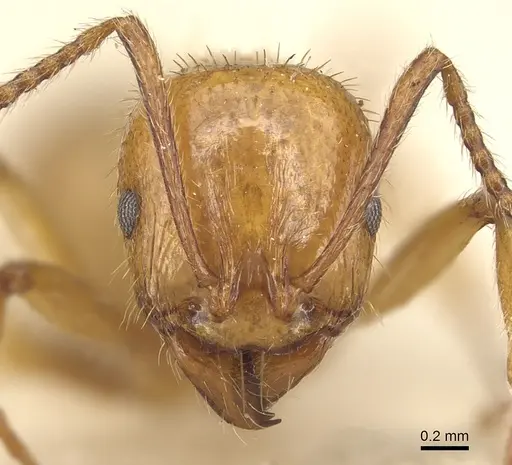
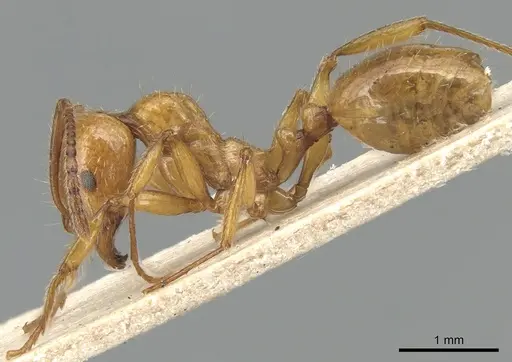
These ants are immediately recognizable by their uniformly pale yellow body coloration and unusually smooth, shiny appearance [1]. Unlike many related species, A. holtzi has a predominantly smooth and shiny head and mesosoma (the middle body section), with only the sides of the forehead showing some faint, sparse wrinkles [1].
Key identifying features include numerous erect hairs on the occipital margin (back edge) of the head, and the lack of a developed humeral tubercle (shoulder bump) [1]. Workers have a head length of approximately 0.94-1.12mm and width of 0.94-1.11mm, suggesting total body lengths around 3-5mm [1]. They resemble Aphaenogaster asterioni, A. ichnusa, and A. subterranea, but differ in the combination of smooth sculpture and pale coloration [6].
Nest Preferences
Based on their membership in the subterranea species group, these ants likely nest in soil and rotting wood in their mountain habitats [4][3]. Related species in this group often create simple chambers under stones or in decaying wood on forest floors.
For captive housing, a naturalistic setup with a clay or gypsum nest section buried in substrate works well for related species. Y-tong (aerated concrete) nests with narrow chambers can also work, provided they maintain the moderate humidity these mountain ants likely prefer. Avoid overly large chambers, scale the space to their small size.
Temperature and Seasonal Care
Their mountain habitat at 1250-1600m elevation suggests these ants experience significant seasonal temperature variation [1]. While exact thermal requirements are unconfirmed, you should start with moderate temperatures around 18-22°C during the active season.
Given their high-altitude collection sites, they likely require a winter rest period (diapause). Without confirmed data, provide a cooling period of 3-4 months at 5-10°C during winter. Watch for signs of reduced activity as temperatures drop naturally in autumn, and avoid keeping them at constant warm temperatures year-round, which may stress the colony.
Feeding and Diet
No specific dietary studies exist for this species. Related Aphaenogaster species are generalist omnivores, collecting seeds, hunting small insects, and tending aphids for honeydew. You should offer a varied diet including small live prey (springtails, fruit flies, small crickets), sugar water or honey water, and possibly seeds.
Observe what your colony accepts and adjust accordingly. Start with small amounts to avoid mold issues, especially given the moderate humidity requirements. Remove uneaten food within 24-48 hours to maintain nest hygiene.
Colony Founding
Founding behavior is unconfirmed for Aphaenogaster holtzi. Most Aphaenogaster species are claustral, meaning the queen seals herself in a chamber and lives off stored body fat until her first workers hatch. However, this is an inference based on genus patterns, not direct observation.
If attempting to found a colony, provide a small, dark chamber with minimal disturbance. Offer a test tube setup with water reservoir and cotton plug, or a small founding formicarium. Do not disturb the queen frequently. If she does not seal herself in or appears to forage actively, she may require feeding during founding (semi-claustral), so offer small amounts of sugar water and prey.
Frequently Asked Questions
Can I keep Aphaenogaster holtzi in a test tube?
Yes, test tubes work well for founding colonies or small colonies. Use a standard water reservoir with cotton barrier, ensuring the tube is darkened with foil or placed in a dark box. Because their biology is unknown, monitor closely to see if the queen seals herself in (claustral) or attempts to forage (semi-claustral).
How long until first workers for Aphaenogaster holtzi?
The egg-to-worker timeline is unknown for this species. Based on related temperate Aphaenogaster species, expect roughly 8-12 weeks at 20-25°C, but this is an estimate. Development may be slower at cooler mountain temperatures.
What temperature do Aphaenogaster holtzi need?
Start with 18-22°C during the active season. Their mountain habitat at 1250-1600m suggests they prefer cooler conditions than lowland tropical species. They likely need a winter cooling period at 5-10°C for several months.
Do Aphaenogaster holtzi need hibernation?
Likely yes. Their collection at high elevations (1250-1600m) in mountainous Türkiye suggests they experience cold winters and require a diapause period. Cool them to 5-10°C for 3-4 months during winter, though exact timing is unconfirmed.
What do Aphaenogaster holtzi eat?
Their specific diet is unknown. Related Aphaenogaster species are generalist omnivores eating seeds, insects, and honeydew. Offer small live prey like springtails or fruit flies, sugar water, and experiment with seeds to see what they accept.
How big do Aphaenogaster holtzi colonies get?
Colony size is unknown. Based on related species in the subterranea group, they likely reach moderate sizes of several hundred to a few thousand workers, but this is speculative.
Are Aphaenogaster holtzi good for beginners?
No. Their biology is almost completely unknown, making them suitable only for expert keepers willing to experiment and accept high failure rates. Beginners should choose well-documented species like Lasius niger or Formica fusca.
Can I keep multiple Aphaenogaster holtzi queens together?
Not recommended. Combining unrelated queens has not been documented for this species. Most Aphaenogaster species are monogyne (single queen), and attempting to house multiple queens together risks fighting and colony failure.
How do I identify Aphaenogaster holtzi?
Look for uniformly pale yellow coloration, a smooth and shiny head and body (unlike the rougher texture of related species), and erect hairs on the back of the head. They belong to the subterranea species group and were previously confused with similar species before recent taxonomic revision.
Why are my Aphaenogaster holtzi dying?
Common causes include incorrect temperature (too hot for a mountain species), lack of winter hibernation, or inappropriate humidity. Their specific needs are undocumented, so you must observe carefully and adjust conditions based on colony behavior rather than fixed guidelines.
References

This caresheet is licensed under CC BY-SA 4.0 .
CASENT0904178
View on AntWeb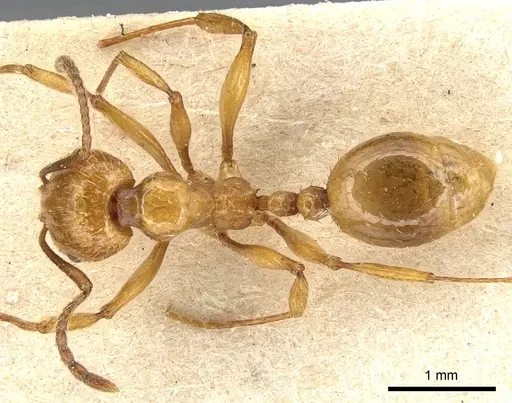
Literature
Loading...Loading products...