

Aenictus philippinensis
- Scientific Name
- Aenictus philippinensis
- Subfamily
- Dorylinae
- Author
- Chapman, 1963
- Distribution
- Found in 0 countries
Aenictus philippinensis Overview
Aenictus philippinensis is an ant species of the genus Aenictus. It is primarily documented in 0 countries . Detailed taxonomic data and occurrence records can be further explored via authoritative databases such as AntWeb or the Global Biodiversity Information Facility (GBIF).
Aenictus philippinensis
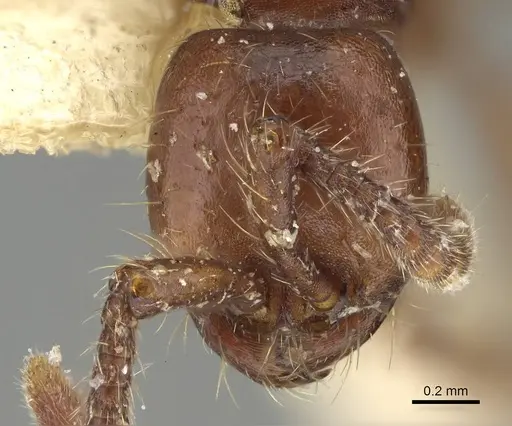
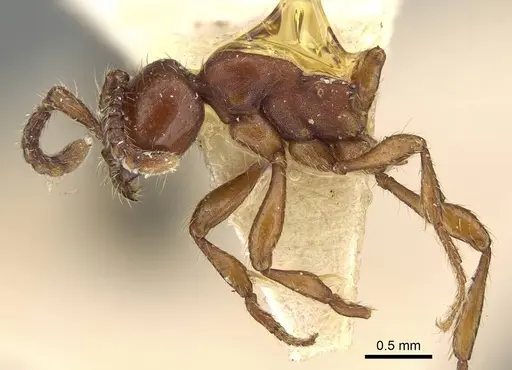
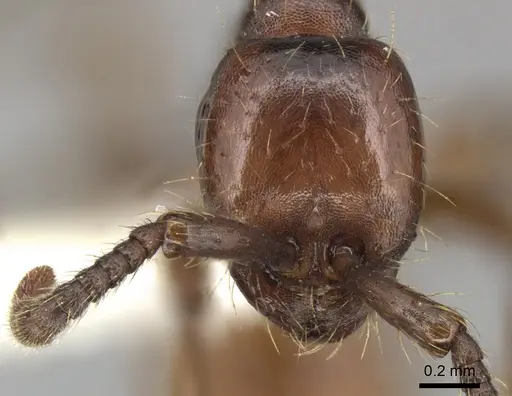
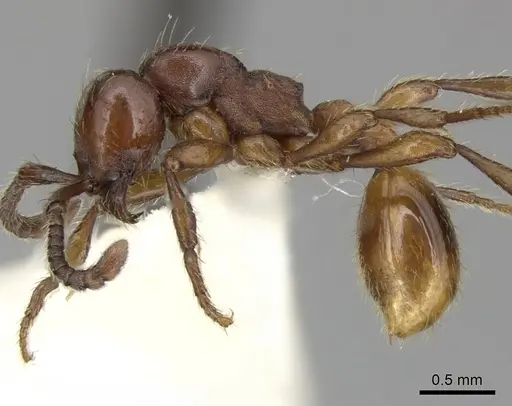
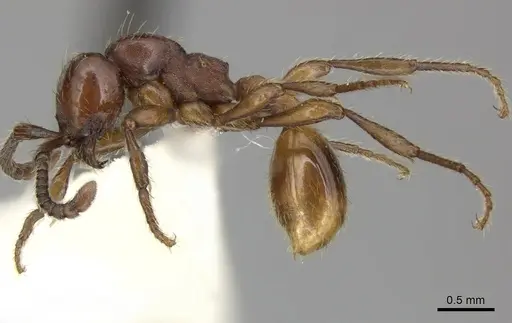
Aenictus philippinensis is a small reddish-brown army ant found only in the Philippines. Workers measure 3.7 to 4 millimeters long and have a shiny, weakly sculptured head with a distinctive ridge separating the middle body section from the side plates [1][2]. They live in the mountainous forests of Negros and Mindanao islands, where collectors have found them under stones and in leaf litter [3][4]. Unlike ants that build permanent nests, these are true army ants that form temporary bivouacs, living structures made from the ants' own bodies. Chapman famously observed workers pouring from a hole in the ground to build a living pyramid on a stump, only to vanish completely by the next morning with no trace of their camp remaining [3][1].
Quick Summary
- Difficulty: Expert
- Origin & Habitat: Philippines (Negros and Mindanao islands), found in mountainous forests at 450-1080 meters elevation, under stones and in leaf litter [3][4]
- Colony Type: Unknown, only the worker caste has been documented, no queens described [AntWiki]
- Size & Growth:
- Queen:{.size-link} Unknown, no queens described [AntWiki]
- Worker:{.size-link} 3.70-4.00 mm total length [1][2]
- Colony: Unknown, likely thousands based on army ant biology, but unconfirmed
- Growth: Unknown
- Development: Unknown, founding behavior undocumented (No queens have been described for this species, making captive founding impossible)
- Antkeeping:
- Temperature: Tropical species, likely 24-28°C based on Philippine climate, but specific requirements unconfirmed. Start at 25°C and adjust based on activity levels.
- Humidity: High humidity required, collected from leaf litter and damp forest floor. Keep substrate moist but not waterlogged [4].
- Diapause: No, tropical species do not hibernate.
- Nesting: Nomadic bivouacs in nature, they do not build permanent nests. In captivity this requires massive space to simulate constant movement [3].
- Behavior: Highly active nomadic predators. They form temporary bivouacs (living nests) and are constantly on the move. Small size (under 4mm) means escape prevention must be excellent [3][1].
- Common Issues: no queens are known or described, making colony founding impossible for keepers., nomadic lifestyle requires enclosures far larger than standard formicaria to prevent stress and colony collapse., army ants require massive amounts of live prey daily, difficult to sustain in captivity., tiny size allows escapes through the smallest gaps in standard antkeeping setups., colony social structure likely requires specific caste ratios and army ant behaviors that are impossible to replicate in captivity.
Natural History and the Bivouac Behavior
Aenictus philippinensis is a true army ant that lives a nomadic lifestyle. In 1942, Chapman observed workers emerging from a hole in the ground at 3600 feet elevation on Negros Island. They climbed a nearby stump and spent an hour constructing a living pyramid in the center, a bivouac formed by the ants linking their bodies together. Some workers attempted to build horizontally from the stump's edge. By the next morning, the entire structure had vanished, digging around the original hole revealed no trace of their camp [3][1]. This illustrates the temporary nature of their nesting. Jaitrong and Yamane later found a colony under a stone near a road, confirming they also use simple ground shelters [1]. These ants are probably restricted to the Philippines and live alongside the related species Aenictus rabori in Negros Oriental [1][2].
Why This Species Is Not Suitable for Standard Antkeeping
You cannot keep Aenictus philippinensis in a standard ant farm or test tube setup for several critical reasons. First, no queens have ever been described for this species, only workers are known [AntWiki]. Without a queen, you cannot start a colony. Second, army ants are nomadic, they do not stay in one place. They require massive enclosures to simulate their natural movement patterns, far beyond what most keepers can provide. Third, their food requirements are extreme. Army ants are specialized predators that hunt in massive groups, consuming enormous quantities of live prey daily. Finally, their small size (under 4mm) combined with active foraging behavior makes escape prevention nearly impossible in typical setups. While they are not dangerous to humans, they will escape through the tiniest gaps. [1][2]
Identification and Similar Species
Workers are small (3.7-4.0 mm), reddish-brown, and have a distinctive ridge between the middle body section (mesonotum) and the side plates (mesopleuron), a feature shared only with Aenictus rabori among Philippine species [3][5]. The head is superficially reticulate and shiny, not deeply sculptured. The pronotum (front part of the middle section) is smooth and shiny on top [1][6]. You can tell them apart from the similar Aenictus punctatus by their weaker head sculpturing, A. philippinensis has a shiny, weakly reticulated head while A. punctatus has finely punctate (dotted) sculpturing. Also, A. philippinensis has a low rim on the back edge of the propodeum, while A. punctatus has a much more prominent rim sticking out backward [1][2].
Habitat and Microclimate
These ants inhabit the mountainous forests of the Philippines. Specimens come from elevations of 450 to 1080 meters (about 1500 to 3600 feet) in the Horns of Negros region [3]. Recent records show they also occur on Mindanao Island, where they were collected from leaf litter using Winkler extraction [4]. This collection method suggests they forage and nest in the leaf litter layer of the forest floor. Based on this data, they need warm, humid conditions typical of tropical montane forests, not as hot as lowland jungle, but consistently warm with high humidity and access to moist soil or rotting wood.
Frequently Asked Questions
Can I keep Aenictus philippinensis in a test tube?
No. These are nomadic army ants that do not stay in one place. They require massive enclosures to simulate their natural movement patterns, and they need specialized care that makes test tubes completely unsuitable.
How do I start an Aenictus philippinensis colony?
You cannot start a colony because no queens have ever been described for this species. Only workers are known from scientific collections. Without a queen, founding is impossible.
What do Aenictus philippinensis eat?
As army ants, they are specialized predators that hunt other arthropods, possibly including termites and other ants. However, their specific prey preferences are undocumented. Army ants generally require massive amounts of live prey daily, making them extremely difficult to feed in captivity.
Do Aenictus philippinensis ants sting?
They can bite but are too small (under 4mm) to cause significant harm to humans. However, they are active predators with strong mandibles for their size, so they may bite if handled.
What temperature do Aenictus philippinensis need?
They come from tropical Philippine forests, so they likely need temperatures around 24-28°C. However, specific thermal requirements are unconfirmed. Start at 25°C and observe their activity levels.
How big do Aenictus philippinensis colonies get?
Unknown. Army ant colonies typically contain thousands of workers, but the exact colony size for this species has never been documented.
Can I keep multiple Aenictus philippinensis queens together?
Unknown. Since no queens have ever been found for this species, we do not know if they accept multiple queens or how their colony structure works.
Why are my Aenictus philippinensis dying?
If you have these ants in captivity, they are likely dying because army ants require specialized care that is nearly impossible to provide: massive space for nomadic movement, enormous quantities of appropriate live prey, and specific humidity and temperature gradients. They are not suited to standard antkeeping setups.
Where do Aenictus philippinensis nest in the wild?
They form temporary bivouacs, living structures made of linked ant bodies, rather than permanent nests. They have been found under stones and observed building temporary camps on stumps that they abandon within hours [3][1].
Are Aenictus philippinensis good for beginners?
No. They are unsuitable for keepers of any experience level because they are not commercially available (no queens known), require impossible-to-provide housing conditions, and have extreme feeding requirements.
Report an Issue
The current care sheet is based fully on literature. See inconsistencies, or something that's incorrect? Please , it will be resolved after review from an admin. Contributing to the blogs tab also helps providing information, to make us be able to further improve the caresheets. Thank you for your support!
References

This caresheet is licensed under CC BY-SA 4.0 .
CASENT0217381
View on AntWeb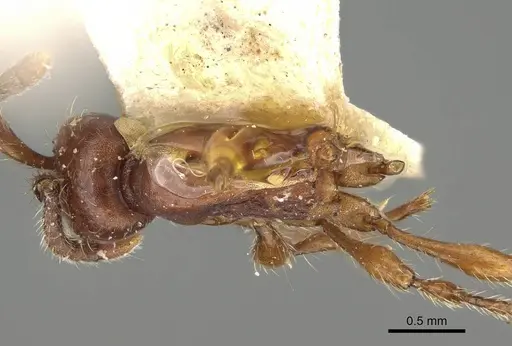
CASENT0249282
View on AntWeb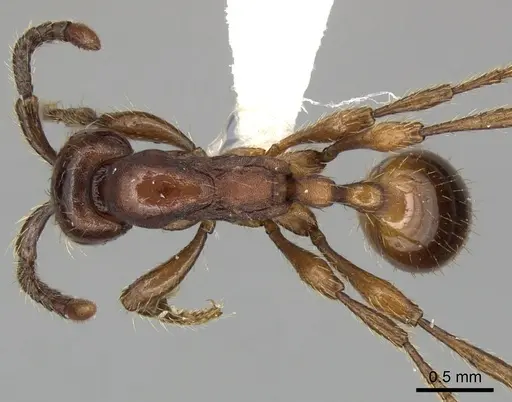
Literature
Loading...Loading products...