

Tetramorium glabratum
- Scientific Name
- Tetramorium glabratum
- Tribe
- Crematogastrini
- Subfamily
- Myrmicinae
- Author
- Stitz, 1923
- Distribution
- Found in 2 countries
Tetramorium glabratum Overview
Tetramorium glabratum is an ant species of the genus Tetramorium. It is primarily documented in 2 countries , including Namibia, South Africa. Detailed taxonomic data and occurrence records can be further explored via authoritative databases such as AntWeb or the Global Biodiversity Information Facility (GBIF).
Tetramorium glabratum
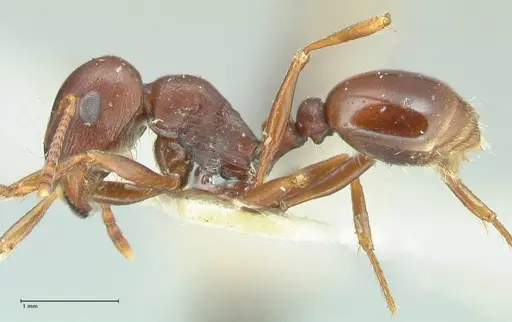
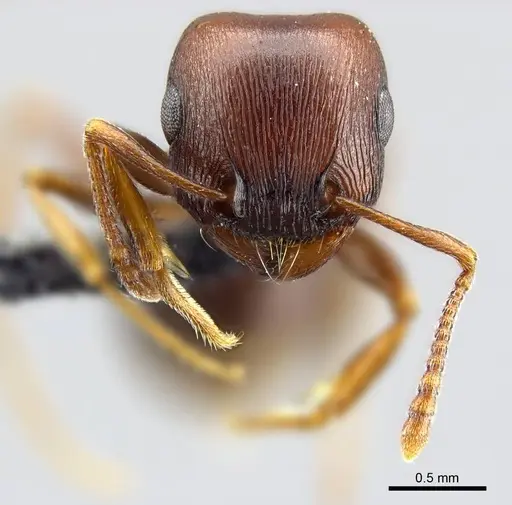
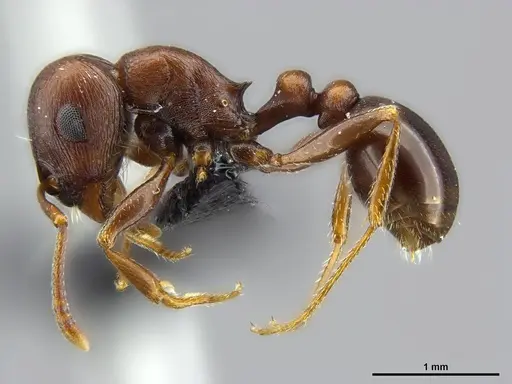
Tetramorium glabratum is a small reddish ant measuring around 5mm in total length, belonging to the Tetramorium solidum species group [1]. Workers have a distinctive appearance with short, broad propodeal spines (the pointed projections on their back) that are triangular and acute, unlike the long narrow spines seen in the similar-looking T. rufescens species [1][2]. The ant's body is mostly smooth and glossy with a dull red coloration, and notably lacks the stiff hairs (pilosity) on the upper surface of its mesosoma and first abdominal segment that many related species have [1].
This species is a seed harvester ant native to the arid regions of southern Africa, specifically found in South Africa's Northern Cape and Western Cape provinces as well as Namibia [1][2]. The species inhabits some of the driest environments in southern Africa, including the Nama Karoo, Succulent Karoo, and the Namib Desert [1]. Despite being a described species since 1923,almost nothing is known about the biology, colony structure, or captive care requirements of this ant, making it a true mystery species for antkeepers.
Quick Summary
- Difficulty: Unknown, biology unstudied
- Origin & Habitat: South Africa (Northern Cape, Western Cape) and Namibia. Inhabits arid to semi-arid regions including Nama Karoo, Succulent Karoo, and Namib Desert [1].
- Colony Type: Unconfirmed, colony structure has not been studied in this species. Most Tetramorium species are monogyne (single queen) colonies, but this is unconfirmed for T. glabratum.
- Size & Growth:
- Queen:{.size-link} Undescribed, no queen measurements available [1][2]
- Worker:{.size-link} 5.0-5.7mm total length, HL 1.04-1.14mm, HW 1.03-1.09mm [1][2]
- Colony: Unknown, no colony size data available
- Growth: Unknown, no development data exists
- Development: Unknown, no direct observations of development. Based on typical Tetramorium patterns, expect 6-10 weeks at warm temperatures, but this is an estimate. (No published data on egg-to-worker development time. Related Tetramorium species typically develop in 6-8 weeks at optimal temperatures.)
- Antkeeping:
- Temperature: Based on arid habitat (Nama Karoo, Namib Desert), this species likely tolerates warm conditions. Start around 22-26°C with a gradient, similar to other southern African Tetramorium species.
- Humidity: Low to moderate, these ants come from arid environments. Keep nest substrate moderately dry with some moisture available. Avoid overly damp conditions.
- Diapause: Unknown, southern African ants from desert habitats may have reduced winter activity but likely do not require true hibernation like temperate species. More research needed.
- Nesting: Natural nesting is unstudied. Based on arid habitat, likely nests in soil or under stones. For captivity, standard test tubes or Y-tong nests work well. Provide a dry to moderately moist substrate.
- Behavior: Behavior is unstudied. As a seed harvester ant, likely forages for seeds and small insects. Escape risk is moderate, workers are about 5mm so standard barriers are effective. Temperament is unknown but most Tetramorium are not aggressive.
- Common Issues: biology is completely unstudied, all care recommendations are estimates based on related species, colony structure unknown, may be single or multi-queen, no data on founding behavior, assume claustral like other Tetramorium, no information on nuptial flight timing, no documented diet preferences in captivity
Identification and Appearance
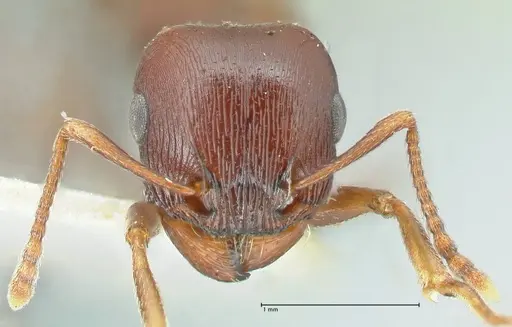
Tetramorium glabratum workers are small ants measuring approximately 5.0-5.7mm in total length [1]. They have a distinctive reddish coloration and a relatively smooth, glossy appearance. The most distinguishing feature is their short, broad propodeal spines (the spines on the rear of their mesosoma) which are triangular with a broad base and acute tip, this contrasts sharply with the long, narrow spines seen in the similar species T. rufescens [1][2]. The species also lacks the stiff standing hairs (pilosity) on the upper surface of the mesosoma and first gastral segment that many related ants possess [1]. The head is finely longitudinally rugulose (has fine lengthwise ridges), and the dorsal surfaces of the alitrunk, petiole, postpetiole and first gastral tergite are hairless [1].
Natural Habitat and Distribution
This species is native to the arid and semi-arid regions of southern Africa, specifically found in South Africa's Northern Cape and Western Cape provinces as well as Namibia [1][2]. The species inhabits three distinct desert and karoo biomes: the Nama Karoo (a semi-arid grassland and shrubland ecoregion), the Succulent Karoo (known for its diverse succulent flora), and the Namib Desert (one of the oldest deserts in the world) [1]. This distribution across extremely dry environments suggests the species is well-adapted to arid conditions with limited water availability. The habitat information indicates these ants prefer dry to very dry conditions, something to keep in mind for captive care.
Taxonomic Context
Tetramorium glabratum belongs to the Tetramorium solidum species group, a collection of seed-harvester ants native to southern Africa [1]. The species was originally described as a subspecies of T. solidum by Stitz in 1923,then raised to full species status by Bolton in 1980 [1]. It was also previously known as Tetramorium glabratum (described by Prins in 1973), which is now recognized as a junior synonym [1]. The species can be distinguished from its closest relative T. rufescens by the shape of its propodeal spines: T. glabratum has short, broad spines (propodeal spine length index PSLI 4-8) while T. rufescens has long, narrow spines (PSLI 16-23) [1].
Feeding and Diet
As a member of the Tetramorium solidum group, this species is classified as a seed harvester ant [1]. In nature, they likely collect and store seeds as a primary food source, similar to other seed-harvesting ants in this group. However, no specific observations exist on their diet in the wild or in captivity. Based on general Tetramorium biology, they are likely omnivorous and probably supplement their seed diet with small insects and other arthropods. For captive care, you should offer a mix of seeds (grass seeds, millet, dandelion seeds) and protein sources (small insects like fruit flies, mealworms, or crickets). Sugar water or honey may also be accepted. Start with seeds as a primary food and add protein sources to test acceptance.
Temperature and Care
Because this species comes from arid environments in southern Africa (Nama Karoo, Succulent Karoo, Namib Desert), it likely prefers warmer and drier conditions than many common pet ant species [1]. For captive care, aim for a temperature range of 22-28°C in the nest area, with a slight gradient allowing workers to choose their preferred temperature. These ants should be kept relatively dry, avoid the damp conditions preferred by tropical species. Use a test tube setup or Y-tong nest with moderately moist but not wet substrate. Provide a shallow water source. Since nothing is known about their exact requirements, observe your colony's behavior and adjust conditions accordingly, if workers cluster in warmer areas, increase temperature slightly, if they avoid heat, reduce it.
Nesting in Captivity
The natural nesting behavior of Tetramorium glabratum has not been documented. However, given their arid habitat and classification as seed harvesters, they likely nest in soil or under stones in the wild. For captive housing, standard test tube setups work well for founding colonies. Once established, you can transition to a Y-tong (acrylic) nest or a naturalistic setup with soil substrate. Keep the nest relatively dry, these are desert-adapted ants that likely prefer conditions drier than most captive ant setups. A small chamber or test tube with a water reservoir at one end (maintaining moderate humidity) is a good starting point. Allow the substrate to dry partially between water additions. [1]
Colony Structure and Founding
The colony structure of Tetramorium glabratum has not been studied, we simply do not know whether they form single-queen (monogyne) or multi-queen (polygyne) colonies [1][2]. Most Tetramorium species studied are monogyne, but this cannot be confirmed for T. glabratum. Similarly, founding behavior is unconfirmed. Most Tetramorium are claustral, meaning the queen seals herself in a chamber and raises her first workers using stored body fat without leaving to forage. Assume claustral founding for now. The first workers (nanitics) will be smaller than mature workers. Colony growth rate is unknown, seed harvesters typically grow more slowly than predatory species. Be patient with new colonies.
Frequently Asked Questions
How long does it take for Tetramorium glabratum to raise first workers?
The development time from egg to first worker is unknown, no research exists on this species. Based on typical Tetramorium patterns, expect approximately 6-10 weeks at warm temperatures (24-26°C). However, this is an estimate only, as no direct observations have been published for this species.
What do Tetramorium glabratum ants eat?
As seed harvesters, they likely primarily collect seeds in the wild. For captive care, offer a mix of small seeds (millet, grass seeds, dandelion seeds) and protein sources (small insects like fruit flies or tiny mealworms). Sugar water or honey may also be accepted. Start with seeds and observe what they accept.
Are Tetramorium glabratum good for beginners?
This species cannot be recommended for beginners because its biology is completely unstudied. No information exists on colony structure, founding behavior, temperature preferences, or humidity requirements. If you want to keep this species, be prepared to experiment with care conditions and document your observations carefully.
Do Tetramorium glabratum ants sting?
Tetramorium ants have a functional stinger in the Myrmicinae subfamily. However, no specific information exists on whether this species stings or its pain level. Given their small size (around 5mm), any sting would likely be mild.
What temperature should I keep Tetramorium glabratum at?
Based on their arid habitat in southern Africa (Nama Karoo, Namib Desert), they likely prefer warm, dry conditions. Start with a range of 22-28°C in the nest area with a slight gradient. Observe your colony, if they cluster near warmer areas, increase temperature slightly.
Can I keep multiple queens together?
The colony structure of this species is unknown. No research exists on whether they are single-queen (monogyne) or multi-queen (polygyne) colonies. Until more is known, it is not recommended to combine unrelated queens.
How big do Tetramorium glabratum colonies get?
Colony size is unknown, no published data exists on maximum colony size for this species. As seed harvesters, they likely form moderate-sized colonies, but exact numbers are unconfirmed.
Do Tetramorium glabratum need hibernation?
Diapause requirements are unknown. This species comes from southern Africa's arid regions, which have mild winters. They likely do not require true hibernation like temperate species. More research is needed.
What humidity level do Tetramorium glabratum need?
Based on their arid habitat (Nama Karoo, Succulent Karoo, Namib Desert), they prefer dry to moderately dry conditions. Keep nest substrate moderately moist but not damp. Avoid the high humidity levels needed by tropical species.
When do Tetramorium glabratum have nuptial flights?
Nuptial flight timing is unknown, no observations have been published. The timing would likely occur during the warmer months in their native range (roughly October to March in the southern hemisphere).
Is Tetramorium glabratum aggressive?
No specific information exists on the temperament of this species. Most Tetramorium are not particularly aggressive and are considered docile. However, this is an inference from related species rather than documented behavior for T. glabratum specifically.
What size nest do I need for Tetramorium glabratum?
Workers are approximately 5mm in size, so standard ant keeping setups work well. Use test tubes for founding colonies, then transition to a Y-tong or acrylic formicarium as the colony grows. No specific chamber size requirements exist, provide appropriately scaled passages.
Report an Issue
The current care sheet is based fully on literature. See inconsistencies, or something that's incorrect? Please , it will be resolved after review from an admin. Contributing to the blogs tab also helps providing information, to make us be able to further improve the caresheets. Thank you for your support!
References

This caresheet is licensed under CC BY-SA 4.0 .
FOCOL2085
View on AntWeb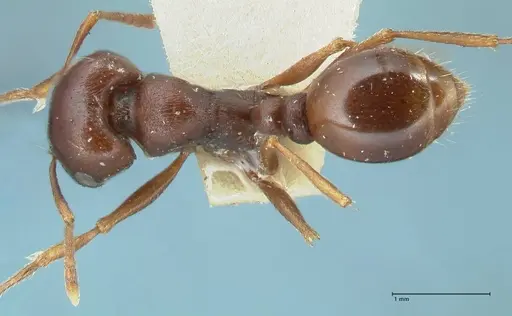
SAM-HYM-C024395
View on AntWeb
Literature
Loading...Loading products...