

Tetramorium barbigerum
- Scientific Name
- Tetramorium barbigerum
- Tribe
- Crematogastrini
- Subfamily
- Myrmicinae
- Author
- Bolton, 1980
- Distribution
- Found in 1 countries
Tetramorium barbigerum Overview
Tetramorium barbigerum is an ant species of the genus Tetramorium. It is primarily documented in 1 countries , including Namibia. Detailed taxonomic data and occurrence records can be further explored via authoritative databases such as AntWeb or the Global Biodiversity Information Facility (GBIF).
Tetramorium barbigerum
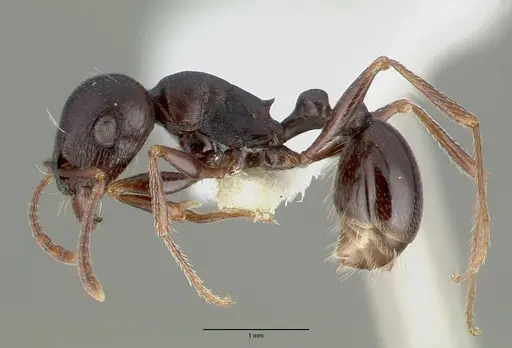
Tetramorium barbigerum is a small to medium-sized ant species belonging to the Myrmicinae subfamily, part of the Tetramorium solidum group of seed-harvesting ants. Workers measure 4.8-5.4mm in total length, with a distinctive black coloration that sets them apart from related reddish species in the region [1]. The species is easily recognized by its head shape, which narrows in front of the eyes rather than being uniformly broad, a trait shared only with its closest relatives T. jordani and T. signatum [1]. This ant is known only from a single collection location in Namibia, making it one of the most geographically restricted Tetramorium species in southern Africa [1][2].
What makes T. barbigerum particularly interesting is its extreme rarity in the ant-keeping hobby. As a species only documented from its type locality in Namibia, there is virtually no captive breeding history or established care protocols. The solidum group species are seed harvesters, suggesting this ant likely collects and processes seeds as a food source, though direct observations of foraging behavior are lacking. The presence of propodeal spines and the distinctive head sculpture (feeble cephalic sculpture fading at eye level) are key identification features that also hint at its behavioral ecology [1].
Quick Summary
- Difficulty: Expert
- Origin & Habitat: Native to Namibia in the Afrotropical region, specifically known only from the type locality near Okombahe, approximately 16km west of the town at 920m elevation [1]. The natural habitat would be typical Namibian savanna or arid woodland, though no specific habitat data exists for this species.
- Colony Type: Unknown, colony structure has not been documented. Most Tetramorium species are monogyne (single queen), but this cannot be confirmed for T. barbigerum.
- Size & Growth:
- Queen: Undocumented, no queen measurements available [1][2]
- Worker: 4.8-5.4mm total length, HL 1.214-1.266mm, HW 1.201-1.240mm, WL 1.227-1.356mm [1]
- Colony: Unknown, no colony size data available
- Growth: Unknown, no development data exists for this species
- Development: Unknown, no direct observations. Based on typical Tetramorium patterns, estimate 6-10 weeks at optimal temperature, but this is a rough guess. (Development timeline is entirely unstudied. Related species in the solidum group may provide rough estimates, but no species-specific data exists.)
- Antkeeping:
- Temperature: Inferred from Namibian origin: likely prefers warm conditions in the range of 22-28°C. Namibia experiences high temperatures, so this species likely tolerates and prefers warmer temperatures than European Tetramorium species.
- Humidity: Likely prefers dry to moderate conditions typical of arid Namibia. Provide a gradient with a moist nesting area and drier foraging area. Avoid overly humid conditions.
- Diapause: Unknown, no data on overwintering requirements. Namibia has mild winters, so this species may not require a true diapause. Observe colony behavior for seasonal slowdowns.
- Nesting: No specific nesting data exists. Based on related solidum-group species, likely nests in soil or under stones in arid habitats. A naturalistic setup with soil substrate or a Y-tong/plaster nest with moderate moisture would be appropriate starting points.
- Behavior: No behavioral observations have been documented in scientific literature. As a seed harvester in the solidum group, likely forages for seeds and small insects. Escape risk is moderate given worker size around 5mm, standard barrier precautions recommended. Temperament is unknown but most Tetramorium are not particularly aggressive.
- Common Issues: This species has never been kept in captivity, there are no established care protocols or success stories to reference, No biological data exists for this ant, making all care recommendations speculative, Wild-caught colonies may be the only option, but the species is only known from a single remote location in Namibia, Extremely limited availability, this species is essentially unavailable to antkeepers, Any colony obtained would likely be from scientific collections, not commercial sources
Identification and Distinction
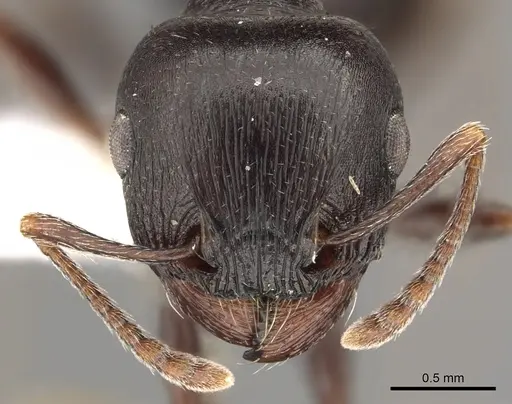
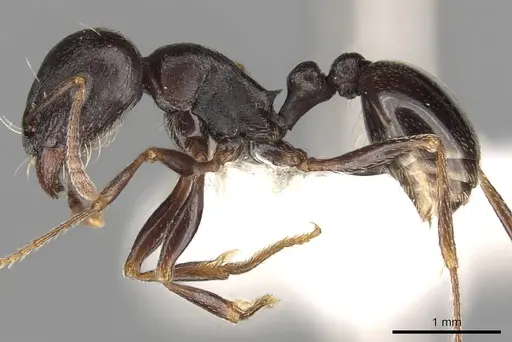
Tetramorium barbigerum can be identified by several key morphological features. The most distinctive is the head shape: narrower in front of the eyes than behind, a trait that separates it from most other Tetramorium species [1]. Workers are uniformly blackish-brown in color, with lighter appendages, and measure 4.8-5.4mm total length [1]. The propodeum (the section behind the waist) bears short but distinct spines (PSLI 7-8), which help distinguish it from T. jordani, a close relative that lacks propodeal spines entirely [1]. Unlike T. signatum, which has much stronger cephalic sculpture, T. barbigerum has feeble sculpture that fades at the level of the eyes, replaced by fine punctation [1]. Erect hairs are absent from the dorsal alitrunk (middle body section), petiole, and postpetiole, a feature shared with its close relatives in the solidum group [1].
Distribution and Rarity
This species is known only from a single collection event at the type locality near Okombahe, Namibia, approximately 16km west of the town at an elevation of 920 meters [1]. The original specimens were collected in May 1958 by R.E. Ross and R.E. Leech [1]. No additional records exist in scientific literature, making this one of the most poorly known and geographically restricted Tetramorium species in southern Africa [1][2]. The Namibian environment at this location would be characterized by arid savanna with extreme temperature variations. This extreme rarity means the species has never been documented in the ant-keeping hobby, and no captive populations are known to exist.
Taxonomic Context
Tetramorium barbigerum belongs to the Tetramorium solidum group, a cluster of closely related species endemic to southern Africa [1]. The solidum group consists of seed-harvesting ants that share certain morphological characteristics. Within this group, T. barbigerum is most closely related to T. jordani, T. signatum, and T. pogonion [1]. These species are all black in color and lack erect hairs on the mesosoma, but can be distinguished by head shape, propodeal spine development, and sculpture intensity [1]. The genus Tetramorium is one of the most species-rich ant genera globally, with numerous species across Africa, Asia, and other regions.
Keeping Considerations
Keeping Tetramorium barbigerum in captivity presents extreme challenges, primarily because no care information exists and the species is essentially unavailable. If a colony were to become available (likely only through scientific collections), care would need to be inferred from related species and Namibian conditions. Provide warm temperatures (22-28°C), moderate to low humidity reflecting arid conditions, and a nesting setup with soil or plaster. As seed harvesters, they likely accept seeds alongside protein sources like small insects. However, every aspect of their care would be experimental. This species is not recommended for any keeper except those with specific scientific interest and ability to obtain rare specimens through proper channels. The complete lack of captive data means any keeping attempt would be pioneering work with no established protocols to follow.
Related Species in the Solidum Group
The Tetramorium solidum group contains several species that may be more commonly available to antkeepers. T. jordani lacks propodeal spines entirely (PSLI 1-2 versus 7-8 in T. barbigerum) and has a broader head [1]. T. signatum has much stronger cephalic sculpture [1]. T. pogonion is smaller (HW 0.86-0.92mm) with relatively larger eyes [1]. Other species in the group include T. rufescens and T. glabratum, which are red in color and unlikely to be confused with the black T. barbigerum [1]. For antkeepers interested in the solidum group, these more common relatives may be better candidates, as they have more established care histories and are more likely to be available.
Frequently Asked Questions
Is Tetramorium barbigerum available for purchase?
No, this species is essentially unavailable to antkeepers. It is only known from a single collection in Namibia in 1958 and has never been documented in the ant-keeping hobby. No commercial sources or captive-bred colonies exist.
How do I care for Tetramorium barbigerum?
No care protocols exist for this species. Any recommendations would be entirely speculative, based on related species and Namibian habitat conditions. This is not a species for hobbyist keeping, it remains a scientific curiosity with no captive history.
What does Tetramorium barbigerum look like?
Workers are 4.8-5.4mm, uniformly blackish-brown with lighter appendages. The most distinctive feature is the head shape, narrower in front of the eyes than behind. It has short propodeal spines and lacks erect hairs on the mesosoma [1].
Where does Tetramorium barbigerum live?
Only known from Okombahe, Namibia, a single location in southern Africa. The type locality is approximately 16km west of Okombahe at 920m elevation [1].
Can I keep multiple queens together?
Unknown, colony structure has never been documented for this species. Most Tetramorium are monogyne (single queen), but this cannot be confirmed for T. barbigerum.
How long does it take for eggs to become workers?
Unknown, no development data exists for this species. Related Tetramorium species typically take 6-10 weeks from egg to worker at optimal temperatures, but this is a rough estimate with no species-specific data.
Does Tetramorium barbigerum need hibernation?
Unknown, no data on overwintering requirements. The Namibian climate is mild, so this species may not require a true diapause. However, this is entirely unstudied.
What do Tetramorium barbigerum ants eat?
Likely seed harvester like other species in the solidum group, but no direct observations exist. Probably accepts seeds and small insects. Sugar sources may also be accepted. This is entirely inferred, not observed.
Is Tetramorium barbigerum aggressive?
Unknown, no behavioral observations have been documented. Most Tetramorium species are not particularly aggressive, but this cannot be confirmed for this specific species.
Are there similar species that are easier to keep?
Yes, other species in the Tetramorium solidum group like T. jordani, T. signatum, or T. pogonion may be more available. These related species share similar morphology and likely ecology but have more documented distributions.
References

This caresheet is licensed under CC BY-SA 4.0 .
CASENT0901181
View on AntWeb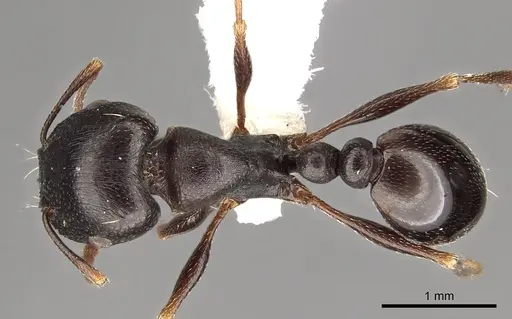
CASTYPE13386
View on AntWeb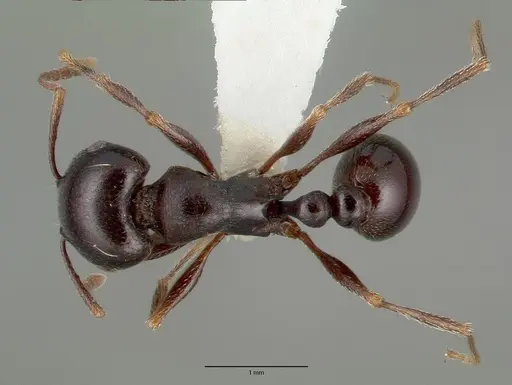

Literature
Loading...Loading products...