

Stigmatomma mulanae
- Scientific Name
- Stigmatomma mulanae
- Tribe
- Amblyoponini
- Subfamily
- Amblyoponinae
- Author
- Xu, 2000
- Distribution
- Found in 1 countries
Stigmatomma mulanae Overview
Stigmatomma mulanae is an ant species of the genus Stigmatomma. It is primarily documented in 1 countries , including China. Detailed taxonomic data and occurrence records can be further explored via authoritative databases such as AntWeb or the Global Biodiversity Information Facility (GBIF).
Stigmatomma mulanae
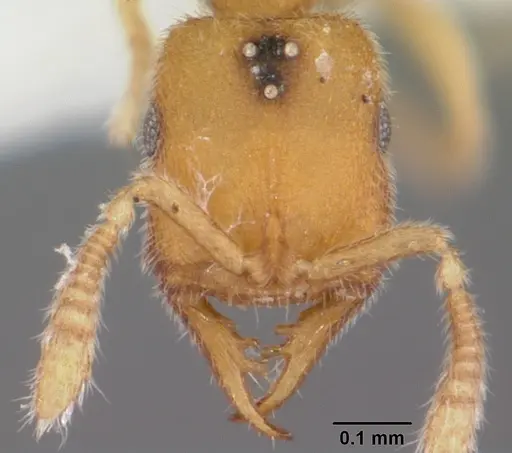
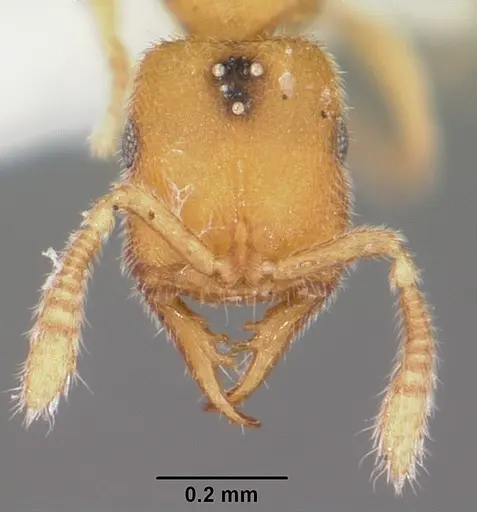
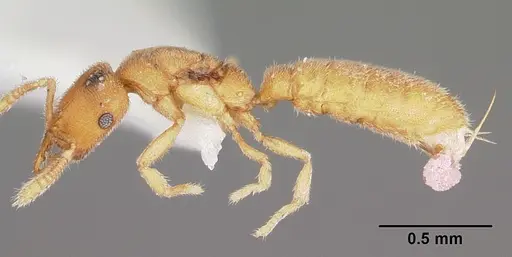
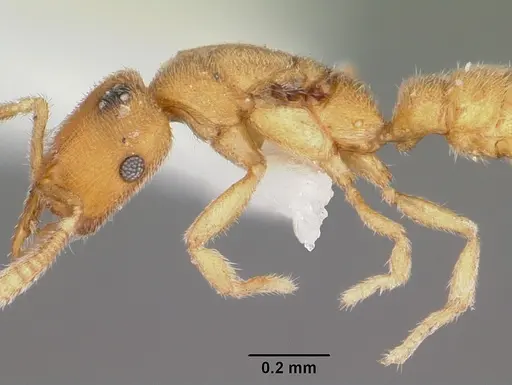
Stigmatomma mulanae is an extremely rare ant species known only from a single queen specimen collected in southern Yunnan Province, China [1]. The queen is tiny at just 2.1mm total length, with a yellowish-brown body, black eyes and ocelli, and distinctive rectangular head (head index 84) [1][2]. The species was originally described as Stigmatomma mulanae in 2000 and later transferred to Stigmatomma in 2016 [3]. What makes this species particularly interesting is its unique mandibular structure, the jigsaw tab-shaped median teeth are shared with only one other species, S. luyiae [4]. Workers and males have never been collected, meaning this species remains essentially unknown to science despite being described over two decades ago.
Quick Summary
- Difficulty: Expert
- Origin & Habitat: Known only from Manzhuang Village, Mengla County, Yunnan Province, China at 900m altitude in semi-evergreen monsoon forest [1][2]. This is a tropical to subtropical forest environment in southwestern China.
- Colony Type: Unknown, only the queen has been collected. No workers or colony structure has ever been observed.
- Size & Growth:
- Queen: 2.1 mm total length,0.38 mm head length,0.32 mm head width [1]
- Worker: Unknown, worker caste has never been collected
- Colony: Unknown, no colony data exists
- Growth: Unknown
- Development: Unknown, no development data exists for this species (No brood development has ever been observed. Related Stigmatomma species may provide rough estimates but this species remains unstudied.)
- Antkeeping:
- Temperature: Likely 20-26°C based on habitat (tropical/semi-evergreen forest at 900m). No direct data exists, start in the mid-range and observe colony activity.
- Humidity: Likely 60-80% based on monsoon forest habitat. Provide moist substrate without waterlogging.
- Diapause: Unknown, no seasonal data exists for this species
- Nesting: Unknown, collected from soil sample. Related species nest in soil, rotting wood, or under stones. Use test tube or naturalistic setup with moist substrate.
- Behavior: Completely unknown, no behavioral observations exist for this species. Based on genus placement in Amblyoponinae, likely predatory on small invertebrates. Has a functional sting [1]. Escape risk unknown due to lack of worker observations.
- Common Issues: No biological data exists, this is essentially a ghost species with no captive husbandry information, Worker caste has never been described, you cannot obtain workers, Colony founding behavior is completely unconfirmed, Related Amblyoponinae species can be aggressive defenders with functional stings, use caution, This species may have specialized requirements unknown to science
Species Overview and Identification
Stigmatomma mulanae is one of the most poorly known ant species in the world, known only from a single dealate (wingless) queen collected in 1998 from Yunnan Province, China [1]. The queen measures just 2.1mm in total length, making it a very small ant [1]. Its most distinctive feature is the jigsaw tab-shaped median mandibular teeth, which it shares with only one other species, Stigmatomma luyiae from Taiwan [4]. The species was originally described in the genus Bannapone but was transferred to Stigmatomma in 2016 when genetic analysis revealed its true phylogenetic placement [3]. The queen can be identified by its rectangular head (head index 84),11-segmented antennae, three-toothed mandibles, and yellowish-brown body coloration with black eyes and ocelli [1][2].
Distribution and Habitat
This species is known only from Manzhuang Village in Mengla County, Yunnan Province, China, collected at an elevation of 900 meters [1][2]. The type locality is semi-evergreen monsoon forest, a tropical to subtropical forest type characterized by seasonal rainfall patterns [1]. This represents the entire known range of the species, it has never been collected anywhere else despite targeted ant surveys in the region [5]. The elevation of 900m suggests it may occur in montane tropical forest habitats. Nothing is known about its microhabitat preferences beyond being collected from a soil sample [1].
What We Don't Know
This is perhaps the most important section for any prospective keeper: Stigmatomma mulanae is essentially unknown to science. Workers have never been collected, the worker caste remains completely undescribed [1][6]. Males have never been observed. No colony has ever been found. No behavioral observations exist in the scientific literature. We have no information on founding behavior, diet, temperature preferences, humidity needs, nuptial flight timing, or any aspect of its biology [1]. This is not a case of limited data, this species has simply never been studied in the wild or in captivity. Any care recommendations for this species would be pure speculation based on related species. There is no established husbandry information in the antkeeping hobby for this species.
Related Species and Inferred Care
While we have no direct data on S. mulanae, we can look to related species in the Amblyoponinae subfamily for rough guidance. The genus Stigmatomma contains predatory ants that typically hunt small invertebrates [4]. Amblyoponinae ants are known for their unusual colony structures, with some species using gamergates (reproductive workers) rather than dedicated queens [3]. Many Amblyoponinae species are semi-claustral founders, meaning the queen leaves the nest to forage during colony founding. However, these are broad generalizations, S. mulanae may differ significantly. If you somehow obtained a founding queen, you would need to treat it as an experimental species and document your observations carefully. Do not expect established care protocols to work.
Legal and Ethical Considerations
Stigmatomma mulanae is known only from a single location in China and has never been found since its original collection in 1998 [5]. It may be extremely rare or potentially endangered. Any collection would require appropriate permits from Chinese authorities. The species is not established in the antkeeping hobby, and no legitimate source exists for purchasing workers or colonies. Be extremely cautious of any claims to offer this species for sale, they are almost certainly misidentified or illegally collected. Instead of seeking this ghost species, consider keeping better-known Amblyoponinae species like Stigmatomma sila or related genera that have established husbandry protocols.
Frequently Asked Questions
Can I keep Stigmatomma mulanae ants?
No. This species is essentially unknown to science, workers have never been collected, and no colony has ever been found [1]. There is no established husbandry information, and no legitimate source exists for obtaining this species. Even if you obtained a queen, there would be no guidance on how to successfully raise it.
Where can I buy Stigmatomma mulanae?
You cannot. This species has never been found since the original single queen specimen in 1998 [5]. No colony has ever been collected, and no antkeeping hobbyist or breeder has ever kept this species. Any vendor claiming to sell S. mulanae is almost certainly misidentifying another species or operating illegally.
What does Stigmatomma mulanae eat?
Unknown, no feeding observations have ever been recorded for this species [1]. Based on genus placement in Amblyoponinae, it is likely predatory on small invertebrates like related Stigmatomma species, but this is pure speculation.
How long do Stigmatomma mulanae queens live?
Unknown, no colony has ever been established, so no lifespan data exists. Even the original queen specimen was not maintained in captivity.
Do Stigmatomma mulanae ants sting?
Yes, the queen has a functional sting [1]. However, workers have never been observed, so we cannot confirm whether workers also possess a functional sting. Based on related Amblyoponinae species, workers likely can sting and may use it for defense.
What is the colony size of Stigmatomma mulanae?
Unknown, no colony has ever been found or studied [1]. We have no data on colony size, growth rate, or social structure. The entire scientific knowledge of this species consists of one queen specimen.
Are Stigmatomma mulanae good for beginners?
No. This species is not suitable for any keeper, it has never been kept in captivity, workers have never been described, and no care information exists. Even expert antkeepers would have no guidance for this species. Consider better-documented species instead.
What temperature do Stigmatomma mulanae ants need?
Unknown, no temperature data exists for this species [1]. The type locality in Yunnan at 900m elevation in semi-evergreen monsoon forest suggests a tropical to subtropical climate, likely 20-26°C. However, this is a rough estimate with no experimental validation.
Do Stigmatomma mulanae need hibernation?
Unknown, no seasonal data exists for this species [1]. The monsoon forest habitat suggests year-round activity, but without any observations, we cannot confirm whether they have a dormant period.
Why is Stigmatomma mulanae so rare?
We don't know. It may be genuinely rare, it may have a very restricted range, or it may simply have been overlooked. The fact that only one specimen has been collected in over 25 years of searching suggests it is either extremely localized or difficult to collect [5].
References

This caresheet is licensed under CC BY-SA 4.0 .
CASENT0104980
View on AntWeb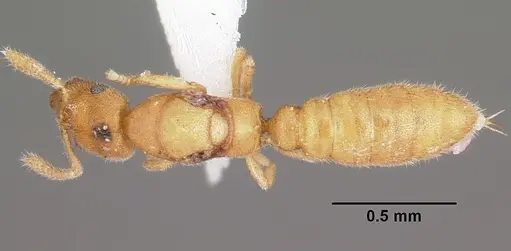
Literature
Loading...Loading products...