

Romblonella liogaster
- Scientific Name
- Romblonella liogaster
- Tribe
- Crematogastrini
- Subfamily
- Myrmicinae
- Author
- Santschi, 1928
- Distribution
- Found in 1 countries
Romblonella liogaster Overview
Romblonella liogaster is an ant species of the genus Romblonella. It is primarily documented in 1 countries , including Fiji. Detailed taxonomic data and occurrence records can be further explored via authoritative databases such as AntWeb or the Global Biodiversity Information Facility (GBIF).
Romblonella liogaster
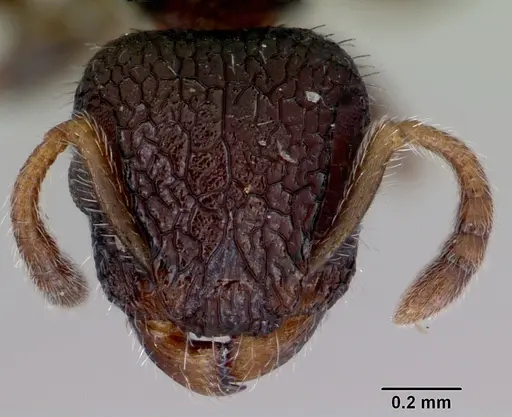
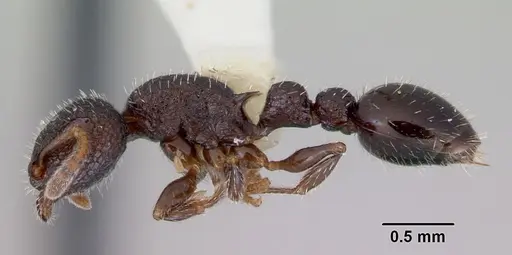
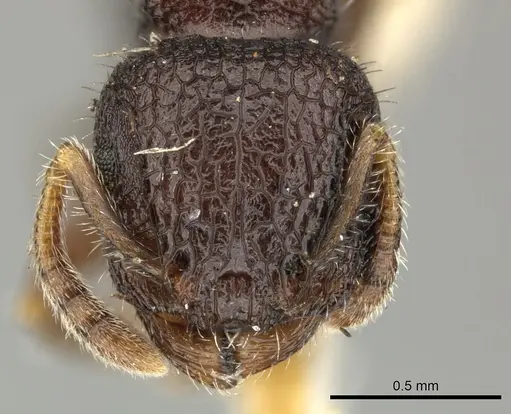
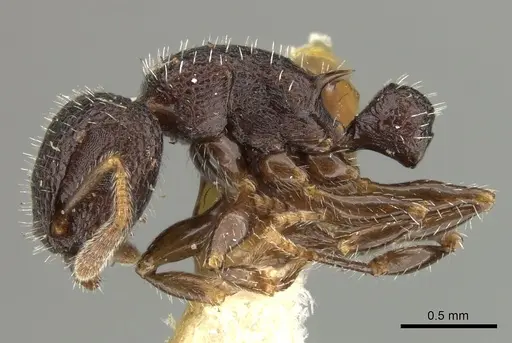
Romblonella liogaster is a robustly built medium-sized ant endemic to Fiji, easily recognized by its subquadrate petiole, strongly arching mesosoma, deeply excavated antennal scrobes, and evenly distributed stout white hairs that are shorter than the length of its eye [1]. Workers have a smooth dorsum on the first gastral tergite and feature a simple sting, with sculpture on the head and mesosoma that can resemble dark Tetramorium species like T. pacificum and T. manni [1][2]. This species was originally described as a variety of Romblonella scrobifera by Santschi in 1928,later raised to full species status by Sarnat and Economo in 2012,and is now known to be a senior synonym of Romblonella liogaster [1]. The closest relatives of R. liogaster are found in New Guinea, New Britain, Queensland, and the Solomon Islands, suggesting it belongs to a group of Pacific island species [1].
Quick Summary
- Difficulty: Unknown
- Origin & Habitat: Endemic to Fiji, specifically recorded from the Lau Group, Vanua Balevu, Wakaya Island, and Ovalau in the Ovalau group [1][3][4]. The original specimens were collected during a 1924 expedition to the archipelago [1]. This is a poorly known species with limited collection data.
- Colony Type: Unconfirmed colony structure. No published data on whether this species forms single-queen or multi-queen colonies.
- Size & Growth:
- Queen: Unknown, no specific measurements available
- Worker: Medium-sized ant (specific measurements not provided in available literature) [1]
- Colony: Unknown, no colony size data available
- Growth: Unknown
- Development: Unknown, no development data available for this species (Development timeline unconfirmed. Based on typical Myrmicinae patterns from similar tropical Pacific island species, expect 4-8 weeks at optimal temperature, but this is an estimate.)
- Antkeeping:
- Temperature: Based on Fiji habitat (tropical Pacific), keep warm at 24-28°C. This is an estimate based on similar tropical Myrmicinae.
- Humidity: Based on Fiji's humid tropical climate, maintain moderate to high humidity around 70-80%. Provide a moist substrate.
- Diapause: Unlikely, as a tropical species from Fiji, diapause is probably not required. This is an estimate.
- Nesting: No specific nesting data available. In captivity, typical Myrmicinae setups like test tubes, Y-tong nests, or plaster nests would likely be appropriate. Provide moist substrate.
- Behavior: Behavior is poorly documented. As a Myrmicinae species, they likely have a functional sting for defense. Medium-sized ants with simple sting morphology [1]. Escape prevention should be moderate, these are not extremely small ants but standard Myrmicinae size. No specific aggression or foraging behavior data available.
- Common Issues: this species has never been documented in the antkeeping hobby, no care information exists, very limited scientific data makes it difficult to provide accurate care recommendations, endemic status means wild populations are small and localized, no information on founding behavior or colony development in captivity, diapause requirements are unknown for this tropical species
Species Background and Identification
Romblonella liogaster is a fascinating endemic ant from Fiji that was only recently recognized as a full species. Originally described by Santschi in 1928 as a variety of Romblonella scrobifera, it was later elevated to species status in 2012 by Sarnat and Economo in their comprehensive work on Fijian ants [1]. The species was also independently described as Romblonella liogaster by Smith in 1953,based on specimens collected from Wakaya Island, but this is now recognized as a junior synonym [1][3]. The ant is robustly built with distinctive features including a subquadrate petiole, strongly arching mesosoma, deeply excavated antennal scrobes, and evenly distributed stout white hairs [1]. The first gastral tergite is smooth, which helps distinguish it from close relatives [2]. In Fiji, this species can be confused with dark Tetramorium species like T. pacificum and T. manni due to similar rugoreticulate sculpture on the head, mesosoma, and waist [1].
Distribution and Rarity
Romblonella liogaster is endemic to Fiji, meaning it is found nowhere else in the world [3][4]. The species has been recorded from only a handful of locations: Vanua Balevu in the Lau Group, Wakaya Island near Ovalau, and Ovalau itself [1][3][4]. The original specimens were collected by E.H. Bryan during a 1924 expedition to the archipelago [1]. Notably, Sarnat and Economo (2012) were unable to find this species in its type locality during their comprehensive Fiji ant survey, suggesting it may be quite rare or localized in its natural habitat [2]. Only three museum specimens are known: the type from Vanua Balevu, Smith's type of R. vitiensis from Wakaya, and a third specimen from Ovalau deposited at ANIC [1]. This limited distribution makes R. liogaster one of the rarest ant species in Fiji.
Housing and Nesting
No specific captive care information exists for Romblonella liogaster, as this species has never been documented in the antkeeping hobby. However, we can make educated guesses based on its classification as a Myrmicinae ant and its origin from tropical Fiji. A standard Myrmicinae setup would be appropriate, test tubes work well for founding colonies, while Y-tong or plaster nests suit established colonies. Keep the nest substrate consistently moist but not waterlogged, mimicking the humid conditions of its native habitat. Room temperature in most homes (20-24°C) may be suitable, though a slight increase to 24-28°C would better approximate its tropical origins. Ensure adequate ventilation to prevent mold while maintaining humidity.
Feeding and Diet
No specific dietary information exists for Romblonella liogaster. As a Myrmicinae ant, it likely has typical ant dietary preferences: protein sources (small insects, mealworms, fruit flies) and sugar sources (honey water, sugar water). In its native Fiji habitat, it would have access to typical forest floor prey and honeydew from aphids or scale insects. For captive colonies, offer protein-rich foods like small crickets, fruit flies, or mealworms, along with sugar water or honey as an energy source. Feed small amounts and remove uneaten prey within a day to prevent mold.
Temperature and Seasonal Care
As a tropical species endemic to Fiji, Romblonella liogaster likely experiences warm, humid conditions year-round. No diapause requirement has been documented, and none would be expected for a tropical ant species. Keep colonies at warm temperatures, ideally in the 24-28°C range. This can be achieved with a heating cable on one side of the nest to create a temperature gradient. Avoid temperatures below 20°C for extended periods. Humidity should be moderate to high, around 70-80%, which can be maintained by keeping the water reservoir in test tube setups full or using moist substrate in nests.
Behavior and Defense
Specific behavioral data for Romblonella liogaster is extremely limited. As a Myrmicinae ant, it possesses a simple sting which it can use for defense [1]. Workers are medium-sized and robustly built, suggesting they are capable of defending the colony. No data exists on aggression levels, foraging patterns, or activity levels. Based on related Romblonella species and typical Myrmicinae behavior, these ants likely forage on the ground and may be active during both day and night. The species' deeply excavated antennal scrobes suggest it may have specialized head morphology, though the behavioral significance of this is unknown.
Frequently Asked Questions
Is Romblonella liogaster available in the antkeeping hobby?
No, Romblonella liogaster has never been documented in the antkeeping hobby. This is an extremely rare endemic species from Fiji with very limited scientific collection data. It is not currently available from any known ant breeders.
Where does Romblonella liogaster live in the wild?
Romblonella liogaster is endemic to Fiji, found only on a few islands in the Lau Group and near Ovalau. Specimens have been collected from Vanua Balevu, Wakaya Island, and Ovalau [1][3][4].
How do I care for Romblonella liogaster?
No captive care information exists for this species. Based on its classification as a Myrmicinae ant from tropical Fiji, use a standard setup with warm temperatures (24-28°C), moderate to high humidity (70-80%), and typical Myrmicinae diet (protein insects + sugar sources). This is an educated estimate, not confirmed care requirements.
What does Romblonella liogaster look like?
Romblonella liogaster is a robustly built medium-sized ant with a subquadrate petiole, strongly arching mesosoma, deeply excavated antennal scrobes, and evenly distributed stout white hairs that are shorter than the length of its eye [1]. The first gastral tergite is smooth, and it has a simple sting [1][2].
How big do Romblonella liogaster colonies get?
Colony size data is not available for this species. Only three museum specimens have ever been collected [1]. Based on its medium worker size and rarity, colonies are likely small to moderate in size.
Does Romblonella liogaster need hibernation?
No, hibernation is unlikely required. As a tropical ant species from Fiji, it would not experience cold winters in its native habitat. Keep colonies at warm temperatures year-round.
Can I keep multiple queens together?
No data exists on colony structure for this species. The colony type (single-queen or multi-queen) has never been documented. Do not attempt combining unrelated queens without specific evidence this species tolerates pleometrosis.
Does Romblonella liogaster sting?
Yes, Romblonella liogaster has a simple sting, as it belongs to the Myrmicinae subfamily [1]. The sting's potency or pain level has not been documented.
How long does it take for Romblonella liogaster to develop from egg to worker?
Development timeline is completely unconfirmed for this species. No scientific data exists on egg-to-worker development time. Based on typical Myrmicinae patterns for tropical Pacific island species, estimate 4-8 weeks at optimal warm temperatures, but this is purely speculative.
Is Romblonella liogaster endangered?
No formal conservation status has been assessed. However, the species is extremely rare with a very limited distribution in Fiji and has rarely been observed since its original collection in 1924 [1][2].
References

This caresheet is licensed under CC BY-SA 4.0 .
CASENT0172277
View on AntWeb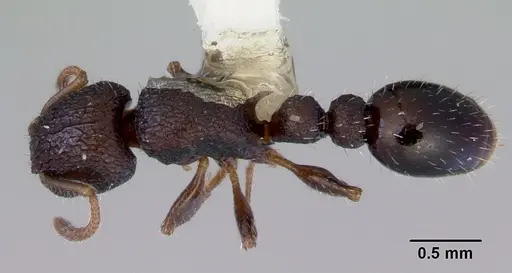
CASENT0249110
View on AntWeb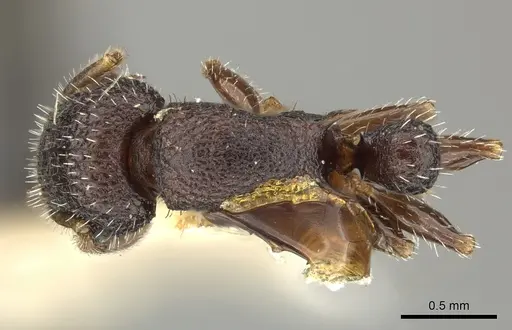
Literature
Loading...Loading products...