

Pristomyrmex hamatus
- Scientific Name
- Pristomyrmex hamatus
- Tribe
- Crematogastrini
- Subfamily
- Myrmicinae
- Author
- Xu & Zhang, 2002
- Distribution
- Found in 2 countries
Pristomyrmex hamatus Overview
Pristomyrmex hamatus is an ant species of the genus Pristomyrmex. It is primarily documented in 2 countries , including China, Lao People's Democratic Republic. Detailed taxonomic data and occurrence records can be further explored via authoritative databases such as AntWeb or the Global Biodiversity Information Facility (GBIF).
Pristomyrmex hamatus
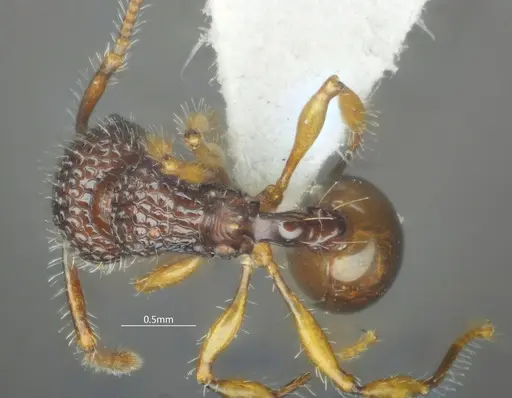
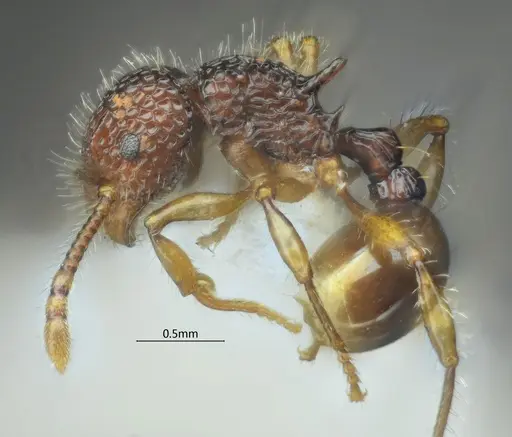
Pristomyrmex hamatus is a tiny myrmicine ant native to southern China. Workers measure just 3.2-3.4mm and have a distinctive reddish-brown to yellowish body with unusually long, curved propodeal spines that hook inward at the tips. Their mandibles feature a unique tooth on the inner margin that helps distinguish them from close relatives like Pristomyrmex punctatus. The head is nearly circular, and the body surface is coarsely sculptured with a reticulate pattern. These ants inhabit monsoon forests and limestone forest areas in Yunnan and Hainan provinces at elevations between 415-1029 meters.
Quick Summary
- Difficulty: Medium
- Origin & Habitat: Southern China, specifically Yunnan Province (including Gaoligong Shan mountains, Xishuangbanna area, and Menglun Town in Mengla County) and Hainan Province. They live in tropical and subtropical monsoon forests, including karst monsoon forest and semi-evergreen monsoon forest at elevations of 650-900m [1][2][3].
- Colony Type: Unconfirmed colony structure. Only known from worker specimens, queen caste has not been described.
- Size & Growth:
- Queen: Unknown, queen caste not yet described [1]
- Worker: 3.2-3.4mm [1]
- Colony: Unknown, only known from small worker series
- Growth: Unknown, likely moderate based on small worker size
- Development: Unknown, estimate 6-8 weeks based on typical Myrmicinae development at tropical temperatures (No direct development data exists for this species. Estimates based on related Pristomyrmex species and typical Myrmicinae development patterns.)
- Antkeeping:
- Temperature: Aim for 22-26°C, they inhabit tropical/subtropical monsoon forests and likely prefer warm, stable conditions. A gentle gradient allowing workers to self-regulate is ideal [2].
- Humidity: High humidity required, these ants live in damp forest environments. Keep nest substrate consistently moist but not waterlogged. Provide a water tube for drinking access.
- Diapause: Unlikely required, their native habitat in southern China and Hainan Province does not experience cold winters. They likely remain active year-round.
- Nesting: In captivity, they do well in test tube setups or small acrylic nests. Their tiny size means chambers should be appropriately scaled. They likely prefer dark, humid nesting sites similar to their forest floor habitat.
- Behavior: These are small, relatively docile ants that likely forage in the leaf litter layer. Their curved propodeal spines may serve a defensive function. They are not known to be aggressive and probably focus on small prey and honeydew. Their very small size means escape prevention is critical, they can squeeze through standard test tube cotton and tiny gaps in equipment.
- Common Issues: tiny size makes escape likely without fine mesh barriers and tight-fitting lids, no colony data means founding and early development may be challenging, high humidity needs can lead to mold if ventilation is poor, lack of species-specific care information means keepers must adapt from related species, wild-caught colonies may be difficult to locate as they are not common
Natural Habitat and Distribution
Pristomyrmex hamatus is known from two main regions in southern China: Yunnan Province and Hainan Province. In Yunnan, they have been collected from multiple locations including the Gaoligong Shan mountains and the Xishuangbanna area around Menglun Town. The type specimens came from karst monsoon forest at 660m elevation in Mengla County, with paratypes from both 650m and 900m elevations in semi-evergreen monsoon forest [1]. In Hainan Province, they were recently recorded from Wuzhishan and several nature reserves at elevations between 415-1029m [3].
These ants show a strong preference for natural forest environments. Research in Xishuangbanna found them only in primary and secondary forest, with an abundance of 5 in limestone forest and just 1 in rainforest, they were completely absent from rubber plantations [2]. This suggests they are sensitive to habitat disturbance and require intact forest floor microhabitats.
Identification and Distinguishing Features
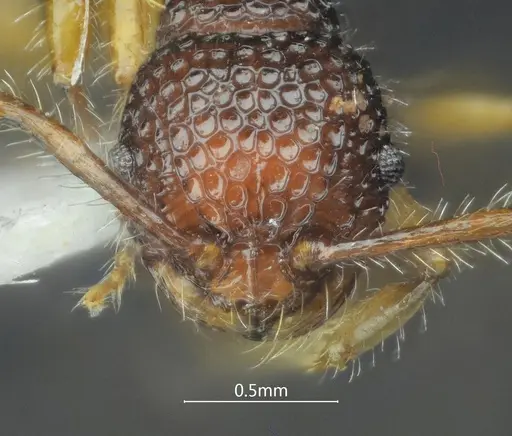
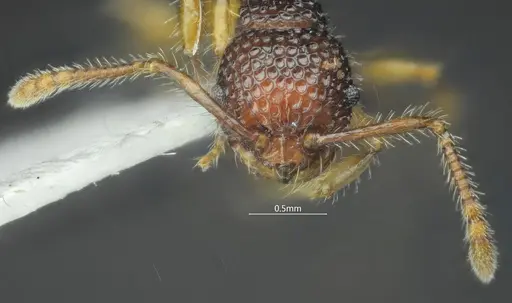
Pristomyrmex hamatus workers are tiny at just 3.2-3.4mm and can be identified by several distinctive features. The most notable are the long propodeal spines that curve inward at their tips, appearing hook-like when viewed from above. The mandible has a unique tooth in the center of its inner margin, this separates them from the similar Pristomyrmex punctatus which lacks this feature. The head is nearly circular, slightly longer than broad, with the occipital margin nearly straight but weakly indented in the middle.
The body coloration ranges from yellow to reddish brown, with the head and alitrunk (the middle body section) being coarsely foveolate (pitted) creating a reticulate or net-like surface texture. They have abundant erect long hairs on the head and alitrunk, and the antennal scapes extend past the occipital corner by about one-quarter of their length [1].
Housing and Nest Setup
For such tiny ants, appropriate housing is critical. Test tube setups work well for founding colonies, use a small test tube with a water reservoir sealed with cotton, providing humidity while allowing the ants to escape if conditions become too wet. The tube should be kept in a dark location to simulate their natural forest floor habitat.
Because of their very small size (3.2mm), escape prevention must be excellent. Standard cotton batting may allow workers to squeeze through, so consider using tighter barriers or fluon-coated rims. When the colony grows, a small acrylic nest or ytong nest with appropriately sized chambers will work well. Keep the nest humid but ensure some ventilation to prevent mold buildup.
A small outworld for foraging allows you to observe their hunting and feeding behaviors. Keep the entire setup in a temperature-controlled environment around 24°C. [1]
Feeding and Diet
While no specific dietary studies exist for P. hamatus, Pristomyrmex species are generally omnivorous. They likely forage for small prey in the leaf litter layer and probably tend aphids or scale insects for honeydew. In captivity, offer a varied diet including small live prey like fruit flies, pinhead crickets, or tiny insects. Sugar sources like honey water or sugar water are typically accepted.
Feed small amounts of protein (insects) several times per week, and keep a constant sugar source available. Remove uneaten prey after 24-48 hours to prevent mold. Given their tiny size, prey items should be appropriately small, flightless fruit flies or small mealworm pieces work well. [1]
Temperature and Seasonal Care
Based on their natural range in tropical and subtropical southern China, these ants prefer warm conditions around 22-26°C. They inhabit monsoon forests which experience warm temperatures year-round with seasonal rainfall. Unlike temperate species, they likely do not require a diapause or hibernation period.
Maintain stable temperatures without major fluctuations. A heating cable on one side of the nest can create a gentle gradient allowing the ants to self-regulate. Keep them away from direct sunlight and air conditioning vents. Room temperature in most homes should be suitable, but monitor during winter if your heating creates cold spots. [2][3]
Frequently Asked Questions
How long does it take for Pristomyrmex hamatus to produce first workers?
The egg-to-worker timeline is unconfirmed for this species. Based on typical Myrmicinae development at warm temperatures (24-26°C), estimate 6-8 weeks from egg to first worker. However, this is an educated guess rather than documented development data.
What do Pristomyrmex hamatus ants eat?
While not specifically studied, Pristomyrmex species are omnivorous. Feed small live insects (fruit flies, tiny crickets), and provide constant access to sugar sources like honey water or sugar water. They likely forage in leaf litter for small prey and may tend aphids for honeydew.
Can I keep Pristomyrmex hamatus in a test tube?
Yes, test tubes work well for this tiny species. Use a small test tube with a water reservoir. However, escape prevention is critical, their 3.2mm size means they can squeeze through standard cotton. Use tight-fitting barriers or fluon-coated rims.
Do Pristomyrmex hamatus ants need hibernation?
No, hibernation is not required. These ants inhabit tropical and subtropical southern China (Yunnan and Hainan provinces) which do not experience cold winters. Keep them at warm room temperature year-round.
How big do Pristomyrmex hamatus colonies get?
Colony size is unknown for this species. Based on their small worker size (3.2mm) and the typical Pristomyrmex pattern, colonies likely reach dozens to a few hundred workers rather than large supercolonies.
Are Pristomyrmex hamatus ants aggressive?
They are not known to be aggressive. These are small, docile ants that likely focus on foraging in leaf litter rather than defending large territories. However, they will defend their nest if threatened.
What temperature do Pristomyrmex hamatus need?
Keep them warm at 22-26°C. Their natural habitat in tropical monsoon forests is warm year-round. A gentle temperature gradient allows workers to choose their preferred zone.
Where is Pristomyrmex hamatus found in the wild?
They are native to southern China, specifically Yunnan Province (including Xishuangbanna and Gaoligong Shan mountains) and Hainan Province. They live in monsoon forests at elevations between 415-1029m.
How do I identify Pristomyrmex hamatus?
Look for tiny workers (3.2-3.4mm) with distinctive inward-curving hook-like propodeal spines. The mandible has a unique tooth on the inner margin, and the body is reddish-brown to yellow with coarse reticulate sculpturing.
Are Pristomyrmex hamatus good for beginners?
They are rated Medium difficulty. While small and relatively docile, the lack of species-specific care information and their tiny size requiring excellent escape prevention makes them better suited for keepers with some experience.
References

This caresheet is licensed under CC BY-SA 4.0 .
ANTWEB1060569
View on AntWeb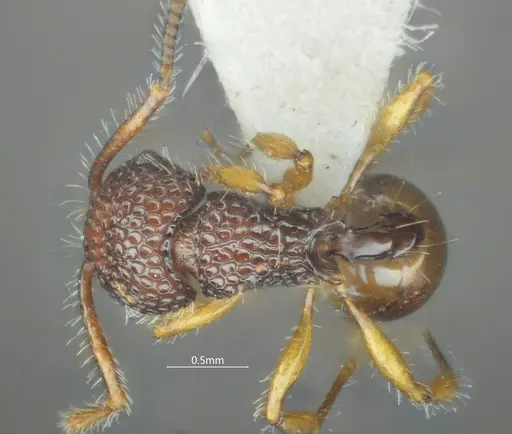
Literature
Loading...Loading products...