

Pristomyrmex collinus
- Scientific Name
- Pristomyrmex collinus
- Tribe
- Crematogastrini
- Subfamily
- Myrmicinae
- Author
- Wang, 2003
- Distribution
- Found in 1 countries
Pristomyrmex collinus Overview
Pristomyrmex collinus is an ant species of the genus Pristomyrmex. It is primarily documented in 1 countries , including Philippines. Detailed taxonomic data and occurrence records can be further explored via authoritative databases such as AntWeb or the Global Biodiversity Information Facility (GBIF).
Pristomyrmex collinus
Pristomyrmex collinus is a small, smooth-bodied myrmicine ant endemic to the Philippines, where it inhabits forest leaf litter [1][2]. Workers measure 3.3-3.9mm with a uniformly reddish-brown coloration and distinctive short spines on both the pronotum and propodeum [1]. The head and alitrunk (the middle body section) are notably smooth and highly polished, giving these ants a sleek appearance. They belong to the Quadridens species group and are closely related to Pristomyrmex flatus, which also occurs in the Philippines [1]. These ants are diurnal, found actively foraging in leaf litter during the day [3].
Quick Summary
- Difficulty: Medium
- Origin & Habitat: Philippines (Luzon, Tablas, Panay, Negros), forest leaf litter habitat [1][2][3]
- Colony Type: Unknown colony structure, no data on queen number or colony organization
- Size & Growth:
- Queen: 4.04-4.38mm [1], from original description
- Worker: 3.3-3.9mm [1][2], confirmed from specimens
- Colony: Unknown, no colony size data available
- Growth: Unknown, no development data available
- Development: Unknown, no direct measurements exist (Development timeline has not been studied. Related Pristomyrmex species suggest 4-8 weeks at warm temperatures, but this is an estimate.)
- Antkeeping:
- Temperature: Based on Philippine forest habitat, aim for 24-28°C. Provide a gentle gradient allowing the colony to self-regulate.
- Humidity: Keep substrate moderately moist, these leaf litter ants prefer damp conditions with some drier areas available.
- Diapause: Unknown, Philippine species may not require true hibernation, but may show reduced activity in cooler months.
- Nesting: These ants live in leaf litter, so they do well in naturalistic setups with moist substrate, or Y-tong/plaster nests with tight chambers scaled to their small size.
- Behavior: Diurnal leaf litter foragers, they search through the substrate for small prey and nectar [3]. Workers are small at 3-4mm, so escape prevention should be good even though they are not particularly aggressive. Their small size means they can slip through standard barriers if not careful.
- Common Issues: no captive husbandry data exists, this is a poorly studied species in captivity, small size means escapes are possible without fine mesh barriers, unknown if they accept sugar sources, have not been documented, no data on founding behavior or colony establishment success rates, wild-caught colonies may struggle with captive conditions due to lack of documented care
Appearance and Identification
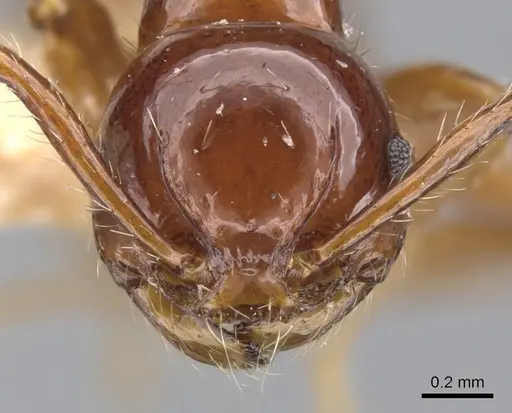
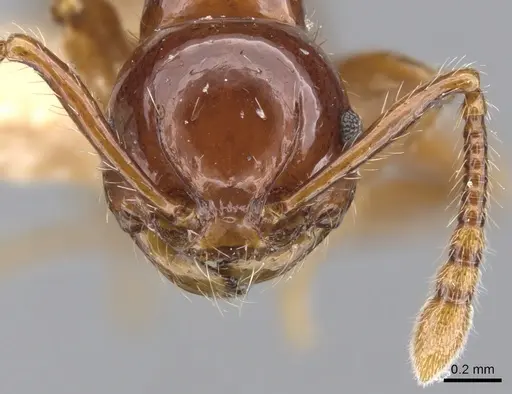
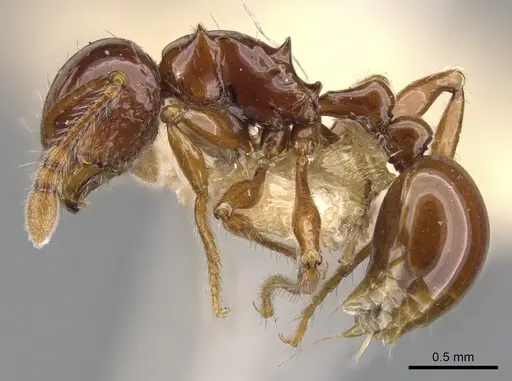
Pristomyrmex collinus workers measure 3.3-3.9mm in total length, making them a small to medium-sized myrmicine ant [1]. They have a distinctive smooth and highly polished appearance, the dorsal surfaces of both the head and alitrunk are unsculptured and shiny [1]. Their coloration is uniformly reddish-brown. The most recognizable features are the short but acute spines on both the pronotum and propodeum, these spines are tooth-like and roughly equal in length [1]. The petiole node has 1-2 pairs of hairs, and the first gastral tergite lacks setae entirely [1]. Queens are larger at 4.04-4.38mm and have reduced propodeal spines compared to workers [1]. You can distinguish P. collinus from its close relative P. flatus by its smaller size (HW 0.77-0.94 vs 0.98-1.04) and the convex dorsum of the promesonotum versus the depressed shape in P. flatus [1].
Natural History
This species is endemic to the Philippines, known from islands including Luzon, Tablas, Panay, and Negros [1][2]. They inhabit forest leaf litter and are classified as diurnal, they have been collected actively foraging during the day [3]. However, they are also found in leaf litter samples collected during both day and night, suggesting they may have some nocturnal activity in the leaf litter layer [3]. The species was formally described by Wang in 2003 and belongs to the Pristomyrmex Quadridens species group, which includes several closely related species distributed across Southeast Asia, Australia, and the Pacific [1]. Nothing specific is known about their diet, nuptial flight timing, or colony founding behavior in the wild.
Housing and Nesting
Based on their leaf litter habitat in Philippine forests, these ants would do best in a naturalistic setup with moist substrate that mimics forest floor conditions. A Y-tong (AAC) nest or plaster nest with appropriately scaled chambers also works well, the chambers should be tight since these are small ants. Provide a water tube or moisture reservoir to maintain humidity. Since they are found in leaf litter, include some decaying leaves or organic material in the outworld to give them foraging material. They are small (under 4mm), so ensure your escape prevention uses fine mesh or tight-fitting barriers. Because there is no captive husbandry data for this species, observe your colony closely and adjust conditions based on their behavior and activity levels.
Feeding and Diet
The specific diet of Pristomyrmex collinus has not been documented in scientific literature. As Myrmicinae ants, they likely are omnivorous, feeding on small insects, honeydew, and nectar like many related species. Based on their small size and leaf litter habitat, they probably hunt tiny prey like springtails, mites, and other micro-arthropods in the wild. For captivity, offer small live prey such as fruit flies, pinhead crickets, or mealworms. Sugar sources like honey water or sugar water may be accepted, offer these occasionally but do not rely on them as a primary food source since acceptance is unconfirmed. Start with small protein prey and observe whether they accept it.
Temperature and Seasonal Care
As a Philippine species from forest habitats, Pristomyrmex collinus likely prefers warm, stable temperatures in the range of 24-28°C. Provide a gentle temperature gradient so the colony can self-regulate, a heating cable on one side of the nest can achieve this. Avoid temperatures below 20°C for extended periods. Regarding seasonal changes, the Philippines has a tropical climate with relatively mild seasonal variation, so this species may not require a true hibernation period. However, they may show reduced activity during cooler months. Monitor your colony, if they become less active in winter, reduce feeding and ensure humidity is maintained without over-wetting the substrate.
Frequently Asked Questions
How long does it take for Pristomyrmex collinus to go from egg to worker?
The development timeline has not been scientifically documented for this species. Based on related Pristomyrmex species and typical Myrmicinae development, expect approximately 4-8 weeks from egg to first worker at optimal warm temperatures (around 26°C). However, this is an estimate, actual times may vary.
What do Pristomyrmex collinus ants eat?
Their specific diet has not been studied. Based on their small size and leaf litter habitat, they likely hunt tiny prey like springtails and mites. In captivity, offer small live prey such as fruit flies, small mealworms, or pinhead crickets. Sugar sources like honey water may be accepted but are unconfirmed.
Are Pristomyrmex collinus good for beginners?
This species is not recommended for beginners. There is virtually no captive husbandry data available, no information on founding success, preferred conditions, or common problems. This makes it a species for experienced antkeepers willing to experiment and document their findings.
Do Pristomyrmex collinus ants sting?
Pristomyrmex belongs to the Myrmicinae subfamily, which includes many species with functional stingers. While stinging behavior has not been documented for this specific species, they likely can sting if threatened. However, given their small size, any sting would be mild.
How big do Pristomyrmex collinus colonies get?
The maximum colony size is unknown, no colony size data exists in scientific literature. Related Pristomyrmex species typically form colonies of several hundred to a few thousand workers.
What temperature do Pristomyrmex collinus need?
Based on their Philippine forest habitat, aim for 24-28°C. Provide a temperature gradient so the colony can choose its preferred zone. Avoid prolonged temperatures below 20°C.
Do Pristomyrmex collinus need hibernation?
Hibernation requirements are unknown. As a Philippine species from a tropical climate, they likely do not require a true diapause. They may show reduced activity in cooler months but probably do not need hibernation temperatures.
Can I keep multiple Pristomyrmex collinus queens together?
Colony structure has not been studied, we do not know whether they are single-queen (monogyne) or multi-queen (polygyne) species. Combining unrelated queens has not been documented and is not recommended.
Is Pristomyrmex collinus a difficult species to keep?
Yes, this is considered a difficult species due to the complete lack of captive husbandry information. There are no established care protocols, no data on founding success rates, and no knowledge of their specific needs. This species is best kept by experienced antkeepers who can experiment and document their results.
References

This caresheet is licensed under CC BY-SA 4.0 .
CASENT0901723
View on AntWeb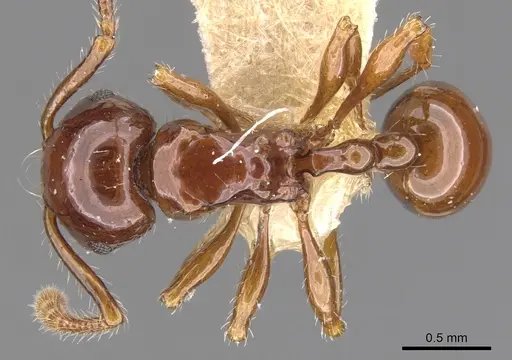
Literature
Loading...Loading products...