

Oxyepoecus inquilinus
- Scientific Name
- Oxyepoecus inquilinus
- Tribe
- Solenopsidini
- Subfamily
- Myrmicinae
- Author
- Kusnezov, 1952
- Distribution
- Found in 3 countries
Oxyepoecus inquilinus Overview
Oxyepoecus inquilinus is an ant species of the genus Oxyepoecus. It is primarily documented in 3 countries , including Argentina, Bolivia, Plurinational State of. Detailed taxonomic data and occurrence records can be further explored via authoritative databases such as AntWeb or the Global Biodiversity Information Facility (GBIF).
Oxyepoecus inquilinus
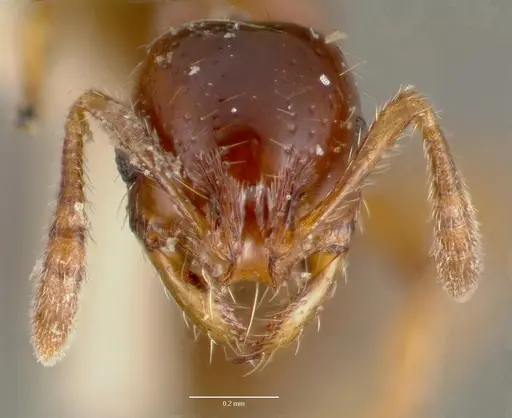
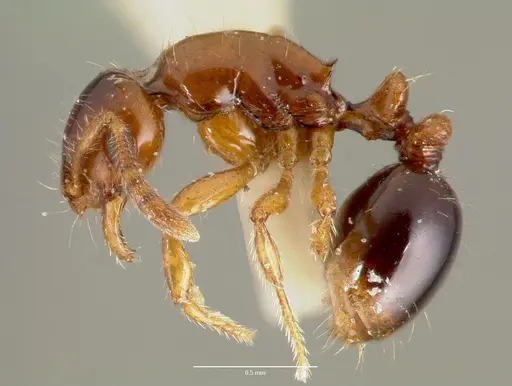
Oxyepoecus inquilinus is a tiny, rare ant measuring just 2.5-2.9mm in total length, with a distinctive appearance featuring very large compound eyes containing about 50 ommatidia and well-developed propodeal spines [1]. The workers are dark chestnut brown with a darker gaster, while their mandibles, antennae, and legs are yellowish brown [1]. This species has the broadest distribution in its genus, being found across Argentina, Bolivia, Brazil, Chile, Paraguay, and Colombia, though it appears locally rare and is listed as IUCN Vulnerable [2][3]. What makes this ant extraordinary is its lifestyle, it is an inquiline, meaning it lives permanently within the nests of other ant species, specifically Pheidole radoszkowskii, making it completely dependent on a host colony for survival [2]. Only worker castes have ever been documented, no queens or males have been formally described in the scientific literature [4].
Quick Summary
- Difficulty: Expert
- Origin & Habitat: Native to the Neotropical region spanning Argentina, Bolivia, Brazil, Chile, Paraguay, and Colombia. Found in diverse habitats including savanna, pasture, dry Chaco, and Valdivian forest, occurring in both open and closed areas and in both degraded and pristine ecosystems [2][5].
- Colony Type: Inquiline social parasite, permanently lives within nests of host species (Pheidole radoszkowskii). No wild colonies have ever been documented with a queen, only workers have been found, typically as stray individuals within host nests [2][6].
- Queen: Socially parasitic
- Size & Growth:
- Queen: Unknown, queens have never been described in scientific literature
- Worker: 2.5-2.9mm total length [1]
- Colony: Unknown, only stray workers have been documented, typically 1-2 workers per host nest sample [2]
- Growth: Unknown
- Development: Unknown, no developmental data exists for this species (No brood has ever been documented in scientific studies. As an inquiline, reproduction likely occurs within the host colony but details are unconfirmed.)
- Antkeeping:
- Temperature: Unknown, no thermal studies exist for this species. Based on its broad distribution across varied climates (tropical to temperate), it likely tolerates a wide range but specific requirements are unstudied.
- Humidity: Unknown, no humidity data exists. Its host species Pheidole radoszkowskii inhabits varied environments from dry Chaco to humid Amazon regions.
- Diapause: Unknown, no seasonal studies have been conducted. Given its broad distribution, some form of seasonal dormancy may occur in cooler southern parts of its range.
- Nesting: This species does not build its own nests. In the wild, it lives within the nests of its host Pheidole radoszkowskii. Captive keeping would require maintaining a healthy host colony, which has never been documented in antkeeping literature.
- Behavior: Workers are typically found wandering within host nests or occasionally foraging near nest entrances. When placed together with host soldiers, Pheidole radoszkowskii workers show aggressive behavior, attempting to cut inquiline workers apart with their mandibles [4]. The species is considered locally rare, typically appearing in just 1-2 workers per sample even when host colonies are present [2]. Escape risk is minimal given the tiny worker size, but this is irrelevant as the species cannot be maintained in captivity.
- Common Issues: This species cannot be kept, it is an obligate inquiline that requires a host colony to survive. There are no documented cases of successful captive maintenance., No queens have ever been found or described, making colony founding impossible. You cannot establish a colony without a queen., The species is protected as IUCN Vulnerable. Collecting from the wild would be ecologically harmful and potentially illegal., Even if you could obtain workers, they would likely be killed by host colony soldiers if introduced to a non-native Pheidole species., No information exists on proper host colony requirements, feeding, or care, this has simply never been studied or attempted.
Why This Species Cannot Be Kept
Oxyepoecus inquilinus is an OBLIGATE INQUILINE, this is perhaps the most critical fact to understand. Unlike most ant species that build their own nests and forage independently, this ant has evolved to live permanently within the nests of another species, specifically Pheidole radoszkowskii [2]. The workers cannot survive on their own, cannot found their own colonies, and have no queen caste that has ever been documented. In scientific collections, only worker ants have been found, typically as single stray individuals wandering within host nests or occasionally captured in Winkler samples and pitfall traps near host colonies [2]. This means there is quite literally no way to establish a colony, you cannot obtain a queen because none has ever been described, and you cannot simply introduce workers to a host colony because they would likely be killed by the host's soldier caste [4]. Beyond the biological impossibility, this species is listed as IUCN Vulnerable due to its rarity and fragmented distribution [2][3]. Collecting any individuals from the wild would be ecologically harmful and potentially illegal depending on local regulations.
The Search for the Queen
One of the most fascinating mysteries surrounding Oxyepoecus inquilinus is the complete absence of documented queens in over 70 years of study. The species was first described in 1952 by Kusnezov based on workers found in Argentina, and subsequent researchers have repeatedly searched for queens without success [6]. This is unusual even for inquiline species, as most social parasites at least have a queen stage (even if she never leaves the host nest). Several hypotheses exist: the queen may be morphologically similar to workers and simply unrecognized, she may be wingless and rarely leaves the host's nest chambers, or the species may rely entirely on host colony reproduction. The fact that only 1-2 workers are typically found even in samples where host colonies are present suggests the inquiline population within any given host nest is extremely small [2]. This makes finding a queen during field collection extraordinarily unlikely. For antkeepers, this means the species will likely remain a scientific curiosity rather than a captive species for the foreseeable future.
Distribution and Rarity
Despite being the most widely distributed species in the genus Oxyepoecus, O. inquilinus remains remarkably rare wherever it is found [2]. The species has been documented in Argentina (Tucumán province), Bolivia (Bení Department), Brazil (São Paulo, Goiás, Pará), Chile (Valdivian forest), Paraguay (Boquerón department), and Colombia (Meta and Córdoba departments) [2][5][7]. However, the distribution is discontinuous, populations are isolated from each other rather than forming a continuous range. In Paraguay, researchers found only 2 workers in one Winkler sample and 2 workers in pitfall traps across hundreds of samples, despite extensive surveying [2]. This pattern of extreme rarity (finding just 1-2 individuals across extensive sampling efforts) is consistent throughout its range. The species appears to be present in both open and closed habitats, in degraded and pristine ecosystems, and in both dry and wet areas [2], which explains its broad geographic range but does not explain why it remains so locally uncommon.
Identification and Distinctive Features
Oxyepoecus inquilinus can be identified by two key characteristics that set it apart from other Oxyepoecus species: its very large compound eyes containing about 50 ommatidia, and its well-developed propodeal spines [1][2]. For reference, most related Solenopsidini ants have much smaller eyes with far fewer ommatidia. The workers measure 2.5-2.9mm in total length, making them tiny but not among the smallest of the tribe [1]. The body is dark chestnut brown with a darker gaster, while the mandibles, antennae, and legs are yellowish brown, creating a bicolored appearance that is distinctive [1]. The mandibles are unusually elongate and sublinear, a feature shared with Oxyepoecus vivax but not with other species in the genus. These identification features are important for researchers conducting field surveys, as the species is easily overlooked due to its small size and inquiline lifestyle.
Frequently Asked Questions
Can I keep Oxyepoecus inquilinus as a pet ant?
No. This species is an obligate inquiline that cannot be kept in captivity. No queen has ever been documented, workers cannot survive without a host colony, and the species is protected as IUCN Vulnerable. There are no documented cases of successful captive maintenance of this or any related inquiline species.
Where can I find Oxyepoecus inquilinus in the wild?
This is not recommended. The species is IUCN Vulnerable due to its rarity, and collecting would be ecologically harmful. Additionally, finding them requires extensive field work, researchers typically find only 1-2 workers across hundreds of samples. They live within nests of Pheidole radoszkowskii, which are themselves not common.
What do Oxyepoecus inquilinus eat?
This is unknown. As an inquiline living within host nests, they likely feed on whatever the host colony brings in or may be fed directly by host workers through trophallaxis. No feeding observations have been documented in scientific literature.
Why is the queen unknown?
Scientists have been searching for queens since the species was described in 1952 without success. Possible explanations include: the queen may look similar to workers and be unrecognized, she may be wingless and rarely leave host nest chambers, or the species may rely entirely on host colony reproduction. This remains one of the great mysteries of Neotropical myrmecology.
Is this species endangered?
Yes, it is listed as IUCN Vulnerable due to its apparently local rarity and discontinuous distribution across its range. Populations are isolated and small, making them vulnerable to habitat disturbance.
What is an inquiline ant?
An inquiline is a social parasite that lives permanently within the nest of another ant species without having its own worker caste. Unlike temporary social parasites (which invade a host colony temporarily), inquilines like Oxyepoecus inquilinus spend their entire lives within the host nest, relying on the host workers for food, shelter, and colony maintenance.
What ants are similar to keep?
If you are interested in observing social parasitism, consider observing wild Pheidole colonies and looking for any unusual tiny workers inside, this is how researchers first discovered O. inquilinus. Otherwise, focus on non-parasitic ant species that are well-established in the hobby. This species should be appreciated in scientific literature rather than sought as a pet.
References

This caresheet is licensed under CC BY-SA 4.0 .
CASENT0006160
View on AntWeb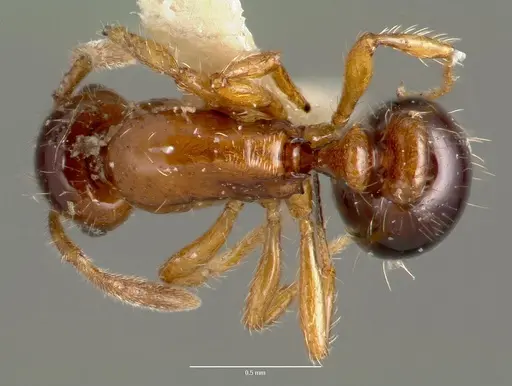
Literature
Loading...Loading products...