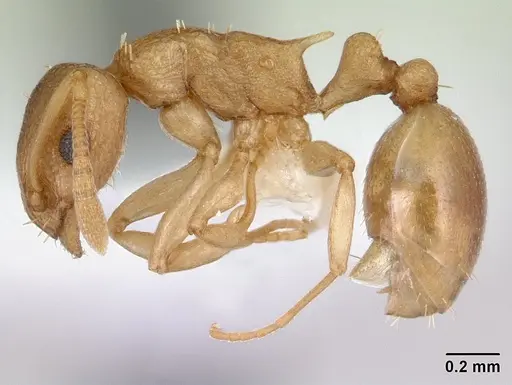
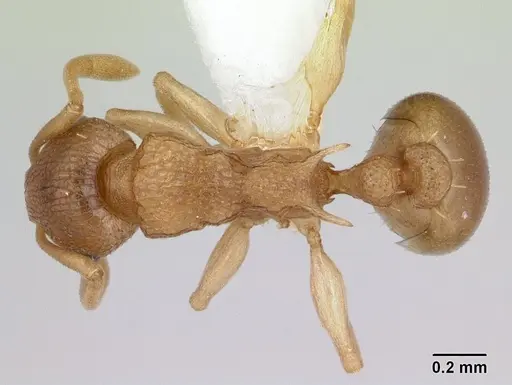
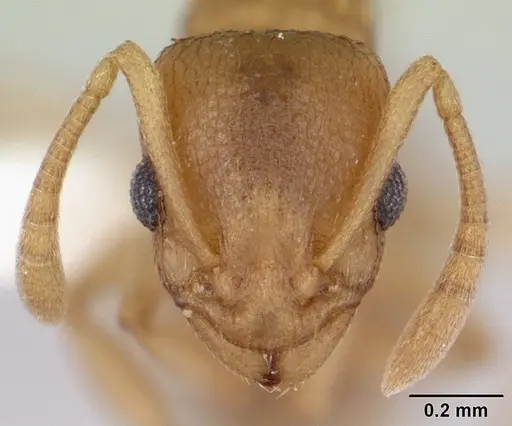
Nesomyrmex evelynae - "Evelyn's Canopy Ant"
Nesomyrmex evelynae is a small, striking ant species belonging to the Myrmicinae subfamily. Workers typically measure between 2.5 to 2.9 millimeters in total length and are characterized by their yellowish coloration. A distinguishing feature is the conspicuously impressed metanotal groove on their mesosoma, along with a long petiolar peduncle. Unlike many other ants, their propodeum (the back part of their 'thorax') lacks standing hairs, as does most of their first gastral tergite (the main segment of their gaster), except for a single transverse row at the very end. They also have straight, relatively long propodeal spines. Their head and upper body exhibit a finely sculpted, somewhat reticulate pattern, giving them a unique texture. These ants are known for their preference for arboreal habitats within rainforest canopies.
- Difficulty: Medium
- Origin & Habitat: Equatorial Africa (Burkina Faso, Central African Republic, Democratic Republic of Congo, Ghana, Kenya, Uganda) in Rainforests, specifically in the canopy stratum, nesting in pre-existing cavities within trees and branches..
- Colony Type: Monogyne, claustral (nests in pre-existing wood cavities) founding.
- Size & Growth:
- Queen: 3.0-3.5mm
- Worker: 2.5-2.9mm
- Colony: Small (tens to a few hundred workers). Slow to Medium, due to typically small colony sizes. growth.
- Antkeeping:
- Temperature: Maintain a warm and stable environment, ideally between 24-28°C (75-82°F). Avoid significant temperature fluctuations..
- Humidity: High humidity is crucial, around 70-90% in the nesting area. The outworld can be slightly lower, but consistent moisture is key to their well-being..
- Diapause: Not required. Not specified at Not specified.
- Nesting: Being arboreal, these ants thrive in nests that mimic natural wood cavities. Cork bark inserts, specialized acrylic nests with small chambers, or even natural wood pieces integrated into a setup are ideal. They require very small entrance holes..
- Behavior: Low (towards handler, primarily defensive) aggressiveness.
- Common Issues: Humidity fluctuations leading to desiccation or mold, Escape due to small size, Finding appropriately small food items, Colony stalling if environmental conditions are not met.
Keeping Evelyn's Canopy Ants requires a keen eye for detail and a stable environment. Their small size means they can easily escape through tiny gaps, so secure enclosures are paramount. Because they are canopy dwellers, providing an arboreal setup is highly recommended. This might involve horizontally oriented acrylic nests, or creatively integrated natural cork bark pieces that allow them to nest within the bark's crevices, mimicking their wild habitats. Ensuring good ventilation while maintaining high humidity can be a delicate balance, often achieved with partial coverage of ventilation holes or strategic misting.
Diet-wise, Nesomyrmex evelynae are primarily carnivorous, and your colony will thrive on a regular supply of small insect protein. Fruit flies, tiny crickets, or freshly killed mealworms cut into minuscule pieces are excellent choices. While they are omnivorous and will also take sugars, their protein intake seems to be especially important for healthy brood development. Offer small amounts of sugar water, honey, or an ant jelly alongside their insect meals, ensuring a balanced diet that supports all colony activities, from foraging to queen egg-laying.
Humidity management is arguably the most critical aspect of keeping this species. As rainforest inhabitants, they are highly sensitive to desiccation. Misting the nest area or employing a humidity gradient within the setup can help. Monitoring humidity levels with a hygrometer is not just helpful, it's essential for their long-term survival. Stagnant, overly damp conditions can lead to mold, so a balance of high humidity with adequate airflow is necessary to prevent harmful fungal growth.
Given their relatively small colony sizes, often only reaching a few hundred workers, observing their growth can be a slow but rewarding process. Avoid frequent disturbances or vibrations near their nest, as these can stress the queen and hinder brood development. Patience is key when keeping these delicate ants; allow them ample time to settle into their new home before expecting rapid expansion. Creating a peaceful and stable environment will encourage them to flourish, allowing you to witness their fascinating behaviors firsthand.
Frequently Asked Questions
What kind of nest is best for Nesomyrmex evelynae?
For Evelyn's Canopy Ants, an arboreal setup is ideal. Think about formicaria with cork bark inserts, specialized acrylic nests designed with small, shallow chambers, or even hollowed-out natural wood pieces. The key is mimicking their natural tree-dwelling habitats, ensuring small entrance holes and a humid interior.
What do Nesomyrmex evelynae eat?
These ants are mostly carnivorous, so focus on protein! Offer small insects like fruit flies, tiny cricket pieces, or small mealworm segments. They're also omnivorous, so don't forget to provide sugar sources such as diluted honey or ant jelly for energy.
How big do Nesomyrmex evelynae colonies get?
Nesomyrmex evelynae colonies are on the smaller side. You can expect a mature colony to range from a few tens to a few hundred workers, rarely exceeding that number. They are not a species that will overwhelm your setup with massive numbers.
Do Nesomyrmex evelynae need high humidity?
Absolutely! Hailing from rainforest canopies, Evelyn's Canopy Ants require very high humidity, typically in the 70-90% range within their nesting chambers. Consistent moisture is vital to prevent desiccation and ensure the health of your colony and brood.
Are Nesomyrmex evelynae good for beginner antkeepers?
Due to their specific humidity requirements, small size (which makes them escape artists), and delicate nature, Nesomyrmex evelynae are generally considered a medium difficulty species. They might be a bit challenging for absolute beginners, but a dedicated antkeeper with some experience can certainly succeed.
Do these ants sting?
Yes, like many species in the Myrmicinae subfamily, Nesomyrmex evelynae workers do possess a sting. However, given their tiny size, their sting is unlikely to be medically significant to humans, generally causing only a mild irritation if at all.
How fast do Nesomyrmex evelynae colonies grow?
Their growth rate is typically slow to medium. Don't expect explosive population booms. Patience is a virtue when rearing Evelyn's Canopy Ants, as their colonies expand steadily but not rapidly.
Do Nesomyrmex evelynae need a diapause (hibernation)?
No, as a tropical rainforest species, Nesomyrmex evelynae do not require a diapause period. Maintain consistent warm temperatures and high humidity year-round.
What are common issues when keeping Nesomyrmex evelynae?
The main challenges include maintaining stable high humidity without encouraging mold growth, preventing escapes due to their small size, and ensuring they receive appropriate, tiny food items. Colony stalling can occur if their specific environmental needs aren't consistently met.
How long does it take for an egg to become a worker?
From egg to adult worker, the development time for Nesomyrmex evelynae generally ranges from 4 to 6 weeks, assuming optimal temperature and humidity conditions are consistently provided.