

Mystrium maren
- Scientific Name
- Mystrium maren
- Tribe
- Amblyoponini
- Subfamily
- Amblyoponinae
- Author
- Bihn & Verhaagh, 2007
- Distribution
- Found in 1 countries
Mystrium maren Overview
Mystrium maren is an ant species of the genus Mystrium. It is primarily documented in 1 countries , including Indonesia. Detailed taxonomic data and occurrence records can be further explored via authoritative databases such as AntWeb or the Global Biodiversity Information Facility (GBIF).
Mystrium maren
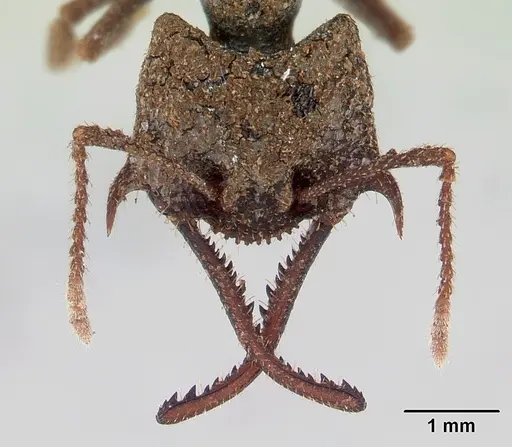
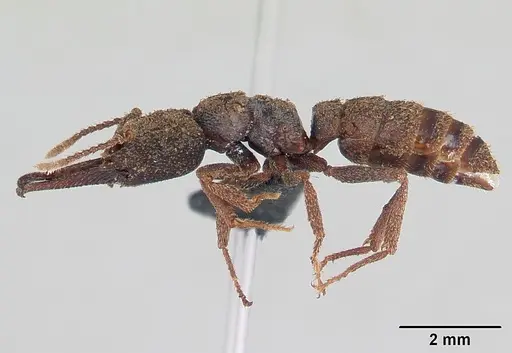
Mystrium maren is a tiny predatory ant from the Amblyoponinae subfamily, found only on Waigeo Island in Indonesia's West Papua province. Workers measure approximately 2.3-2.5mm in head length, making them one of the smaller ant species in the genus Mystrium [1]. They have a distinctive appearance with long curved spines projecting from the front corners of their head, and remarkably long slender mandibles equipped with two staggered rows of teeth for capturing prey [1]. Their body is dark brown to black with lighter rusty brown on the head, mandibles, and abdomen [1].
This species is one of the rarest ants in the world, it has only ever been collected twice, both times from leaf litter samples in old growth rainforest near the summit of Gunung Susu at 350-450m elevation [1]. The queen and male castes remain completely unknown, and no one has ever documented a living colony. Like other Mystrium species, they likely have unusual hunting behaviors given their specialized mandible structure, but captive husbandry methods remain entirely unstudied [1].
Quick Summary
- Difficulty: Expert
- Origin & Habitat: Indonesia (West Papua, Waigeo Island) in old growth rainforest leaf litter at 350-450m elevation [1]
- Colony Type: Unknown, only worker specimens have been collected. The species is only known from two workers, with queen and male castes undescribed. Based on the genus, they likely form small colonies but colony structure is unconfirmed.
- Size & Growth:
- Queen: Unknown, queen has never been collected or described [1]
- Worker: 2.34-2.46mm head length (HL),2.64-2.72mm head width (HW) [1]
- Colony: Unknown, no colony observations have been documented
- Growth: Unknown
- Development: Unknown, no development data exists for this species (Development timeline has not been studied. Related Mystrium species typically develop in 2-4 months at tropical temperatures, but this is unconfirmed for M. maren.)
- Antkeeping:
- Temperature: Based on its rainforest origin in equatorial Indonesia, likely requires warm conditions around 24-28°C. No direct temperature data exists for this species.
- Humidity: High humidity is essential, collected from leaf litter in old growth rainforest suggests they need consistently damp conditions similar to forest floor microhabitats.
- Diapause: Unknown, no seasonal data exists. As a tropical species from near the equator, they may not require a diapause period.
- Nesting: Likely nests in small cavities within leaf litter or rotting wood on the forest floor. In captivity, a small test tube setup or mini formicarium with high humidity would be the best starting point.
- Behavior: Behavior is unstudied in captivity. Based on genus-level knowledge of Mystrium, they are likely predatory on small invertebrates and use their specialized mandibles to capture prey. Workers likely forage individually through leaf litter. Escape prevention should be excellent given their small size, they can easily slip through standard barriers.
- Common Issues: No captive husbandry information exists, this is essentially an unkeepable species for hobbyists, Colony structure is completely unknown, we don't know if they are single-queen or multi-queen, The queen has never been described, making artificial propagation impossible, Growth rate and development timeline are entirely unknown, Very small size means excellent escape prevention is critical if attempting to keep them
Discovery and Rarity
Mystrium maren was described in 2007 by Jochen Bihn and Manfred Verhaagh based on only two worker specimens collected in January 2001 from leaf litter samples in an old growth rainforest on Waigeo Island, Indonesia [1]. The type locality is near Urbinasopen on Gunung Susu mountain at 350-450 meters elevation [1]. The species was named in dedication to Dr. Maren Scheidhauer, a friend of the first author [1]. This ant remains one of the rarest species in the entire genus Mystrium, with no additional specimens collected since its original discovery. The queen caste, male caste, and any colony-level observations remain completely unknown to science.
Identification and Morphology
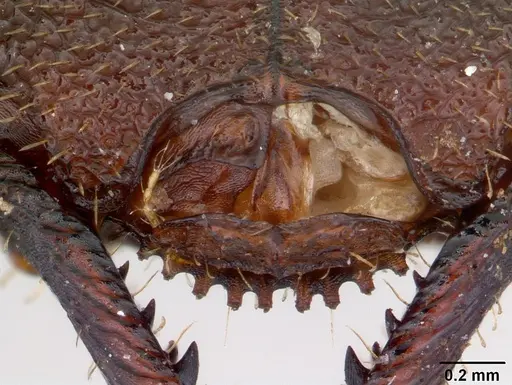
Workers of Mystrium maren can be identified by several distinctive features. The head is wider than long with a deeply emarginated (notched) posterior margin, and each anterolateral corner produces a long forward-directed curved spine [1]. The most remarkable feature is their extremely long slender mandibles, which run parallel to each other and are distinctly sinuate (wavy) in dorsal view [1]. The inner margin of each mandible bears two staggered longitudinal rows of 12-14 hamulus-like teeth, with the lower row having larger teeth than the upper row [1]. Compound eyes are minute, consisting of only 7-10 ommatidia [1]. The body is dark brown to black with lighter rusty brown coloration on the anterior head, mandibles, antennae, and gaster [1]. They show camouflage tendencies, with soil particles adhering to their integument [1].
Natural History
This species is known only from leaf litter samples in old growth rainforest at moderate elevation on Waigeo Island, part of the Raja Ampat archipelago in West Papua, Indonesia [1]. The habitat type suggests they are a forest floor species living in damp, shaded microhabitats within the leaf litter layer. The presence of well-developed mandibles in the collected specimens confirms they are true workers, not wingless reproductives which would have reduced mandibles in this genus [1]. Nothing is known about their diet, foraging behavior, colony size, or reproductive biology. As members of the Amblyoponinae subfamily, they are likely predatory on small invertebrates, but this is inferred from genus-level knowledge rather than species-specific observations.
Keeping Status and Challenges
Mystrium maren is NOT a species that can be practically kept in captivity. It is one of the most poorly known ant species in the world, with only two workers ever collected and described. No one has ever observed a living colony, found a queen, or documented any aspect of their captive care. The complete absence of basic biological information, colony structure, queen identity, development timeline, dietary preferences, temperature tolerance, makes responsible husbandry impossible. Additionally, there is no legal pathway to obtain this species as no colonies have ever been exported or cultivated. Antkeepers interested in Amblyoponinae species should consider more commonly kept genera like Amblyopon, Stigmatomma, or related species where captive husbandry has been developed. Attempting to keep this species would be both ethically questionable and practically impossible. [1]
Frequently Asked Questions
Can I keep Mystrium maren as a pet ant?
No. This species is essentially unkeepable. Only two workers have ever been collected, both in 2001,and no one has ever documented a living colony, found a queen, or established a captive population. There is no legal or practical way to obtain this species, and even if you could, we have zero information about how to care for it.
What does Mystrium maren look like?
Workers are tiny at about 2.3-2.5mm head length. They have a distinctive dark brown to black body with lighter rusty brown on the head, mandibles, and abdomen. Their most unusual feature is a pair of long curved spines projecting from the front corners of their head, plus extremely long slender mandibles with two rows of teeth [1].
Where does Mystrium maren live?
Only known from Waigeo Island in Indonesia's West Papua province. They were collected from leaf litter in old growth rainforest at 350-450 meters elevation on Gunung Susu mountain [1].
How big do Mystrium maren colonies get?
Unknown. No colony has ever been observed. We don't even know what a queen looks like for this species.
Do Mystrium maren ants sting?
Unknown. Amblyoponinae ants can sting, but the sting is typically too small to penetrate human skin. No specific information exists for this species.
What do Mystrium maren eat?
Unknown. Based on genus-level knowledge of Mystrium, they are likely predatory on small soil invertebrates, but no species-specific dietary observations exist.
Are Mystrium maren good for beginners?
Absolutely not. This is an expert-level species in name only, in reality, it cannot be kept at all due to complete lack of biological data and no known captive populations. Beginners should start with well-documented species like Lasius niger, Camponotus, or Messor.
What temperature do Mystrium maren need?
Unknown. As a tropical rainforest species from near the equator, they likely prefer warm conditions around 24-28°C, but no direct temperature data exists for this species.
Do Mystrium maren need hibernation?
Unknown. As a tropical species from equatorial Indonesia, they likely do not require a diapause period, but no seasonal observations exist to confirm this.
How long does it take for Mystrium maren to develop from egg to worker?
Unknown. No development data exists for this species. Related Mystrium species may take 2-4 months, but this is entirely unconfirmed for M. maren.
References

This caresheet is licensed under CC BY-SA 4.0 .
CASENT0178197
View on AntWeb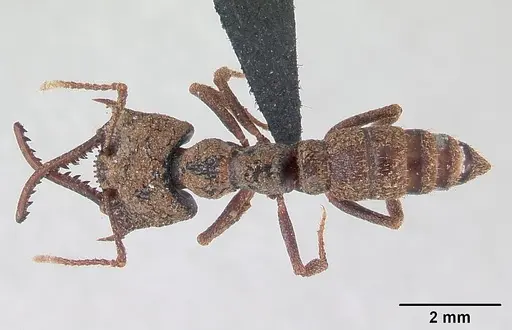
Literature
Loading...Loading products...