

Mystrium leonie
- Scientific Name
- Mystrium leonie
- Tribe
- Amblyoponini
- Subfamily
- Amblyoponinae
- Author
- Bihn & Verhaagh, 2007
- Distribution
- Found in 1 countries
Mystrium leonie Overview
Mystrium leonie is an ant species of the genus Mystrium. It is primarily documented in 1 countries , including Indonesia. Detailed taxonomic data and occurrence records can be further explored via authoritative databases such as AntWeb or the Global Biodiversity Information Facility (GBIF).
Mystrium leonie
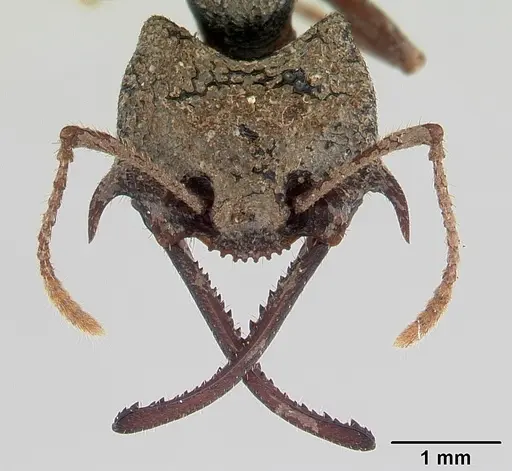
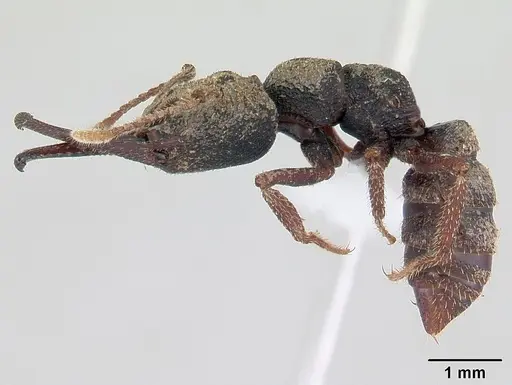
Mystrium leonie is an extremely rare ant species from the Amblyoponinae subfamily, known only from a single worker specimen collected in old growth rainforest near Elelim in Papua, Indonesia. These are medium-sized ants with a distinctive appearance, they have a dark brown to black body with lighter rusty brown on the head, mandibles, and gaster. The most striking features are the long, curved spines projecting from the front corners of the head and their remarkably long, slender mandibles equipped with two rows of specialized teeth for hunting. Their entire body is covered in a layer of soil and detritus that acts as natural camouflage as they forage through leaf litter. This species remains one of the most poorly documented ants in the world, with no known colonies in captivity and virtually no biological information available beyond the original specimen description.
Quick Summary
- Difficulty: Expert
- Origin & Habitat: Only known from a single specimen collected in old growth rainforest near Elelim, Papua Province, Indonesia at 750m altitude [1]. The region is tropical rainforest with high humidity and stable warm temperatures year-round.
- Colony Type: Unknown, only a single worker specimen has ever been collected. The queen and male castes remain undescribed. Based on related Mystrium species, the colony structure is likely single-queen (monogyne), but this is unconfirmed.
- Size & Growth:
- Queen: Unknown, queen has never been described
- Worker: Head width 2.45mm, head length 2.26mm from holotype measurements [1]. This indicates workers are medium-sized for the genus.
- Colony: Unknown, no colony data exists
- Growth: Unknown
- Development: Unknown, no development data exists for this species. Based on typical Amblyoponinae patterns, expect 6-10 weeks at optimal temperature, but this is a rough estimate. (No direct data available. Related Mystrium species suggest standard ant development timelines, but this is inferred.)
- Antkeeping:
- Temperature: Unconfirmed. Based on the tropical rainforest habitat in New Guinea, aim for warm conditions around 24-28°C with stable temperatures. Avoid temperature drops below 20°C.
- Humidity: Unconfirmed. The leaf litter habitat suggests high humidity needs, aim for 70-85% humidity with moist (but not waterlogged) substrate. Mist regularly and provide a water source.
- Diapause: Unknown, no seasonal data exists. Given the tropical origin, diapause is likely not required, but this is unconfirmed.
- Nesting: Unconfirmed. Based on the leaf litter collection and cryptic behavior, they likely nest in small cavities within rotting wood, under bark, or in dense leaf litter. In captivity, a naturalistic setup with moist substrate, small chambers, and plenty of hiding spaces would be appropriate. Avoid large open spaces.
- Behavior: These are cryptic, ground-dwelling ants that forage in leaf litter. The soil-covered camouflage suggests they actively avoid detection, they are likely shy and non-aggressive. Their well-developed mandibles with specialized teeth indicate they are predators, likely hunting small arthropods in the leaf litter layer. Escape risk is moderate, they are not tiny ants but are agile. Use standard escape prevention. The minute eyes (only 7-10 ommatidia) suggest they rely more on chemical and tactile senses than vision.
- Common Issues: This species has never been kept in captivity, there is no established care protocol, Only a single specimen exists in museum collections, making wild collection extremely unlikely, The unknown colony structure and founding requirements make successful cultivation highly speculative, No information on acceptable food sources, dietary requirements are completely unknown, Temperature and humidity requirements are inferred from habitat, not from captive studies
Rarity and Collection History
Mystrium leonie is one of the rarest ants in the world, known from only a single specimen collected in December 2004 from a leaf litter sample in old growth rainforest near Elelim, Papua Province, Indonesia. The holotype worker is deposited at the Museum Zoologicum Bogoriense (MZBJ). Despite subsequent extensive ant surveys in New Guinea, no additional specimens have been found. This extreme rarity makes the species essentially unavailable to antkeepers, and no colonies exist in captivity anywhere in the world. The species was formally described in 2007 by Jochen Bihn and Manfred Verhaagh, who named it in dedication to Leonie Wiegel, the daughter of co-author Verhaagh. [1]
Identification and Morphology
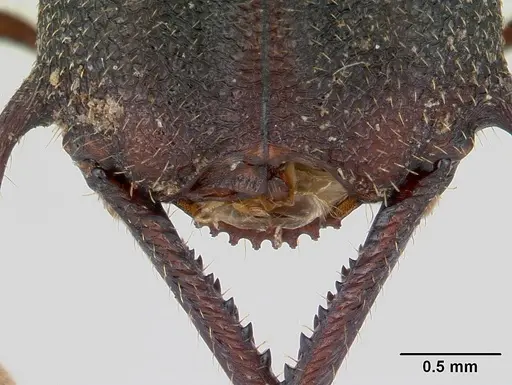
The worker of Mystrium leonie can be identified by several unique features. The most distinctive are the long, curved spines projecting forward from each corner of the head. The mandibles are exceptionally long and slender, with the basal two-thirds straight and the distal third curving inward. Each mandible has two staggered longitudinal rows of 14 hamulus-like teeth, with the teeth in the lower row being larger than those in the upper row. The compound eyes are extremely small, consisting of only 7-10 ommatidia, suggesting limited visual capability. The body is covered with a tightly adhering layer of soil and detritus that serves as natural camouflage, this is not debris stuck to the specimen but appears to be actively maintained by the ant. The body coloration is mostly dark brown to black, with the anterior part of the head, mandibles, antennae, and gaster being a lighter rusty brown. [1]
Habitat and Ecology
The only known specimen was collected from leaf litter in old growth rainforest at 750 meters elevation near Elelim in the Jayawijaya region of Papua Province, Indonesia. This location is in the central highlands of New Guinea, an area characterized by tropical rainforest with high year-round humidity and warm temperatures. The soil-covered body and cryptic foraging behavior suggest this species is a specialized leaf litter dweller, hunting small prey among the decomposing organic matter on the forest floor. The minute eyes and reliance on camouflage rather than escape or aggression are typical of ambush predators in the leaf litter layer. Nothing is known about their diet, but related species in the Amblyoponinae are predatory, using their specialized mandibles to capture small arthropods. [1]
Why This Species Cannot Be Kept
Mystrium leonie is not available to antkeepers for several critical reasons. First, no colonies have ever been found, only a single worker exists in museum collections. Second, even if specimens were to be discovered, the species has never been studied in captivity and no care information exists. Third, the extreme rarity means no ant breeder or supplier has ever had access to this species. For antkeepers interested in Amblyoponinae species, related ants like Mystrium camillae (the type species of the genus) or other Amblyoponinae such as Amblyopone, Stigmatomma, or Prionopelta are far more accessible and have established care protocols. These alternatives offer similar interesting morphology (the long mandibles, cryptic behavior) while actually being obtainable. [1]
Related and Accessible Species
For antkeepers interested in the unique features of Mystrium leonie, several related species in the Amblyoponinae subfamily are more accessible. Mystrium camillae is the type species of the genus and is occasionally available. Other Amblyoponinae like Amblyopone pallipes (from North America) or Stigmatomma species are sometimes kept by advanced antkeepers. These ants share the characteristic long mandibles used for hunting small prey in leaf litter. They typically require high humidity, cryptic setups with plenty of hiding spaces, and a diet of small live prey. However, even these related species are considered advanced-level pets due to their specialized requirements and the difficulty in establishing colonies. The Amblyoponinae as a group is known for their unusual biology, including some species with gamergates (reproductive workers) and specialized predatory behaviors.
Frequently Asked Questions
Can I keep Mystrium leonie as a pet ant?
No. Mystrium leonie is one of the rarest ants in the world, known from only a single specimen collected in 2004. No colonies exist in captivity, and no antkeeper or breeder has ever had access to this species. It remains completely unknown to science beyond the original specimen description.
Where can I find Mystrium leonie for sale?
Mystrium leonie is not available for purchase anywhere in the world. Only a single museum specimen exists. Even specialized ant dealers and international collectors have never obtained this species. It would require a major scientific discovery and collection permit to ever become available.
What does Mystrium leonie eat?
Unknown. No feeding observations have ever been recorded. Based on related Amblyoponinae ants, they are likely predatory on small arthropods in leaf litter, but this is entirely speculative. The well-developed mandibles with specialized teeth suggest active hunting rather than scavenging.
How big do Mystrium leonie colonies get?
Unknown. No colony data exists for this species. The single known worker has a head width of 2.45mm, indicating medium-sized workers, but colony size estimates are impossible without any colony samples.
Do Mystrium leonie ants sting?
Unknown. Amblyoponinae ants typically have functional stingers, but their small size and cryptic behavior suggest they rely on camouflage rather than defense. The stinger would likely be too small to penetrate human skin effectively, similar to most small ants.
What is the temperature requirement for Mystrium leonie?
Unconfirmed. Based on the tropical rainforest habitat in Papua New Guinea, they likely require warm conditions around 24-28°C with high humidity. However, no captive studies exist to confirm this.
Are there similar ants that I can keep instead?
Yes. Other Amblyoponinae species like Mystrium camillae, Amblyopone pallipes, or Stigmatomma species share similar morphology (long mandibles, cryptic leaf-litter behavior) and are occasionally available from specialized ant breeders. These require high humidity, naturalistic setups, and a diet of small live prey.
Why is Mystrium leonie so rare?
This is unknown. It may be naturally rare, have extremely localized distribution, or occupy microhabitats that are difficult to sample. The single known specimen was collected from leaf litter in December 2004,and despite subsequent biodiversity surveys in the region, no additional specimens have been found. The soil-covered camouflage may also make them extremely difficult to detect.
What is the nest setup for Mystrium leonie?
Unknown. No nest has ever been found. Based on the leaf litter collection, they likely nest in small cavities within rotting wood, under bark, or in dense leaf litter. A naturalistic setup with moist substrate and small chambers would be speculative but potentially appropriate if the species ever becomes available.
Do I need to hibernate Mystrium leonie?
Unknown. Given the tropical rainforest origin in New Guinea, diapause is likely not required. However, no seasonal behavior has been documented for this species.
How long does it take for Mystrium leonie to develop from egg to worker?
Unknown. No development data exists for this species. Based on typical Amblyoponinae development patterns, it might take 6-10 weeks at optimal temperature, but this is a rough estimate with no direct evidence.
Is Mystrium leonie aggressive?
Unknown. The cryptic behavior and camouflage suggest they are shy and avoid confrontation rather than being aggressive. Related Amblyoponinae are typically non-aggressive ambush predators that rely on stealth rather than swarming defense.
References

This caresheet is licensed under CC BY-SA 4.0 .
CASENT0178198
View on AntWeb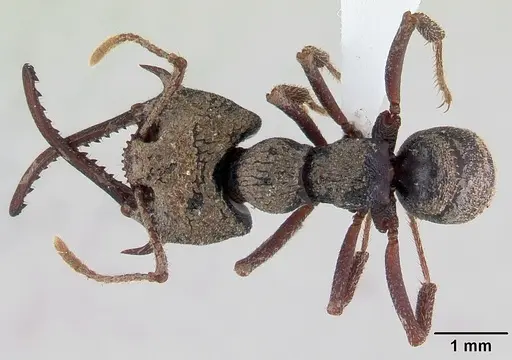
Literature
Loading...Loading products...