

Mycocepurus curvispinosus
- Scientific Name
- Mycocepurus curvispinosus
- Tribe
- Attini
- Subfamily
- Myrmicinae
- Author
- Mackay, 1998
- Distribution
- Found in 4 countries
Mycocepurus curvispinosus Overview
Mycocepurus curvispinosus is an ant species of the genus Mycocepurus. It is primarily documented in 4 countries , including Colombia, Costa Rica, Mexico. Detailed taxonomic data and occurrence records can be further explored via authoritative databases such as AntWeb or the Global Biodiversity Information Facility (GBIF).
Mycocepurus curvispinosus
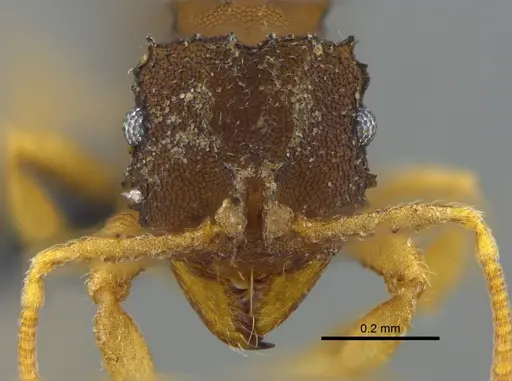
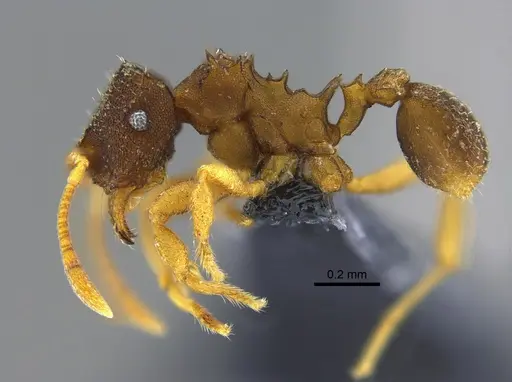
Mycocepurus curvispinosus is a tiny fungus-growing ant belonging to the tribe Attini. Workers measure approximately 2mm and are easily recognized by two key features: they lack the anterior pronotal spines found in most related species, and their propodeal spines curve strongly upward, a combination not seen in any other Mycocepurus species [1]. The queen is slightly larger than 2.5mm total length, making this one of the smallest attine ants in Central America [1]. The body is a rusty ferrugineous red color [1].
This species has a remarkable biology: it lives exclusively within the nests of its close relative Mycocepurus smithii. Workers are slow and timid, forages trailing alongside their host species rather than on their own [1][2]. This makes M. curvispinosus a social parasite, it depends entirely on M. smithii colonies for survival and reproduction. The species is found across the Neotropical region from Mexico through Costa Rica to Panama, inhabiting diverse environments from slashed-and-burned agricultural areas to tropical rainforests [1][3].
Quick Summary
- Difficulty: Expert
- Origin & Habitat: Neotropical region: Mexico (Veracruz, Chiapas), Costa Rica (Heredia), and Panama (Colón). Found in diverse habitats ranging from slashed and burned areas and sub-deciduous forests to tropical rainforests [1][3].
- Colony Type: Social parasite living exclusively within nests of Mycocepurus smithii. The species cannot form independent colonies, queens must invade host colonies to establish reproduction. This is a permanent social parasitic relationship where M. curvispinosus relies entirely on the host's fungus garden and workers for survival.
- Queen: Socially parasitic
- Size & Growth:
- Queen: Slightly more than 2.5mm total length [1]. Measurements: HL 0.71mm, HW 0.67mm, Weber's length 1.07mm [1].
- Worker: Approximately 2mm.
- Colony: Unknown, likely small given parasitic lifestyle. Host colonies (M. smithii) are typically modest in size.
- Growth: Unknown, no development data available for this species.
- Development: Unknown, no direct measurements exist. Related Mycocepurus species may provide rough estimates but this species' parasitic development may differ significantly. (Development is likely tied to host colony cycles. No specific data available.)
- Antkeeping:
- Temperature: Keep warm, around 24-28°C, consistent with tropical rainforest conditions where this species naturally occurs [1]. Use a heating cable on one side of the nest to create a gentle gradient.
- Humidity: High humidity is essential, these ants live in the humid microclimate inside host nests within tropical forests. Keep nest substrate consistently moist but not waterlogged. Aim for 70-80% relative humidity.
- Diapause: Unknown, no documented hibernation behavior. As a tropical species, it likely remains active year-round if kept warm.
- Nesting: This species cannot be kept independently. It requires a established Mycocepurus smithii host colony. The parasitic queen must be introduced to a healthy M. smithii colony for successful establishment. Natural nests are within host colonies in forest floor microhabitats [1].
- Behavior: Workers are slow-moving and timid. They do not forage independently but instead follow the trails of their host species M. smithii [1][2]. This is not an aggressive ant, it has no need to defend its own territory or resources. Escape risk is low as they are small but not particularly mobile on their own. They pose no danger to keepers, they are too small to sting effectively and are not aggressive.
- Common Issues: This species cannot be kept as an independent colony, it requires a host M. smithii colony to survive. Attempting to keep it alone will result in colony failure., Introducing a parasitic queen to a host colony is extremely challenging, host workers often kill introduced queens. Success rates are very low without experienced technique., The tiny size of these ants makes them difficult to observe and care for properly. They can easily be overlooked or accidentally damaged., Wild-caught colonies may have been collected from degraded habitats and may carry parasites or pathogens that cause captive mortality., Because workers are slow and timid, they are outcompeted by faster ants. If housed with any other ant species, they will be overwhelmed.
The Parasitic Lifestyle
Mycocepurus curvispinosus is one of the few known social parasites among the fungus-growing ants. Unlike most attine ants that cultivate their own fungal gardens, this species has evolved to live entirely within the nests of its close relative Mycocepurus smithii [1][2]. The workers are slow and timid, and they do not establish their own foraging trails. Instead, they simply follow along with the trails of their host species, effectively living off the resources the host workers gather [1].
This parasitic relationship means the queen cannot found a colony independently. Instead, a newly mated queen must find her way into an established M. smithii colony and somehow integrate herself there. This is the same basic strategy used by other social parasites like the famous slave-maker ants, though M. curvispinosus appears to be a more passive guest rather than an aggressive usurper. The exact mechanism of how the queen gains entry and establishes her reproduction within the host colony is not documented in scientific literature, but it represents the fundamental challenge in keeping this species.
Housing Requirements
Housing Mycocepurus curvispinosus is exceptionally challenging because you cannot keep it as a standalone colony. You must first maintain a healthy Mycocepurus smithii colony, then attempt to introduce the parasitic queen. This makes this species suitable only for advanced antkeepers with significant experience in colony integration techniques.
If you somehow obtain a colony or queen, the setup should mimic the humid, warm conditions of a tropical forest floor. Use a well-humidified nest (either a Y-tong or a plaster formicarium) kept at 24-28°C with consistent moisture. However, none of this matters without a host colony present, the ants simply cannot survive on their own.
For escape prevention, use standard barriers. While these ants are tiny, they are not particularly active or prone to escaping compared to some other small species. Standard fluon barriers on test tubes or formicarium edges should suffice. [1]
Feeding and Nutrition
In nature, M. curvispinosus likely feeds on the same fungal substrate cultivated by its host M. smithii. Fungus-growing ants in the tribe Attini cultivate specialized fungi that they feed with leaf litter and other organic material. The parasites essentially steal this cultivated food source from their hosts.
In captivity, if you somehow maintain a mixed colony, you would need to provide the same basic nutrition as M. smithii: small pieces of leaf litter, grass clippings, or other organic material that the host colony can use to cultivate their fungus. The actual feeding mechanism is complex, the ants don't eat the leaves directly but rather feed on the fungus that grows on them. This makes keeping this species extraordinarily difficult compared to typical ants that simply need protein and sugar sources. [1][2]
Finding and Acquiring This Species
Mycocepurus curvispinosus is not a species you will find in any ant shop or breeder's catalog. It is rarely collected and poorly studied. Most specimens have been collected in pitfall traps or litter samples in Mexico, Costa Rica, and Panama [1][3]. The species is considered uncommon throughout its range.
If you are determined to keep this species, you would need to travel to its natural range (Mexico, Costa Rica, or Panama), locate a M. smithii colony, and carefully search for the smaller parasitic workers trailing with them. Even then, successfully establishing a parasitic colony in captivity would be a major achievement requiring significant expertise in ant husbandry and colony integration. For most antkeepers, this species remains more of an interesting natural history curiosity than a practical keeping proposition.
Frequently Asked Questions
Can I keep Mycocepurus curvispinosus in a test tube?
No. This species cannot survive independently, it requires a host Mycocepurus smithii colony to live. A test tube setup without a host colony will result in certain death for any M. curvispinosus you place in it. This is not a species that can be kept like typical ants.
How long until first workers appear?
Unknown. No development data exists for this species. Even if a queen successfully integrates into a host colony, the timeline for her reproduction and brood development has not been studied. Related Mycocepurus species may take several months, but this is purely speculative.
Can I keep multiple queens together?
Not applicable. This species is a social parasite that requires a host colony. The question of multiple queens only makes sense in the context of introducing multiple parasitic queens to a single host colony, which would likely result in the queens fighting or being killed by host workers. This has not been studied and is not recommended.
How big do colonies get?
Unknown. The colony size of M. curvispinosus has not been documented. As a social parasite living within host colonies, its numbers would be limited by the resources the host colony can provide. The host species M. smithii forms modest colonies, so any parasitic colonies would likely remain small.
What do Mycocepurus curvispinosus eat?
They eat the fungal cultivar cultivated by their host M. smithii. In captivity, this would mean providing leaf litter or organic material for the host colony to cultivate fungus, the same as feeding M. smithii. This makes their care extraordinarily complex compared to typical ants.
Are Mycocepurus curvispinosus good for beginners?
No. This species is absolutely not suitable for beginners. In fact, it is not suitable for anyone except the most advanced antkeepers with specific expertise in social parasite integration. Even then, success is far from guaranteed. If you are interested in fungus-growing ants, start with easier species like Mycocepurus smithii itself or common Trachymyrmex species.
Do Mycocepurus curvispinosus need hibernation?
No. As a tropical species from Mexico, Costa Rica, and Panama, it does not require hibernation. Keep the colony at warm tropical temperatures (24-28°C) year-round. There is no documented diapause or winter rest behavior.
Why are my ants dying?
If you are attempting to keep this species without a host colony, that is why they are dying. M. curvispinosus cannot survive independently. Even with a host colony present, integration is extremely difficult and most introduced queens are killed by host workers. Additionally, wild-caught specimens may carry parasites or come from degraded habitats that cause captive mortality.
References

This caresheet is licensed under CC BY-SA 4.0 .
CBUMAGENT34560
View on AntWeb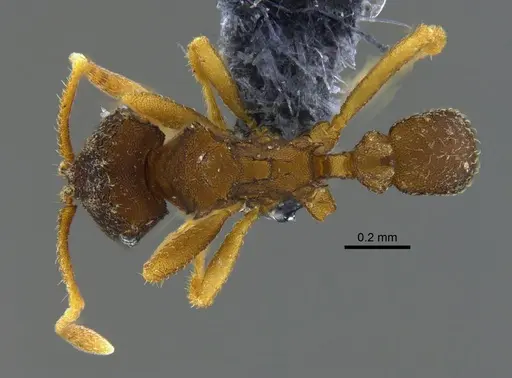
Literature
Loading...Loading products...