

Iridomyrmex macrops
- Scientific Name
- Iridomyrmex macrops
- Tribe
- Leptomyrmecini
- Subfamily
- Dolichoderinae
- Author
- Heterick & Shattuck, 2011
- Distribution
- Found in 1 countries
Iridomyrmex macrops Overview
Iridomyrmex macrops is an ant species of the genus Iridomyrmex. It is primarily documented in 1 countries , including Australia. Detailed taxonomic data and occurrence records can be further explored via authoritative databases such as AntWeb or the Global Biodiversity Information Facility (GBIF).
Iridomyrmex macrops
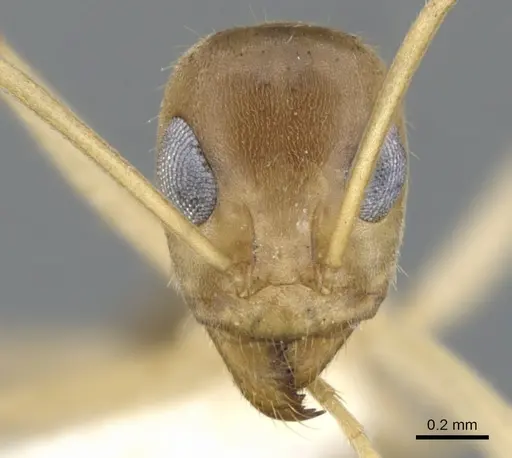
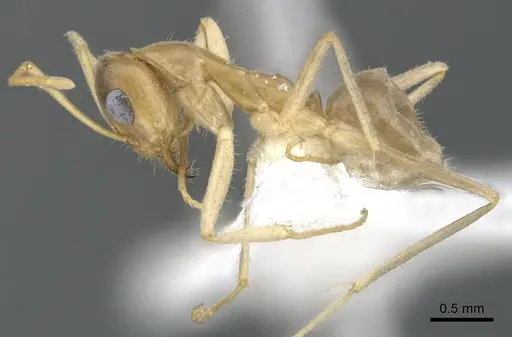
Iridomyrmex macrops is a small to medium-sized ant native to arid and semi-arid regions of Western Australia and South Australia. Workers measure 0.6-0.8mm in head width and feature notably large eyes, the species name 'macrops' literally means 'large eye' in Greek, referring to this distinctive trait [1]. The ants are pale yellow to yellow-brown in color, with erect bristly setae covering their body, particularly on the hind tibiae and sides of the head [1]. This species is closely related to Iridomyrmex dromus but is much more occasional in its occurrence [1].
What makes this species particularly interesting is its adaptation to nocturnal foraging. The large eyes and pale coloration (brightness value 73.7) indicate it has evolved to be active at night, when larger eyes and larger visual facets help it navigate in low-light conditions [2]. In the wild, workers have been observed foraging at night in heathy sandplain habitats and have been collected from mallee tree trunks [1].
Quick Summary
- Difficulty: Medium
- Origin & Habitat: Western Australia and South Australia, arid to semi-arid regions, specifically heathy sandplain and mallee habitats [1]
- Colony Type: Likely single-queen colonies based on typical Iridomyrmex genus patterns, though colony structure is not directly documented
- Colony: Monogyne
- Founding: Claustral
- Size & Growth:
- Queen: Unconfirmed, estimated 5-7mm based on genus patterns
- Worker: 0.6-0.8mm head width,0.73-1.00mm head length [1]
- Colony: Unknown, likely moderate colony size based on similar Iridomyrmex species
- Growth: Moderate, estimated based on genus patterns
- Development: Estimated 6-10 weeks at optimal temperature based on related Iridomyrmex species (Development time is estimated from genus-level data since species-specific timing is unconfirmed)
- Antkeeping:
- Temperature: Keep warm, around 24-28°C, this aligns with their Australian arid-region origin and nocturnal activity pattern
- Humidity: Low to moderate, arid-adapted species, keep substrate relatively dry with occasional moisture zones
- Diapause: Likely required, temperate Australian ants typically need a winter rest period of 2-3 months around 10-15°C
- Nesting: Prefers干燥 environments, Y-tong or acrylic nests work well, with some damp substrate areas for humidity control
- Behavior: Nocturnal and relatively non-aggressive. Workers forage at night and are adapted to low-light conditions with their large eyes [2]. They are likely to be moderate foragers rather than aggressive defenders. Escape prevention should be good, while small, they are not as tiny as some other Iridomyrmex species. Their pale coloration and large eyes are distinctive visual markers.
- Common Issues: nocturnal activity means you may not see much movement during daytime hours, colony size and founding behavior are unconfirmed, expect some trial and error, arid-adapted species can be sensitive to over-humidity which causes mold problems, winter diapause appears necessary but exact requirements are not documented, limited availability in the antkeeping hobby due to restricted distribution
Natural History and Distribution
Iridomyrmex macrops is endemic to southern Australia, specifically Western Australia and South Australia. The species was formally described in 2011 by Heterick and Shattuck as part of a major revision of the Iridomyrmex genus [1]. The name 'macrops' comes from Greek and means 'large eye', referring to the species' most distinctive physical characteristic, its notably enlarged eyes compared to other Iridomyrmex species [1].
In the wild, these ants inhabit arid and semi-arid environments. Workers have been hand-collected at night while foraging in heathy sandplain habitats in Western Australia (Holland Track, east of Hyden), and specimens have been collected from mallee tree trunks (SSW of Coolgardie, WA) [1]. The mallee ecosystem is characteristic of semi-arid Australia, dominated by multi-stemmed Eucalyptus trees in shrubland. This suggests the ants are adapted to warm, dry conditions with access to woody nesting structures.
Nocturnal Adaptations
One of the most fascinating aspects of Iridomyrmex macrops is its adaptation to nocturnal life. Research on eye structure in Iridomyrmex species has shown that pale-colored ants like I. macrops have evolved larger eyes and larger visual facets compared to their dark, diurnal relatives [2]. This is a direct evolutionary response to low-light conditions, larger eyes gather more light, allowing for better vision during night foraging.
The species has a brightness value of 73.7 and a relative eye size of 0.0341,confirming it is a pale species with significantly enlarged eyes [2]. This means in captivity, you should not expect the same activity patterns as diurnal ants. They will likely be most active in the evening and early morning hours, and may spend much of the day resting in darker areas of the nest. This also suggests they may be more sensitive to bright light than typical ants.
Housing and Nesting
Based on their natural habitat in Australian mallee and sandplain environments, Iridomyrmex macrops should be kept in relatively dry conditions with good ventilation. A Y-tong (acrylic) nest or plaster nest works well, providing a humid zone for the brood area while keeping most of the nest relatively dry. The key is to avoid stagnant, overly humid conditions that can lead to mold.
Since this is a small ant (workers 0.6-0.8mm), ensure your formicarium has appropriately sized chambers and tubes. The outworld should be simple with a secure lid, as these ants can climb smooth surfaces well but are not extreme escape artists like some tiny species. Provide a shallow water dish and protein foods in the outworld, with sugar water or honey offered regularly.
Feeding and Diet
Like most Iridomyrmex species, these ants are likely omnivorous with a preference for protein sources. In the wild, they forage for insects and other small arthropods at night [1]. In captivity, offer protein foods such as small crickets, mealworms, fruit flies, or other small insects twice weekly.
For carbohydrates, provide sugar water, honey, or commercial ant nectar. Iridomyrmex ants are known to tend aphids for honeydew in captivity, so if you want to simulate natural conditions, you could offer a small artificial aphid farm or substitute with sugar sources. Fresh water should always be available.
Temperature and Seasonal Care
Iridomyrmex macrops originates from temperate Australia and will likely require a winter diapause period. Keep the nest at warm temperatures during the active season, aim for 24-28°C, which aligns with their arid-region origin and supports brood development. A heating cable on one side of the nest can create a temperature gradient allowing the ants to self-regulate.
For winter, provide a 2-3 month period at cooler temperatures (10-15°C) to simulate natural seasonal cycles. This is important for colony health and triggering reproductive behavior in spring. Reduce feeding during this period and keep the nest slightly cooler but not cold.
Frequently Asked Questions
How long does it take for Iridomyrmex macrops to raise their first workers?
The exact timeline is unconfirmed for this species, but based on related Iridomyrmex species, expect 6-10 weeks from egg to worker at optimal warm temperatures (around 26°C). Be patient, founding colonies grow slowly as the queen must raise all first workers alone.
Are Iridomyrmex macrops good for beginners?
This species is rated as medium difficulty. While not as challenging as some exotic species, the limited documented care information and nocturnal activity pattern mean some trial and error is expected. If you're experienced with Iridomyrmex or other Australian ants, this can be a rewarding species.
What should I feed Iridomyrmex macrops?
Offer a balanced diet of protein (small insects like crickets, mealworms, fruit flies) 2-3 times per week, and constant access to sugar sources (sugar water, honey, or commercial ant nectar). Fresh water should always be available.
When are Iridomyrmex macrops most active?
As a nocturnal species with enlarged eyes, these ants are most active during evening and night hours. You may see minimal activity during daylight hours, which is normal. Keep this in mind when observing your colony.
Do Iridomyrmex macrops need hibernation?
Yes, likely a 2-3 month winter rest period at 10-15°C is recommended. This simulates their natural seasonal cycle in temperate Australia and is important for colony health and future reproduction.
How big do Iridomyrmex macrops colonies get?
Colony size is not well documented for this species. Based on similar Iridomyrmex species, expect moderate colonies of several hundred workers over time. They are not among the largest Iridomyrmex species.
Can I keep multiple queens together?
Colony structure is not directly documented for this species, but based on typical Iridomyrmex patterns, single-queen colonies are most likely. Combining unrelated queens is not recommended as it has not been studied for this species.
What makes Iridomyrmex macrops different from other Iridomyrmex?
Their most distinctive feature is their large eyes, the species name 'macrops' means 'large eye' in Greek. This is an adaptation to nocturnal foraging, making them pale-colored with enlarged eyes compared to dark, day-active relatives [1][2].
References

This caresheet is licensed under CC BY-SA 4.0 .
CASENT0903102
View on AntWeb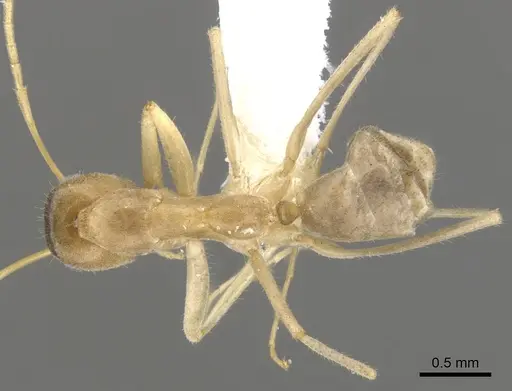
Literature
Loading...Loading products...