

Hypoponera tecta
- Scientific Name
- Hypoponera tecta
- Tribe
- Ponerini
- Subfamily
- Ponerinae
- Author
- Bolton & Fisher, 2011
- Distribution
- Found in 1 countries
Hypoponera tecta Overview
Hypoponera tecta is an ant species of the genus Hypoponera. It is primarily documented in 1 countries , including Kenya. Detailed taxonomic data and occurrence records can be further explored via authoritative databases such as AntWeb or the Global Biodiversity Information Facility (GBIF).
Hypoponera tecta
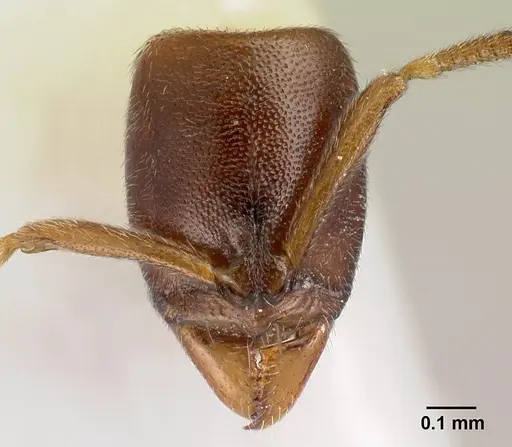
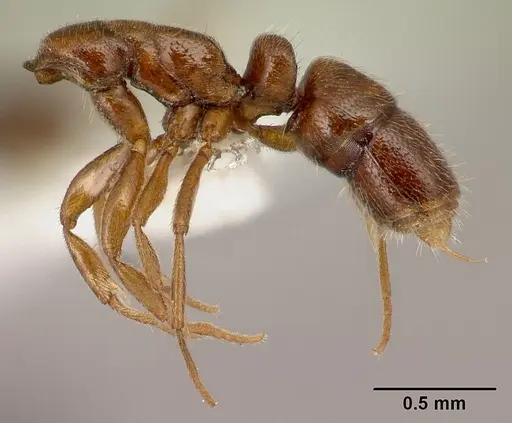
Hypoponera tecta is an extremely small, cryptic ponerine ant species known only from Kenya and Rwanda. Workers measure just 0.60mm in head length, making them among the smallest ants in the genus. They are completely blind (eyes absent) and have a unique diagnostic feature: a small but conspicuous denticle on the front of the clypeus (the face area above the jaws). The body is mostly smooth with subtle sculpturing, and the petiole node has distinctive short ridges on its rear surface. This species belongs to the Hypoponera abeillei group and is considered extremely rare, with only two specimens ever collected across its known range in East Africa [1][2].
Quick Summary
- Difficulty: Expert
- Origin & Habitat: Known from Kenya (Western Province, Mwanza) at 1650m elevation, and recently recorded in Rwanda's Akagera National Park. The genus Hypoponera consists of cryptic ants that nest primarily in soil or decaying wood, allowing them to have wide distributions across various habitats [2].
- Colony Type: Unknown, colony structure has not been documented for this species. Many Hypoponera species have ergatoid (wingless) replacement queens, but this is unconfirmed for H. tecta.
- Size & Growth:
- Queen: Unknown, no queen has been described. Based on worker size of 0.60mm HL, queens would likely be small (estimated 3-4mm) [1]
- Worker: 0.60mm head length,0.48mm head width [1]
- Colony: Unknown, only two specimens have ever been collected [2]
- Growth: Unknown
- Development: Unknown, no development data exists for this species. Based on typical Ponerine patterns, expect 2-4 months at warm temperatures, but this is purely estimated. (Development timeline is unconfirmed. Ponerine ants typically have slower development than many other subfamilies.)
- Antkeeping:
- Temperature: Unknown for this species. Start around 22-26°C and observe colony activity. Most Hypoponera prefer moderate temperatures with stable humidity.
- Humidity: Unknown but likely requires moist conditions. Hypoponera species typically nest in soil and decaying wood, suggesting need for damp substrate. Keep nest substrate consistently moist but not waterlogged.
- Diapause: Unknown, no seasonal data exists. Given the East African distribution (Kenya, Rwanda), a true diapause is unlikely, but colonies may reduce activity during cooler periods.
- Nesting: Natural nesting is in soil or decaying wood [2]. In captivity, a small test tube setup or miniature formicarium with moist substrate would be appropriate. Given their tiny size, narrow passages and small chambers are essential.
- Behavior: Almost nothing is known about their behavior. As Hypoponera, they are likely predatory on small invertebrates. Their tiny size and blindness suggest they may be slow-moving, cryptic foragers. Escape prevention is critical due to their very small size, they can squeeze through the tiniest gaps. Do not assume they are aggressive, many small ponerines are docile.
- Common Issues: extreme rarity means virtually no captive colonies exist, this species is not available in the antkeeping hobby, complete lack of species-specific care information makes successful keeping very high-risk, tiny size creates extreme escape risk, even standard test tube setups may need additional barriers, no information on diet acceptance, feeding would be entirely experimental, blind ants may have different foraging behaviors that are difficult to accommodate in captivity
Species Overview and Identification
Hypoponera tecta is one of the rarest ant species in the world, known from only two specimens collected over nearly two decades. The holotype was collected in Kenya's Western Province in 2007,and a second specimen was found in Rwanda's Akagera National Park in 2026, the first new record since the species was described. This makes H. tecta one of the most poorly known ant species in existence.
Workers are minute at just 0.60mm head length, completely lacking eyes. The most distinctive feature is a small but sharp denticle protruding from the center of the clypeus (the face area between the antennae and jaws). The petiole node has characteristic short ridges on its rear surface, and the body is relatively smooth compared to other Hypoponera species. These morphological details are important for identification but have no practical implications for keeping them in captivity since this species is not available in the hobby [1][2].
Why This Species Is Not Recommended for Keeping
This caresheet exists for completeness, but Hypoponera tecta should NOT be sought after or kept. There are several critical reasons: first, this species has never been found in sufficient numbers to establish a colony, only two individual workers have ever been documented in scientific collections. Second, no biological information exists whatsoever: we don't know what they eat, how they reproduce, what temperature they need, or anything about their colony structure. Third, they appear to be extremely rare in the wild, possibly due to highly specialized habitat requirements or limited distribution.
Even if you somehow obtained specimens, there is no established husbandry knowledge to draw upon. Attempting to keep this species would be essentially experimental with near-zero chance of success. Instead, consider other Hypoponera species that are better understood and more readily available, such as Hypoponera punctatissima or Hypoponera eduardi, which have documented care requirements [1][2].
Genus-Level Care Information
While H. tecta specifically has no documented care requirements, the genus Hypoponera provides some general guidance. These are small, cryptic ants that typically nest in soil, rotting wood, or under stones in moist habitats. Most species are predatory, hunting small invertebrates like springtails, mites, and other micro-arthropods. They are generally not aggressive and possess only mild stingers that are too small to penetrate human skin.
Many Hypoponera species have ergatoid (wingless) queens that can replace the primary queen if she dies, but this varies by species. Founding is typically claustral, the queen seals herself in and lives off stored fat reserves until her first workers emerge. However, none of this has been confirmed for H. tecta specifically [1][2].
Conservation Status and Ethical Considerations
Given that only two specimens of Hypoponera tecta have ever been collected across its known range, the species appears to be genuinely rare or at least extremely difficult to find. This raises significant conservation concerns. Even if specimens were discovered, collecting them could potentially harm tiny wild populations. The scientific community has very little information about this species, and any collection for hobbyist purposes would deprive researchers of the opportunity to study it further.
Additionally, the known distribution in East Africa (Kenya and Rwanda) means any specimens would require export permits and potentially violate international treaties regarding biodiversity. For all these reasons, Hypoponera tecta should be appreciated from a distance, through scientific literature and museum specimens rather than attempts to keep them in captivity [1][2].
References

This caresheet is licensed under CC BY-SA 4.0 .
CASENT0226551
View on AntWeb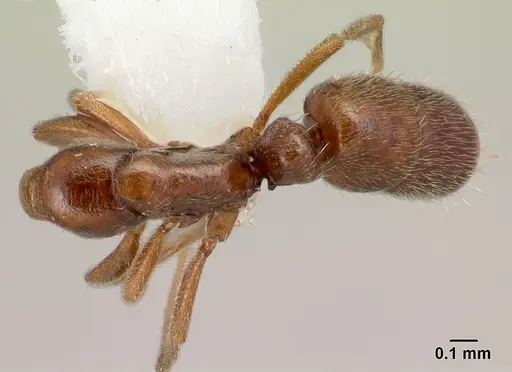
Literature
Loading...Loading products...