

Euponera mialy
- Scientific Name
- Euponera mialy
- Tribe
- Ponerini
- Subfamily
- Ponerinae
- Author
- Rakotonirina & Fisher, 2013
- Distribution
- Found in 1 countries
Euponera mialy Overview
Euponera mialy is an ant species of the genus Euponera. It is primarily documented in 1 countries , including Madagascar. Detailed taxonomic data and occurrence records can be further explored via authoritative databases such as AntWeb or the Global Biodiversity Information Facility (GBIF).
Euponera mialy
Euponera mialy is a small, reddish-orange ant native to Madagascar, specifically found in Ranomafana National Park at elevations around 1100 meters [1]. Workers measure approximately 1.15mm in head width, making them a relatively small species in the Ponerinae subfamily [1]. They have distinctive small eyes with only 7-8 ommatidia, a straight anterior clypeal margin with a median notch, and lack a metanotal groove, features that help distinguish them from similar species like Euponera nosy [1]. The body is glossy reddish-orange with golden pilosity ( erect hairs), and the gaster has an orange apex [1]. This species was originally described as Euponera mialy in 2013 before being transferred to Euponera [1].
This is an extremely poorly known species, only two worker specimens have ever been collected, both from rotten logs in montane rainforest [1][2]. No queens, males, or colony-level observations have been documented, meaning virtually all aspects of their biology in captivity remain speculative. They belong to the sikorae species group within Euponera [1].
Quick Summary
- Difficulty: Expert
- Origin & Habitat: Madagascar, Ranomafana National Park at 1100m elevation in montane rainforest [1][2]. Collected from rotten logs.
- Colony Type: Unknown, only worker specimens have been collected. Colony structure (single-queen or multi-queen) has not been documented.
- Size & Growth:
- Queen: Unknown, no queen specimens have been collected or described [1]
- Worker: 1.15mm head width,1.38-1.41mm head length [1][2]
- Colony: Unknown, colony size has not been documented [1]
- Growth: Unknown
- Development: Unknown, no development data exists for this species (No brood development observations have been documented. Related Ponerine ants typically require 6-12 weeks from egg to worker at optimal temperatures.)
- Antkeeping:
- Temperature: Likely 22-26°C based on montane rainforest origin, no direct data exists. Provide a gentle thermal gradient and monitor colony activity.
- Humidity: High humidity expected given montane rainforest habitat. Keep nest substrate consistently moist but not waterlogged. Aim for 70-85% humidity.
- Diapause: Unknown, no seasonal data exists for this species. Madagascar's highlands may experience cooler winters, so a cool period around 15-18°C for 2-3 months may be beneficial.
- Nesting: In nature they nest in rotten logs [1]. In captivity, a naturalistic setup with damp wood or soil, or a Y-tong/plaster nest with high humidity would likely work well. Avoid dry conditions.
- Behavior: Behavior is undocumented. Based on genus membership, they are likely predatory like most Ponerines, with moderate aggression and a functional sting. Escape prevention should be moderate, workers are small but not tiny enough to require fine mesh barriers. Activity levels are unknown.
- Common Issues: This species is extremely poorly documented, only two workers have ever been collected, so captive care is largely experimental, No established husbandry protocols exist, keepers must be prepared to adjust conditions based on colony response, Colony founding is completely unconfirmed, no queen specimens exist, so captive breeding may be impossible, Growth and development timelines are unknown, making it difficult to assess if colonies are progressing normally, Wild-caught colonies are essentially impossible to obtain since no established populations have been located
Species Discovery and Rarity
Euponera mialy represents one of the most poorly known ants in the antkeeping hobby. This species was only described in 2013 from two worker specimens collected in Ranomafana National Park in Madagascar [1]. The original description placed it in the genus Pachycondyla before it was transferred to Euponera in 2014 [1]. What makes this species particularly challenging for antkeepers is that no queens, males, or colony-level observations have ever been documented. The entire scientific knowledge base consists of two workers collected from rotten logs at 1100m elevation in montane rainforest [1][2]. This means there is no established care information, no development timeline, no confirmed colony structure, and essentially no foundation for captive husbandry. Any antkeeper attempting to keep this species would be pioneering entirely new ground.
Identification and Distinction
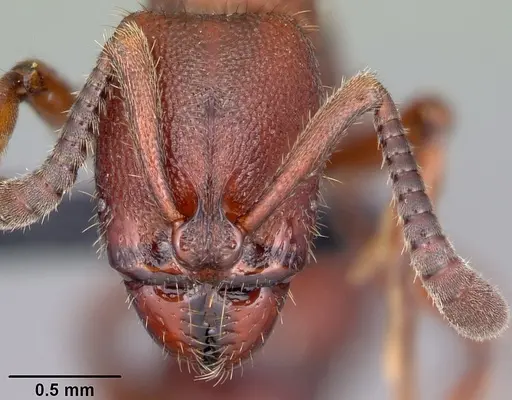
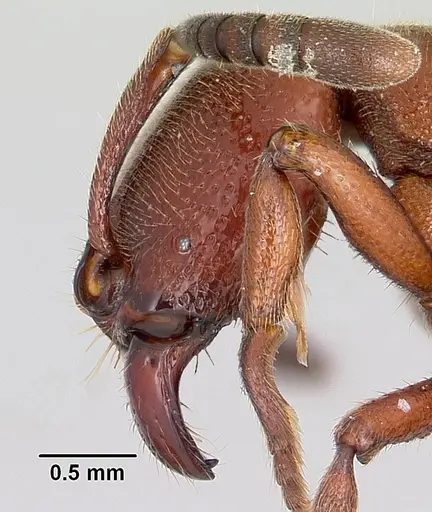
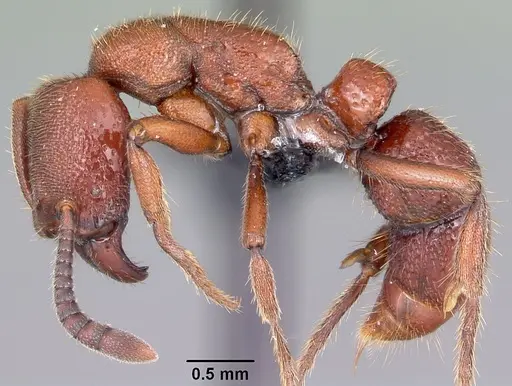
Workers of Euponera mialy can be identified by several key features: very small eyes with only 7-8 ommatidia (most ants have many more), a wide and straight anterior clypeal margin with a median notch, complete absence of a metanotal groove (the groove between the mesosoma and metasoma), and short erect hairs on the antennal scapes and outer tibia surfaces [1]. They are smaller than the similar Euponera nosy, which also has larger eyes, a mesopleural suture, and a reduced metanotal groove [1]. The body is glossy reddish-orange with the gaster having an orange apex, and the entire body is covered in golden erect hairs [1]. These identification features are important because misidentification could lead to keeping the wrong species entirely.
Natural Habitat and Nesting
In the wild, Euponera mialy has only been collected from rotten logs in montane rainforest at approximately 1100 meters elevation in Ranomafana National Park, Madagascar [1][2]. This habitat type suggests they prefer cool, damp, shaded forest environments with access to decaying wood. The montane rainforest of Ranomafana experiences high humidity year-round and temperatures that are cooler than typical tropical lowlands. For captive care, this strongly suggests the need for high humidity environments with damp nest materials. Naturalistic setups using rotting wood or soil-filled setups would most closely mimic their natural preferences. Dry conditions would likely be detrimental to this species.
Inferring Care from Related Species
Since direct care data does not exist for Euponera mialy, we must infer requirements from related species in the Ponerinae subfamily and the sikorae species group. Most Ponerine ants are predatory, hunting small invertebrates like springtails, mites, and tiny insects. They typically require high humidity and benefit from a protein-rich diet. Colony development in related species usually takes 6-12 weeks from egg to worker at optimal temperatures around 22-26°C. However, these are educated guesses based on genus-level patterns, not species-specific data. Keepers should be prepared to experiment and adjust based on observed colony behavior. The complete lack of queen specimens suggests that either ergatoid (wingless) queens exist, or that queen reproduction in this species is poorly understood. Either way, establishing a colony from wild-caught queens would be extremely challenging if not impossible. [1]
Challenges for Antkeepers
Prospective keepers of Euponera mialy should understand they would be attempting something unprecedented. This species has never been kept in captivity to our knowledge, meaning there are no established protocols, no success stories to learn from, and no baseline for assessing whether a colony is thriving. The fundamental challenge is that we don't even know what a queen looks like, no queen specimens have ever been collected or described [1]. This raises serious questions about whether captive breeding is possible at all. Additionally, the extreme rarity of this species in the wild (only two specimens known) means that obtaining a colony would likely be impossible through legal channels. This species is best approached as a scientific curiosity rather than a realistic candidate for antkeeping. Those interested in rare Ponerines may have better success with better-documented species in the genus.
Frequently Asked Questions
Can I keep Euponera mialy as a pet ant?
This species is not recommended for antkeeping. Only two worker specimens have ever been collected in the wild, and no queen or colony has ever been documented. There is no established care information, and obtaining this species legally would be extremely difficult if not impossible.
What does Euponera mialy look like?
Workers are small (about 1.15mm head width) with a glossy reddish-orange body and orange-tipped gaster. They have very small eyes with only 7-8 ommatidia, a straight clypeal margin with a median notch, and lack a metanotal groove. The body is covered in golden erect hairs.
Where does Euponera mialy live?
This species is known only from Ranomafana National Park in Madagascar, at approximately 1100 meters elevation in montane rainforest. They have been collected from rotten logs.
How big do Euponera mialy colonies get?
Unknown, colony size has never been documented. Only two worker specimens have ever been collected, and no colony observations exist.
What do Euponera mialy ants eat?
Unconfirmed, but based on related Ponerine ants, they are likely predatory on small invertebrates like springtails and mites. No direct feeding observations exist for this species.
How long does it take for Euponera mialy to develop from egg to worker?
Unknown, no development data exists for this species. Related Ponerine ants typically require 6-12 weeks at optimal temperatures, but this is purely speculative for E. mialy.
Do Euponera mialy queens exist?
No queen specimens have ever been collected or described. The species is known only from two worker specimens, making queen morphology, colony structure, and breeding biology completely unknown.
Is Euponera mialy a good species for beginners?
No. This is an expert-level species due to complete lack of care documentation, extreme rarity, and unknown biology. Even experienced antkeepers would have no foundation for establishing husbandry protocols.
What temperature and humidity do Euponera mialy need?
Likely 22-26°C with high humidity (70-85%) based on montane rainforest origin. However, no direct data exists, these are estimates based on habitat preferences. Provide a thermal gradient and monitor colony response.
Can I breed Euponera mialy in captivity?
Extremely unlikely, no queen specimens exist, so captive breeding would require finding wild queens that have never been documented. Even if queens were found, no one knows the breeding biology or requirements.
Is Euponera mialy endangered?
Insufficient data exists to assess conservation status. However, the species is known only from two specimens from a single location (Ranomafana National Park), making any population assessment speculative.
References

This caresheet is licensed under CC BY-SA 4.0 .
CASENT0497667
View on AntWeb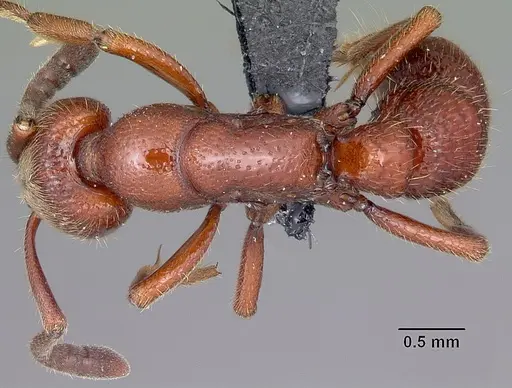
Literature
Loading...Loading products...