

Ectatomma parasiticum
- Scientific Name
- Ectatomma parasiticum
- Tribe
- Ectatommini
- Subfamily
- Ectatomminae
- Author
- Feitosa & Fresneau, 2008
- Distribution
- Found in 1 countries
Ectatomma parasiticum Overview
Ectatomma parasiticum is an ant species of the genus Ectatomma. It is primarily documented in 1 countries , including Mexico. Detailed taxonomic data and occurrence records can be further explored via authoritative databases such as AntWeb or the Global Biodiversity Information Facility (GBIF).
Ectatomma parasiticum
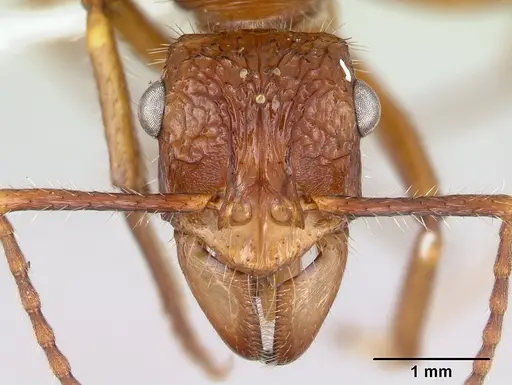
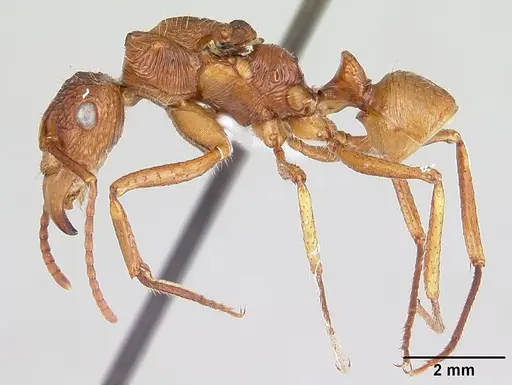
Ectatomma parasiticum is an extraordinarily rare social parasite ant species native to eastern Mexico. It is the first and only known social parasite in the entire subfamily Ectatomminae, making it a unique biological curiosity [1][2]. These tiny parasitic queens measure only about 3.8mm in body length (work mesosoma length), making them significantly smaller than their host species Ectatomma tuberculatum, which reaches around 5.4mm [1]. The species was only formally described in 2008 and is known exclusively from a single location near Apazapan in Veracruz, Mexico [1][3]. The queens are yellowish brown to dark reddish brown in color, with notably reduced sculpture on the clypeus and frontal area compared to the host [1]. This species represents a remarkable case of recent speciation through social parasitism, having diverged from its host within the last 0.4-1.3 million years [4].
What makes E. parasiticum truly extraordinary is its workerless inquiline lifestyle. Unlike typical ants, this species produces almost exclusively sexual offspring (new queens and males) rather than workers [1][3]. The parasitic queens infiltrate established host colonies without killing the resident queen(s), living alongside them and focusing entirely on reproduction [1]. This represents a permanent form of social parasitism without slavery, a rare and fascinating evolutionary strategy [4].
Quick Summary
- Difficulty: Expert
- Origin & Habitat: Eastern Mexico (Veracruz), specifically the Apazapan region near 19°19'N,96°43'W. This is a tropical lowland area where the species parasitizes nests of Ectatomma tuberculatum [1][3]. The habitat is characterized by seasonal rainfall patterns, with successful collections of the parasite occurring after rainy periods [3].
- Colony Type: Workerless inquiline social parasite. This species does not produce true workers, only sexual offspring (new queens and males). Laboratory colonies have produced small individuals with developed reproductive structures (6-10 ovarioles in females, spermatheca present), suggesting these are intercaste reproductive forms rather than true workers [1]. The parasite coexists with host queens in mixed colonies without killing them [1].
- Colony: Polygyne
- Queen: Socially parasitic
- Size & Growth:
- Queen: ~3.8mm WL (work mesosoma length) [1]. This is significantly smaller than the host E. tuberculatum queens at ~5.4mm [1].
- Worker: Workerless, this species does not produce true workers [1][3].
- Colony: In parasitized colonies, researchers found 3-19 parasitic queens per colony, with a median of 3 alate (winged) parasites and 1 dealate (wingless) parasite per colony [3].
- Growth: Unknown, no data on development timeline exists. The species produces sexual offspring almost exclusively [1].
- Development: Not applicable, this is a workerless species [1][3]. (The species produces almost exclusively sexual offspring (new queens and males). No worker production has been documented in the wild [1].)
- Antkeeping:
- Temperature: Unknown for this species specifically. Based on the tropical Mexican location (Veracruz), a temperature range of 22-28°C would be appropriate. The host E. tuberculatum is known from similar Neotropical habitats [3].
- Humidity: Unknown specifically, but the region experiences seasonal variation with distinct rainy periods. The parasite was more frequently collected after rainy periods, suggesting higher humidity may be beneficial [3].
- Diapause: Unknown, no data on overwintering requirements exists. Given its tropical distribution in Mexico, diapause may not be required [3].
- Nesting: This species is an inquiline parasite that lives within the nests of its host Ectatomma tuberculatum. In captivity, keeping this species would require maintaining a healthy host colony first [1][3].
- Behavior: This species is a permanent social parasite that cannot survive without its host. Parasitic queens infiltrate host colonies and are partially accepted due to imperfect chemical mimicry, they have reduced cuticular hydrocarbons compared to hosts, which allows some discrimination by host workers [5]. Host workers can distinguish between parasitic queens and conspecific queens, showing different levels of antennation and immobility toward parasites [3]. Some parasites are attacked by host workers, indicating imperfect social integration [3]. The species shows intracolonial mating, meaning parasites mate within their host colony [3]. Escape risk cannot be assessed as this species cannot be kept without a host colony.
- Common Issues: This species cannot be kept without a host colony, it is an obligate social parasite that cannot found its own colony or survive independently [1][3]., The species is workerless, there are no workers to tend brood, forage, or maintain the colony. All colony functions depend on host workers [1]., Extremely rare in the wild, only known from a single location in Mexico, making wild collection both ethically questionable and practically impossible [3][4]., Even if obtained, keeping this species requires expert knowledge of the host species E. tuberculatum and careful colony management [1]., The species produces almost exclusively sexual offspring, meaning colonies cannot develop worker forces and will not grow in the typical antkeeping sense [1].
Understanding Ectatomma parasiticum
Ectatomma parasiticum represents a remarkable evolutionary phenomenon, it is the first and only social parasite ever described in the subfamily Ectatomminae, which contains some of the more primitive ant groups in the Americas [1][2]. This species was only formally described in 2008,making it one of the most recently discovered ant species available for study [1]. It is a workerless inquiline, meaning it lives permanently within the nests of its host species Ectatomma tuberculatum without producing its own workers [1][3]. Instead of workers, the parasite produces almost exclusively sexual offspring, new queens and males, which is highly unusual among ants [1]. Genetic analysis shows it is a sibling species to E. tuberculatum, having diverged very recently (within the last 0.4-1.3 million years) through a process of sympatric speciation likely facilitated by polygyny in the host population [4][3]. The species is known only from Apazapan in Veracruz, Mexico, making it one of the rarest ants in the world [1][3].
The Host: Ectatomma tuberculatum
Ectatomma parasiticum exclusively parasitizes colonies of Ectatomma tuberculatum, a larger and more common Neotropical ant species [1][6]. The host workers and queens can discriminate between parasitic individuals and their own species through chemical cues, specifically, the parasite has only about one-tenth the cuticular hydrocarbons of host queens and 1.5 times less than host workers [5]. Despite this chemical difference, some integration occurs because the parasite has partially conserved queen-specific substances from its host that produce attracting and settling effects on workers [3]. In mixed colonies, the parasite does not kill the host queen(s) but instead coexists peacefully while focusing its reproductive efforts on producing new sexuals [1]. Host workers show variable responses, sometimes accepting parasites and treating them like nestmates, other times attacking them as intruders [3]. This imperfect chemical mimicry makes the relationship somewhat unstable compared to more integrated social parasites [5].
Why This Species Is Not Suitable for Most Antkeepers
Ectatomma parasiticum is absolutely not suitable for typical antkeeping. This is an obligate social parasite that cannot survive without a host colony, it produces no workers and cannot forage or care for brood independently [1][3]. Keeping this species would require first establishing a healthy colony of Ectatomma tuberculatum, then introducing the parasite and managing the complex interspecies relationship. Even then, the colony would produce no workers, only new queens and males, meaning there would be nothing for the keeper to observe in terms of typical ant behavior [1]. Additionally, the species is known from only a single wild location in Mexico and is extremely rare [3]. There is also an ethical concern: removing these ants from the wild could harm already tiny populations of one of the world's rarest ant species [4]. For antkeepers interested in parasitic species, it is far better to study this fascinating species in scientific literature rather than attempt to keep it [3].
Scientific Significance
Despite being unsuitable for captivity, Ectatomma parasiticum holds tremendous scientific value as the first documented case of social parasitism in the poneroid complex of ant subfamilies [7][8]. It provides researchers with a window into how new ant species can evolve through social parasitism, in this case, likely from a population of E. tuberculatum that developed queen miniaturization and eventually lost the ability to produce workers [4]. The species also demonstrates imperfect chemical mimicry, showing how host recognition systems can be partially bypassed but never fully achieved [5]. Studies have shown that host workers from the Apazapan population can discriminate E. parasiticum from conspecifics, but the discrimination is not perfect, some parasites are accepted while others are attacked [3]. This makes it an excellent model system for studying the evolution of social parasitism and the chemical communication mechanisms that govern ant societies [5][3]. The recent divergence (within the Pleistocene) also makes it valuable for understanding speciation processes in ants [4].
Frequently Asked Questions
Can I keep Ectatomma parasiticum as a pet ant?
No. This species is an obligate social parasite that cannot survive without its host Ectatomma tuberculatum. It produces no workers and cannot found its own colony. Additionally, it is one of the rarest ants in the world, known only from a single location in Mexico. This species should be appreciated through scientific literature, not captivity [1][3][4].
Does Ectatomma parasiticum have workers?
No. This is a workerless species. Laboratory colonies have produced small individuals, but these had developed reproductive structures (ovarioles and spermatheca) rather than being true workers. They appear to be intercaste reproductive forms, not functional workers [1].
How does Ectatomma parasiticum reproduce?
The parasitic queens live within host colonies and produce almost exclusively sexual offspring, new queens (alates) and males. They do not kill the host queen but coexist alongside her, focusing their reproductive efforts on sexual production rather than worker production [1][3].
Where does Ectatomma parasiticum live?
This species is known only from Apazapan in Veracruz, eastern Mexico. It has never been found anywhere else in the world [1][3].
What does Ectatomma parasiticum eat?
This is not directly documented. As a social parasite living within host colonies, it would rely on host workers for food exchange (trophallaxis). It cannot forage independently since it has no workers [1].
How big do Ectatomma parasiticum colonies get?
In parasitized host colonies, researchers found typically 3-19 parasitic queens per colony, with a median of 3 alate (winged) parasites and 1 dealate (wingless) parasite per colony. The colonies do not produce workers, only new sexuals [3].
Is Ectatomma parasiticum dangerous?
No danger to humans, this species is tiny (about 3.8mm) and cannot sting. However, it is dangerous to the host species in the sense that it exploits host resources. For antkeepers, the main concern would be ethical, this is an extremely rare species that should not be collected [1][3].
What is the host species for Ectatomma parasiticum?
Ectatomma tuberculatum. The parasite lives permanently within host colonies without killing the host queen(s), making it an inquiline parasite [1][6].
Why is Ectatomma parasiticum so rare?
It is known from only a single location worldwide (Apazapan, Veracruz, Mexico), has a patchy distribution suggesting short-range dispersal, and shows seasonal abundance patterns tied to rainfall. Its dependence on a specific host species also limits its spread [3][4].
Can I start a colony with a single queen?
No. As an inquiline parasite, this species cannot found colonies independently. The queen must infiltrate an established host colony to survive. There is no documented method for establishing this species in captivity [1][3].
References

This caresheet is licensed under CC BY-SA 4.0 .
CASENT0178851
View on AntWeb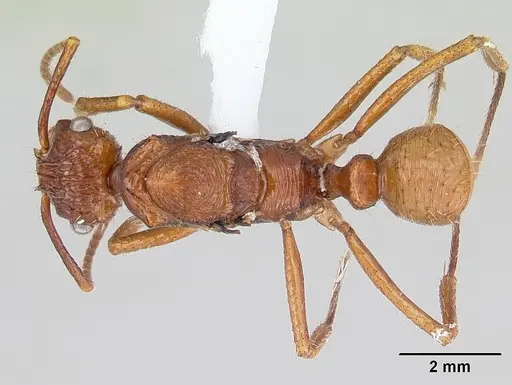
Literature
Loading...Loading products...