

Belonopelta attenuata
- Scientific Name
- Belonopelta attenuata
- Tribe
- Ponerini
- Subfamily
- Ponerinae
- Author
- Mayr, 1870
- Distribution
- Found in 1 countries
Belonopelta attenuata Overview
Belonopelta attenuata is an ant species of the genus Belonopelta. It is primarily documented in 1 countries , including Colombia. Detailed taxonomic data and occurrence records can be further explored via authoritative databases such as AntWeb or the Global Biodiversity Information Facility (GBIF).
Belonopelta attenuata
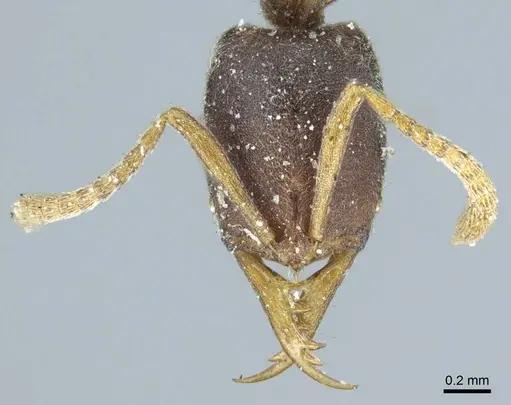
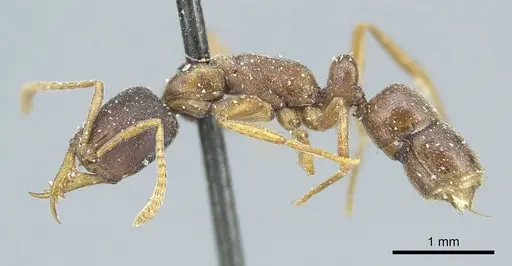
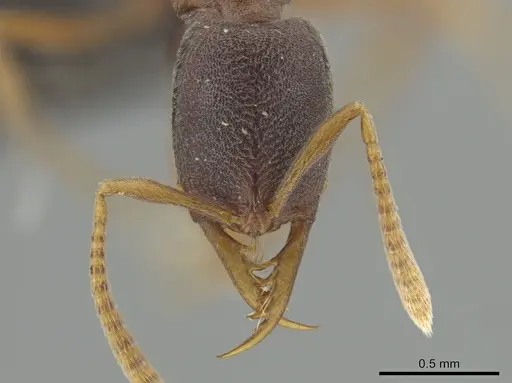
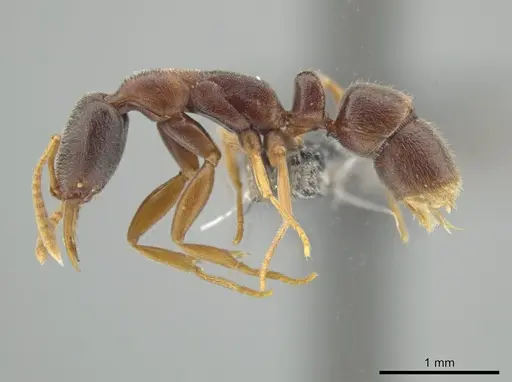
Belonopelta attenuata is a rare predatory ant from the Ponerinae subfamily, found only in Colombia. Workers measure 4.8-5mm and have a distinctive appearance: a black head with brownish-ferruginous body, very finely punctate surface, and slender mandibles with six teeth including the apical tooth [1][2]. The body has scattered erect hairs and well-developed pubescence [2][3]. This species is extremely rare in both the wild and in ant collections, with almost no documented colonies. Its closest relative, Belonopelta deletrix, is also rarely encountered, and what little we know about this genus suggests these are cryptic predators that hunt soft-bodied arthropods like diplurans in hidden microhabitats [4].
Quick Summary
- Difficulty: Expert
- Origin & Habitat: Colombia, South America. This species is known only from Colombia in the Neotropical region, with the type locality being Santa Fé de Bogotá [1][5]. Nothing is known about its specific natural habitat, but related species in the Pachycondyla genus group typically inhabit forest floor environments with moist, shaded conditions.
- Colony Type: Colony structure is completely unconfirmed. No wild colonies have been documented, and the queen has never been described. Based on typical Ponerinae patterns, expect single-queen colonies, but this is an estimate.
- Size & Growth:
- Queen: Unknown, queen has never been described
- Worker: 4.8-5mm [1]
- Colony: Unknown, no colonies have been documented
- Growth: Unknown, no colony data exists
- Development: Unknown, this species has never been kept in captivity (No development data exists. Related Ponerinae species typically take 2-4 months from egg to worker at tropical temperatures.)
- Antkeeping:
- Temperature: Likely needs warm conditions similar to other Colombian Ponerinae. Start around 24-28°C and observe colony activity. Provide a temperature gradient so ants can self-regulate.
- Humidity: Likely requires high humidity, think damp forest floor. Keep nest substrate consistently moist but not waterlogged. Provide a humidity gradient.
- Diapause: Unknown, as a tropical Colombian species, diapause is unlikely but not confirmed. Do not force hibernation without evidence.
- Nesting: Unknown natural nesting behavior. Based on related Ponerinae species, likely nests in soil, under stones, or in rotting wood. A naturalistic setup with moist substrate or a Y-tong/plaster nest would be appropriate starting points.
- Behavior: Behavior is completely unstudied in captivity. Based on morphology and related species, these are likely cryptic, slow-moving predators that hunt alone rather than in groups. Their slender mandibles suggest specialized predation on soft-bodied prey like diplurans (small wingless insects). Escape risk is moderate, workers are 5mm so standard containment measures should work, but their small size means escape prevention should still be taken seriously.
- Common Issues: no captive husbandry information exists, this species has never been documented in the antkeeping hobby, extremely rare in the wild with no documented colonies, prey acceptance is completely unknown, may require specialized live prey, humidity requirements may be critical and difficult to maintain, no information on founding behavior or queen requirements
Why This Species Is So Challenging
Belonopelta attenuata is perhaps the most poorly documented ant species in the hobby. It has never been kept in captivity, and even in the wild, only a handful of specimens have ever been collected. The last documented collection was the original type specimens from the 1800s, with no new material reported since [5]. This means there is absolutely no captive husbandry information, no feeding records, no development data, and no established protocols for keeping this species alive. You would essentially be pioneering all aspects of care from scratch. This level of uncertainty makes this species suitable only for expert antkeepers with extensive experience in raising difficult, data-poor species who can afford to experiment extensively.
Identification and Morphology
Workers of Belonopelta attenuata measure 4.8-5mm in total length [1]. They have a distinctive color pattern: the body is brownish-ferruginous and shining, the head is black with a ferruginous anterior portion, and the mandibles, antennae, and legs are reddish-testaceous [1]. The most distinctive features are the slender mandibles with six teeth including the apical tooth, and the body surface which is very densely and finely punctate (giving a fingerhut-like texture to the head), with very sparse protruding hairs and fine pubescence [1][2]. The abdominal petiole (the narrow 'waist' segment) has a posterior surface that is almost smooth and very shiny, contrasting with the densely punctate rest of the body [1].
Distribution and Rarity
This species is known only from Colombia, making it one of the most restricted ant species in terms of documented range [2][3]. The type locality is Santa Fé de Bogotá, though the exact collection data is limited [1]. No new specimens have been reported since the original description, suggesting either extreme rarity, very cryptic behavior, or both [5]. This extreme endemism to Colombia means any colony would represent a significant range extension if found in captivity, and keepers would need to be especially careful about not releasing any specimens given the species' limited distribution.
Predatory Specialization
Based on mandible morphology and what is known about the related Belonopelta deletrix, this species is likely a specialized predator of diplurans and other soft-bodied arthropods [4]. Diplurans are small, wingless insects that live in moist soil and leaf litter, making them cryptic prey that requires hunting in hidden microhabitats. The slender, toothed mandibles of Belonopelta are adapted for precision strikes on small, soft prey rather than the powerful crushing bites used by some other Ponerinae. In captivity, this likely means offering small live prey such as springtails, small isopods, or similar micro-arthropods. Standard ant foods like mealworms or crickets may be too large or inappropriate. This specialization is a major challenge, if the ants refuse standard prey, you may need to culture specific prey organisms.
Related Species: Belonopelta deletrix
Belonopelta attenuata's only congener, Belonopelta deletrix, is similarly rare but has been slightly better studied through colonies collected by E.O. Wilson [4]. Observations of deletrix provide the best indirect information for keeping attenuata. Like attenuata, deletrix is a cryptic predator that hunts in hidden microhabitats. The two species can be distinguished by several features: deletrix has a shorter and broader head, more projecting clypeus (the shield-like plate above the mouth), more slender and arcuate mandibles with much longer tips, longer antennal scapes, smaller overall size, and coarser punctures on the head in addition to the fine punctation [4]. These differences suggest attenuata may be slightly larger and less specialized in some feeding aspects, but both species share the same basic cryptic predator lifestyle.
Frequently Asked Questions
Can I keep Belonopelta attenuata in captivity?
It is extremely unlikely you will ever find this species for sale. Belonopelta attenuata has never been documented in the antkeeping hobby and only a handful of specimens have ever been collected in the wild. Even if you somehow obtained a specimen, there is zero captive husbandry information, no one knows what they eat, what humidity they need, or how to keep them alive.
What do Belonopelta attenuata ants eat?
Unknown, this has never been documented. Based on mandible morphology and related species, they are likely specialized predators of soft-bodied arthropods like diplurans. They probably need small live prey such as springtails or tiny isopods. Standard ant foods like mealworms or sugar water may not be accepted.
How big do Belonopelta attenuata colonies get?
Unknown, no wild colonies have ever been documented. Based on related Ponerinae species, colonies are likely small (dozens to low hundreds of workers), but this is purely speculative.
What temperature do Belonopelta attenuata ants need?
Not directly studied. As a Colombian tropical species, they likely need warm conditions around 24-28°C. Start in this range and observe colony behavior to adjust.
Do Belonopelta attenuata need hibernation?
Unknown but unlikely. As a tropical species from Colombia, they probably do not enter diapause. However, this has never been studied, so observe colony behavior for seasonal changes.
Is Belonopelta attenuata a good species for beginners?
Absolutely not. This species has never been kept in captivity, has no established care protocols, and is one of the rarest ants in the world. Even expert antkeepers would struggle with the complete lack of information. If you want a challenging Ponerinae, look for better-documented species like Pachycondyla or Neoponera.
Where does Belonopelta attenuata live?
Only in Colombia, South America. The exact locality is Santa Fé de Bogotá. This is one of the most restricted ant species in terms of documented range.
How long do Belonopelta attenuata workers live?
Unknown, no colony data exists. Typical Ponerinae workers live several months to over a year, but this has never been studied for this specific species.
Can I keep multiple Belonopelta attenuata queens together?
Unknown, colony structure has never been documented. Without any data on wild colony structure, there is no way to know whether they are monogyne (single queen) or polygyne (multiple queens). Do not attempt combining queens without evidence.
References

This caresheet is licensed under CC BY-SA 4.0 .
CASENT0915936
View on AntWeb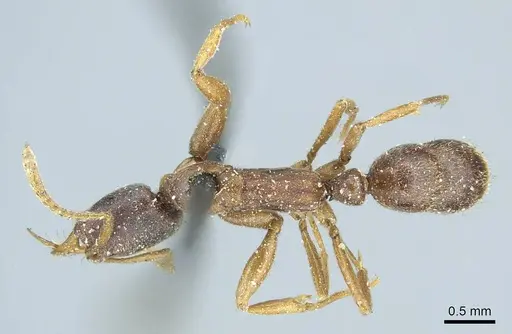
ICN100255
View on AntWeb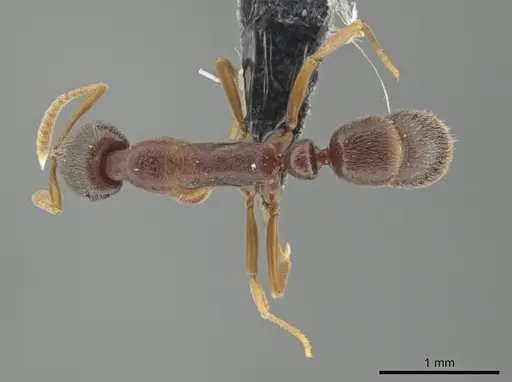
Literature
Loading...Loading products...