

Axinidris ghanensis
- Scientific Name
- Axinidris ghanensis
- Tribe
- Tapinomini
- Subfamily
- Dolichoderinae
- Author
- Shattuck, 1991
- Distribution
- Found in 1 countries
Axinidris ghanensis Overview
Axinidris ghanensis is an ant species of the genus Axinidris. It is primarily documented in 1 countries , including Uganda. Detailed taxonomic data and occurrence records can be further explored via authoritative databases such as AntWeb or the Global Biodiversity Information Facility (GBIF).
Axinidris ghanensis
These tiny reddish-brown ants are one of the rarest species in antkeeping. Workers measure barely 2mm long with smooth, shiny abdomens and darker rear body sections [1][2]. Scientists have only collected this species twice, once from Ghana and possibly once from Uganda, and every known specimen is a worker [2][1]. No queens, males, or nests have ever been found [1]. They belong to the genus Axinidris, a group of tree-dwelling ants scattered across African forests [1].
Because researchers have only found two workers total, nobody knows how their colonies function, what their queens look like, or how to keep them alive in captivity. They remain a scientific mystery rather than a pet ant species.
Quick Summary
- Difficulty: Expert
- Origin & Habitat: Tropical forests of Ghana and Uganda, Africa [2]. The genus lives in trees [1].
- Colony Type: Unknown, only the worker caste has ever been collected [1].
- Size & Growth:
- Queen: Unknown, queens have never been collected [1].
- Worker: Approximately 2mm total length (head width 0.76mm, head length 0.83mm) [1].
- Colony: Unknown.
- Growth: Unknown.
- Development: Unknown, no data exists. Based on typical Dolichoderinae patterns, possibly 6-10 weeks at 25°C, but this is speculative. (No captive colonies have ever been documented.)
- Antkeeping:
- Temperature: Unknown. Based on tropical Ghana origin, likely warm, start around 24-26°C and observe.
- Humidity: Unknown. Forest habitat suggests moderate to high humidity.
- Diapause: Likely not required, tropical species typically do not hibernate.
- Nesting: Unknown. The genus is arboreal [1], so likely nests in tree cavities or twigs.
- Behavior: Unknown temperament. Extremely small size means escape is inevitable without specialized micro-barriers.
- Common Issues: unavailable in the ant trade, only two specimens exist in scientific collections worldwide., unknown founding behavior means captive rearing protocols do not exist., tiny size requires specialized equipment to contain that most keepers do not own., no queens have ever been collected, making colony founding impossible.
Scientific Rarity and Collection History
Axinidris ghanensis is one of the rarest ants in scientific collections. The species is known from only two collections total, the holotype worker collected in Mampong, Ghana in 1970,and potentially one additional collection from Uganda [2][1]. Every confirmed specimen is a worker, no queens, males, or immature stages have ever been found [1].
This extreme rarity means no biological studies exist for this species. Scientists do not know their colony size, nesting habits, diet, or reproductive behavior. The species was described in 1991 by Shattuck based solely on morphological examination of the single available specimen [2]. For antkeepers, this means no captive breeding populations exist, no queens are available for purchase, and no care protocols have been developed.
Morphology and Identification
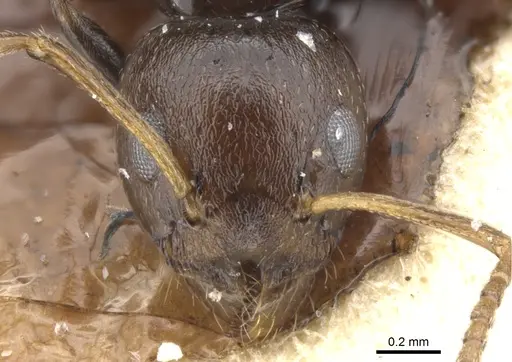
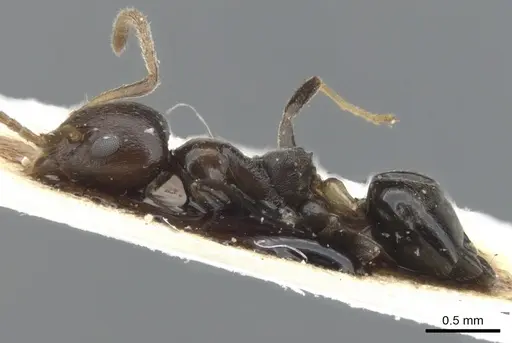
Workers are tiny reddish-brown ants measuring approximately 2mm in total length [1]. Key identifying features include a head width of 0.76mm and head length of 0.83mm, giving them a somewhat elongated head shape [1]. The antennae lack erect hairs, and the pronotum bears only two erect hairs [1]. The middle body section (mesosoma) is finely textured with punctures, while the second abdominal segment is shiny and sparsely punctate [1].
The propodeum has a distinct raised ridge (medial carina) that is slightly expanded at the top, and the spines point backward and outward [1]. The coloration is reddish brown with a darker rear body section, yellowish-red mandibles and antennae, and yellow feet [2]. They most closely resemble Axinidris murielae but are larger and lack the erect hairs on the antennae that A. murielae possesses [2].
Genus-Level Inferences
While specific biology is unknown, Axinidris ghanensis belongs to the subfamily Dolichoderinae, which includes familiar ants like the odorous house ants and Azteca [2]. Dolichoderinae typically have claustral founding where queens seal themselves in chambers to raise first workers, though this is unconfirmed for this species.
The genus Axinidris is arboreal, meaning they nest in trees and vegetation rather than soil [1]. Related species likely feed on honeydew from sap-sucking insects and small prey. If kept in captivity, they would probably require small prey items like springtails or fruit flies due to their tiny size, and would likely appreciate wooden nest cavities simulating tree branches. However, these are educated guesses based on related species, not confirmed behaviors.
Why This Species Is Unavailable to Keepers
You cannot currently keep Axinidris ghanensis. Only two specimens exist in museum collections, and no queens have ever been collected [1]. Without queens, colonies cannot be founded, and without established captive populations, no one can sell or trade them.
Even if specimens were available, their extremely small size (2mm workers) presents technical challenges beyond standard antkeeping equipment. They would require specialized micro-formicaria with extremely fine mesh or barriers to prevent escape. Until researchers successfully collect queens and establish captive colonies, this species remains a scientific curiosity rather than a pet ant.
Frequently Asked Questions
Can I buy Axinidris ghanensis ants?
No. This species is not available in the ant trade. Only two worker specimens exist in scientific collections worldwide, and no queens have ever been found [1][2].
How do I care for Axinidris ghanensis?
Nobody knows. No captive colonies have ever been established. Based on their tropical forest origin, they would likely need warm temperatures around 24-26°C and moderate humidity, but this is speculation [2].
How big are Axinidris ghanensis queens?
Unknown. Queens have never been collected or described for this species [1].
How long until Axinidris ghanensis get their first workers?
Unknown. No one has ever raised this species from a queen. Based on related Dolichoderinae ants, development might take 6-10 weeks at warm temperatures, but this is purely a guess.
What do Axinidris ghanensis eat?
Unknown in the wild. Related Dolichoderinae ants typically eat honeydew and small insects, so they might accept sugar water and tiny prey like springtails, but this is unconfirmed.
Where do Axinidris ghanensis nest?
Unknown for this specific species. The genus Axinidris is arboreal, meaning they nest in trees and vegetation rather than underground [1].
Are Axinidris ghanensis dangerous?
Unknown, but unlikely. They are extremely small (2mm) and belong to a subfamily that lacks stingers. They might bite if threatened, but could not penetrate human skin [1].
Why is Axinidris ghanensis so rare?
They may be genuinely rare in nature, or they may be cryptic, living high in forest canopies where collectors rarely look. Only two collections in over 50 years suggests either extreme rarity or extremely secretive habits [2][1].
References

This caresheet is licensed under CC BY-SA 4.0 .
CASENT0902931
View on AntWeb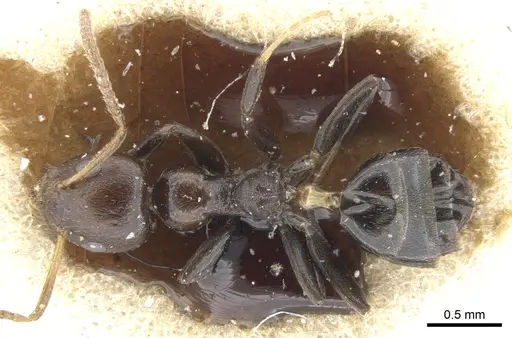
Literature
Loading...Loading products...