

Anochetus alae
- Scientific Name
- Anochetus alae
- Tribe
- Ponerini
- Subfamily
- Ponerinae
- Author
- Shattuck & Slipinska, 2012
- Distribution
- Found in 1 countries
Anochetus alae Overview
Anochetus alae is an ant species of the genus Anochetus. It is primarily documented in 1 countries , including Australia. Detailed taxonomic data and occurrence records can be further explored via authoritative databases such as AntWeb or the Global Biodiversity Information Facility (GBIF).
Anochetus alae
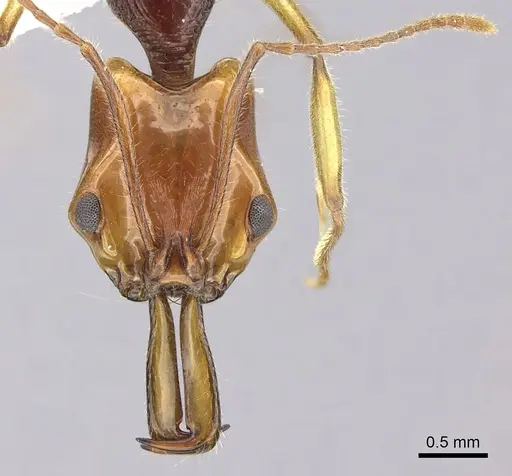
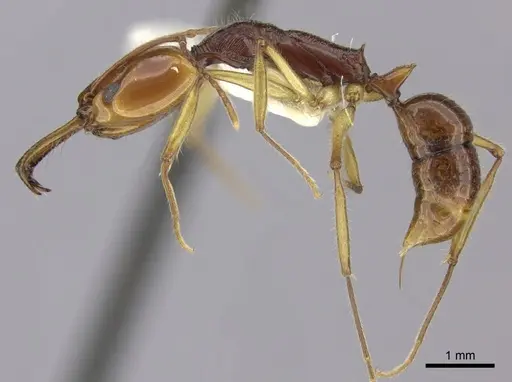
Anochetus alae is quite possibly the rarest ant you will ever encounter. Scientists have found this species exactly once: in 1983,when Phil Ward collected a single nest under a stone in a gully rainforest near Cairns, Queensland [1]. No other colonies have been located in the 40 years since. Workers are large for the genus at roughly 4-5mm total length, with powerful trap-jaw mandibles that snap shut at incredible speed to capture prey. They show a light brown body with yellow-brown heads, antennae, and mandibles, plus yellow legs. Sharp spines protrude from the rear thorax and the petiolar node, and the head carries distinctive sculpturing extending slightly past the eyes [1]. This species belongs to the rectangularis species group within the trap-jaw ant genus [2]. If you are reading this caresheet because you have acquired these ants, you are likely caring for one of the only known living colonies in existence.
Quick Summary
- Difficulty: Expert
- Origin & Habitat: Cairns North, Queensland, Australia (16°53'S 145°46'E), tropical gully rainforest at 100m elevation, nesting under stones [1].
- Colony Type: Unknown, only worker specimens have been collected, queen number and social structure remain unconfirmed [1].
- Size & Growth:
- Queen: Unknown, no queens have been collected or described [1].
- Worker: Approximately 4-5mm total length (head length 1.79-1.81mm, mesosoma length 2.18-2.32mm, mandible length 1.05-1.12mm) [1].
- Colony: Unknown, only one nest has ever been documented [1].
- Growth: Unknown
- Development: Unknown, no breeding or development data exists for this species. (Development has never been documented in the wild or captivity.)
- Antkeeping:
- Temperature: Warm tropical conditions, roughly 24-28°C inferred from Queensland rainforest habitat. Start at 25°C and adjust based on activity levels.
- Humidity: High humidity required, approximately 70-80% estimated from rainforest floor habitat. Keep nest substrate damp but not waterlogged.
- Diapause: Unknown, likely unnecessary given tropical origin, but unconfirmed.
- Nesting: Natural nests occur under flat stones in humid forest floor litter [1]. In captivity, provide flat stone hides or shallow chambers with excellent humidity retention.
- Behavior: Trap-jaw predatory behavior typical of the genus is expected, using lightning-fast mandible strikes to capture small prey. Specific activity patterns, aggression levels, and escape behaviors remain unknown due to lack of observation. Workers likely possess the jumping ability common to trap-jaw ants, using mandible strikes to propel themselves away from danger.
- Common Issues: extreme rarity means no established care protocols exist, you are essentially writing the manual., unknown founding type creates high risk of queen mortality if founding behavior is guessed incorrectly., legal restrictions strictly prohibit export from Australia without permits, captive specimens outside Australia likely represent illegal collection., specific dietary needs are unstudied, may require specialized small prey that is difficult to source., lack of any colony growth data means housing upgrades or space requirements are completely speculative.
Extreme Rarity and Legal Considerations
Anochetus alae holds the distinction of being one of the world's least-known ant species. The entire scientific record consists of a single collection event on August 14,1983,when Phil Ward found one nest containing 22 specimens (one holotype and 21 paratypes) beneath a stone in a gully rainforest near Cairns [1]. Despite extensive ant surveys across Queensland in the decades since, no additional specimens have been reported.
This extreme rarity carries significant legal implications. Australian law strictly protects native wildlife, and exporting ants without appropriate permits violates the Environment Protection and Biodiversity Conservation Act. If you encounter Anochetus alae outside Australia, the specimens likely represent illegal collection or export. Within Australia, keeping native wildlife often requires permits depending on your state or territory. Before attempting to acquire or keep this species, verify all legal requirements thoroughly. Given that only one colony has ever been documented, removing any additional colonies from the wild could represent a significant conservation threat.
Morphology and Identification
Workers of Anochetus alae are immediately recognizable as large members of the genus. The head measures 1.79-1.81mm in length and 1.54-1.58mm in width, with sculpturing on the front of the head extending only slightly beyond the eyes [1]. The antennae are relatively long (scape length 1.61-1.66mm), surpassing the rear corners of the head, and carry abundant fine hairs [1].
The mesosoma shows distinct sculpturing: the pronotum is smooth and shiny on top but striate on the sides, with transverse wrinkles on the front portion. The mesonotum carries a few transverse, irregular ridges. Most notably, the propodeum angles are produced as long spines, and the petiolar node has its top margin concave in the middle with the corners produced as sharp spines [1]. The coloration is light brown overall, with the head, antennae, mandibles, and legs appearing yellow-brown to yellow [1].
These features distinguish Anochetus alae from the similar Anochetus veronicae by its larger size, better-developed mesosoma sculpturing, more convex front face of the petiolar node, and more abundant hairs on the antennae [1].
Natural Habitat and Microclimate
The single known nest came from a gully rainforest habitat at approximately 100 meters elevation in the Cairns North area of Queensland [1]. This region experiences a tropical climate with high year-round rainfall and temperatures typically ranging from 20°C to 30°C. The specific microhabitat, under a stone in a gully, suggests these ants prefer humid, shaded conditions with access to moist soil and leaf litter.
Gully rainforests in this region maintain high humidity even during drier seasons due to reduced evaporation in the sheltered terrain. The nest location under a stone indicates a preference for stable, protected spaces with moderate temperatures and high moisture retention. This microhabitat likely supports the small invertebrate prey that trap-jaw ants typically hunt.
Based on this single collection point, you should aim to replicate warm, humid forest floor conditions with plenty of hiding places and stable moisture levels.
Experimental Care Protocols
Keeping Anochetus alae represents experimental ant keeping at the highest level. With no prior captive care documented, you must rely on general principles for tropical trap-jaw ants and adjust based on your colony's response.
Housing should prioritize humidity and security. Use a naturalistic setup with flat stones or slate pieces that create narrow gaps similar to their natural nesting site under stones. Alternatively, a Y-tong (AAC) nest with small chambers and excellent moisture retention may work. Ensure the nest area stays consistently damp but not flooded, with water reservoirs or hydration chambers that allow gradual moisture release.
Temperature control requires a warm stable environment around 24-28°C. Use a heating cable or mat on one side of the nest to create a gentle gradient, allowing the ants to choose their preferred temperature. Avoid overheating, rainforest species often prefer stable, moderate warmth over hot conditions.
Escape prevention must account for the small size (roughly 4-5mm) and potential jumping ability. Use fine mesh barriers and Fluon or similar anti-escape coatings on outworld walls. [1]
Feeding and Diet
As a trap-jaw ant, Anochetus alae is almost certainly a specialized predator. Related Anochetus species use their spring-loaded mandibles to strike prey at speeds exceeding 200 kilometers per hour, stunning or killing small insects instantly. They typically hunt soft-bodied invertebrates like springtails, small flies, and other tiny forest floor arthropods.
In captivity, start with small, soft-bodied prey. Live springtails (Collembola) and fruit flies (Drosophila) are appropriate sizes for 4-5mm workers. You can also try small pinhead crickets or freshly killed insects. Offer prey items that are smaller than the workers to avoid injury during hunting.
Sugar sources like honey water or sugar water may be accepted, as many trap-jaw ants supplement their diet with honeydew or nectar in nature, but protein will likely form the bulk of their nutritional needs. Provide small drops of sugar water in test tubes or on cotton to prevent drowning.
Feed small amounts frequently rather than large boluses infrequently, as trap-jaw ants often prefer fresh prey. Remove uneaten food within 24 hours to prevent mold in the humid conditions they require. [1]
Frequently Asked Questions
How rare is Anochetus alae?
Anochetus alae is exceptionally rare, one of the world's least-known ants. Scientists have collected it exactly once in 1983,when Phil Ward found a single nest under a stone in a Queensland rainforest. No other specimens have been found in over 40 years of subsequent surveys [1].
Is it legal to keep Anochetus alae?
Probably not without specific permits. Australian law strictly protects native wildlife, and exporting this species without permits violates the Environment Protection and Biodiversity Conservation Act. If you find this species offered for sale outside Australia, it likely represents illegal collection. Within Australia, keeping native ants often requires state or territory permits.
What do Anochetus alae eat?
Their diet is unstudied, but as trap-jaw ants they are specialized predators. They likely hunt small soft-bodied invertebrates like springtails, fruit flies, and tiny insects using their high-speed mandible strikes. Offer small live prey appropriate for their 4-5mm size, plus occasional sugar water, but expect them to rely primarily on protein [1].
How big do Anochetus alae colonies get?
Nobody knows. Only one nest has ever been found, and researchers collected just 22 workers from it. Colony size could range from a few dozen to several thousand workers, there is simply no data to indicate typical mature colony size [1].
Do Anochetus alae need hibernation?
Unknown, but likely not. They come from tropical Queensland where temperatures remain warm year-round. However, Cairns does experience a cooler, drier season. If your colony slows down during winter months, reduce feeding and maintain moderate temperatures around 20-22°C, but full hibernation is probably unnecessary.
Can beginners keep Anochetus alae?
No. This species is suitable only for expert ant keepers with experience in experimental care protocols. No care guidelines exist, the founding behavior is unknown, and the species is so rare that any mistakes could represent a significant loss to science. Additionally, legal restrictions make acquisition extremely difficult.
How do I identify Anochetus alae?
Workers are large for the genus (head length over 1.78mm) with long antennae that extend past the head. Key features include spines on the propodeum and petiolar node, light brown body color with yellow legs, and sculpturing on the head that extends slightly beyond the eyes. They are larger and more sculptured than the similar Anochetus veronicae [1].
What is the natural habitat of Anochetus alae?
The only known nest was found in a gully rainforest near Cairns, Queensland, at 100 meters elevation, specifically under a stone in humid forest floor conditions [1].
How long until Anochetus alae gets its first workers?
Unknown. No one has ever documented the development timeline from egg to worker for this species. If you are founding a colony, document your observations carefully, as you would be contributing the first data on their development time.
Can I keep multiple Anochetus alae queens together?
Unknown. Whether this species accepts multiple queens depends on whether they are monogyne (single queen) or polygyne (multiple queens), which has never been determined. Do not attempt to combine unrelated queens until the social structure is confirmed.
References

This caresheet is licensed under CC BY-SA 4.0 .
CASENT0260513
View on AntWeb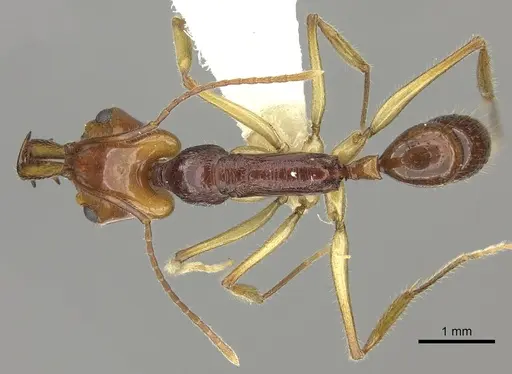
Literature
Loading...Loading products...