

Aenictus schneirlai
- Scientific Name
- Aenictus schneirlai
- Subfamily
- Dorylinae
- Author
- Wilson, 1964
- Distribution
- Found in 1 countries
Aenictus schneirlai Overview
Aenictus schneirlai is an ant species of the genus Aenictus. It is primarily documented in 1 countries , including Papua New Guinea. Detailed taxonomic data and occurrence records can be further explored via authoritative databases such as AntWeb or the Global Biodiversity Information Facility (GBIF).
Aenictus schneirlai
Aenictus schneirlai are tiny reddish-brown army ants native to Papua New Guinea. Workers are minute, measuring only about 2-2.5mm in total length with head widths of just 0.62-0.68mm, and possess distinctive sickle-shaped mandibles with three teeth [1]. They are known only from worker specimens collected from a soil bivouac (temporary army ant encampment) in lowland rainforest near Lae [1][2]. The species was named in honor of Dr. T.C. Schneirla, a pioneering researcher of army ant biology [2]. Unlike typical ant-keeping species, Aenictus schneirlai has never been documented with queens, and their army ant biology makes them unsuitable for captivity.
Quick Summary
- Difficulty: Expert
- Origin & Habitat: Papua New Guinea (type locality: Bubia,13km NW of Lae), lowland rainforest [1]
- Colony Type: Unknown, only worker caste documented [2]
- Size & Growth:
- Antkeeping:
- Temperature: Tropical species, likely requires warm stable temperatures around 25-28°C, though specific requirements remain unconfirmed [1]
- Humidity: High humidity required, collected from rainforest soil, substrate should remain consistently moist but not waterlogged [1]
- Diapause: No, tropical species likely active year-round [1]
- Nesting: Soil bivouacs in nature, incompatible with standard formicaria, requires specialized army ant keeping setups [1]
- Behavior: Army ant biology observed, colony found in statary phase (resting period) with brood present, nomadic lifestyle likely but unconfirmed for this species [1]. Extremely small size creates severe escape risk.
- Common Issues: only known from workers, no queens documented making captive colonies impossible to establish., extremely small size (approximately 2-2.5mm) requires exceptional escape prevention., army ant biology requires massive foraging ranges and frequent relocation impossible to replicate in captivity., rare species known only from type locality, wild collection not recommended.
Collection History and Field Observations
The only known collection of Aenictus schneirlai comes from the type series collected by E.O. Wilson in 1955 near Bubia, Papua New Guinea [1]. The colony was discovered bivouacked in soil on top of a low ridge in open, somewhat disturbed lowland rainforest [1]. The bivouac cavity had a single small entrance with no evidence of recent excavation [1]. When found during the afternoon, no foraging columns were present, and the brood consisted entirely of pupae and packets of eggs [1]. Wilson interpreted this as the statary phase, a resting period in the army ant cycle where the colony remains in one location while brood develops [1].
Morphology and Identification
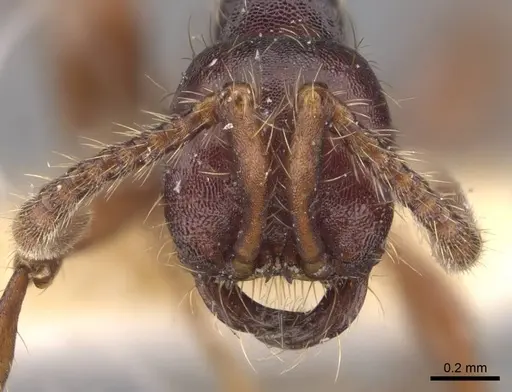
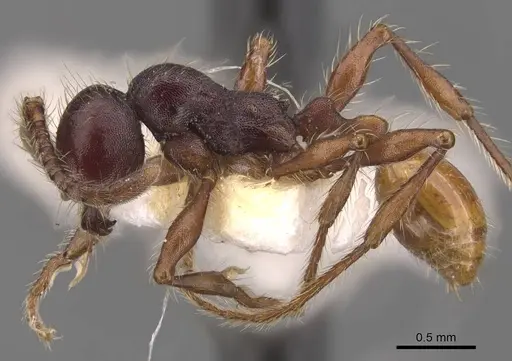
Workers are among the smallest ants in cultivation discussions, with head widths of just 0.62-0.68mm [1]. The holotype (first specimen described) measures head length 0.67mm and scape length 0.56mm [1]. They possess 10-segmented antennae and distinctive falciform (sickle-shaped) mandibles with three teeth [1]. The head and mesosoma (middle body section) are rich medium reddish brown, while the gaster (abdomen) and legs are lighter reddish brown [1]. The body is covered with abundant hair, with the longest pronotal hairs reaching 0.25mm [1]. The subpetiolar process (projection under the waist) is distinctive, featuring a downward-projecting lobe with a secondary tooth and thin flange [1].
Why This Species Is Not Suitable for Captivity
Aenictus schneirlai represents a species that cannot reasonably be kept in captivity. First, no queens are known, the species is documented only from worker specimens [2]. Without queens, colonies cannot be founded or maintained long-term. Second, as a member of the army ant subfamily Dorylinae, they likely possess specialized biology including nomadic phases where colonies frequently relocate, and massive foraging requirements that cannot be met in standard ant-keeping setups [1]. Finally, the species is known only from its type locality near Lae, Papua New Guinea, suggesting it may be rare or have limited distribution [1]. Attempting to collect these ants would harm wild populations for no practical keeping purpose.
Comparison with Related Species
Wilson placed Aenictus schneirlai in the ceylonicus species group based on morphological similarities [1][3]. It shows closest affinities to Aenictus ceylonicus, exilis, and nganduensis at the 13/16 character level [1]. However, schneirlai is distinguished by its unique subpetiolar process and mandibular structure [1]. While some other Aenictus species have been maintained briefly in laboratory settings for research, none are considered viable pets due to their army ant biology and massive colony sizes.
Frequently Asked Questions
Can I keep Aenictus schneirlai as a pet?
No. This species is only known from worker specimens, no queens have ever been documented [2]. Without a queen, you cannot establish a breeding colony. Additionally, as an army ant, they require specialized care including massive foraging spaces and frequent nest relocation that is impossible to provide in captivity.
How do I found an Aenictus schneirlai colony?
You cannot. Founding behavior is completely unconfirmed for this species, and since no queens are known, there is no way to start a colony [2]. Even if a queen were discovered, army ant queens require massive amounts of food and space, and colonies typically contain thousands of workers.
How big do Aenictus schneirlai colonies get?
Unknown. Only one colony has ever been documented, the type series collected by Wilson in 1964 [1]. Army ants typically form large colonies with thousands to millions of workers, but the specific colony size for this species remains undocumented.
What do Aenictus schneirlai eat?
Unknown specifically. As army ants in the genus Aenictus, they are likely specialist predators or raiders like other army ants, but their specific prey preferences have never been observed [1].
Where do Aenictus schneirlai live?
They are native to Papua New Guinea, specifically collected from lowland rainforest near Lae [1]. They nest in soil bivouacs, temporary encampments rather than permanent nests.
Are Aenictus schneirlai dangerous?
No. Despite being army ants, their extremely small size (workers only 2-2.5mm) means they pose no threat to humans [1]. However, they are not suitable for keeping due to their unknown biology and lack of documented queens.
What is the Aenictus ceylonicus group?
The ceylonicus group is a cluster of related Aenictus species sharing similar morphological characteristics [1][3]. Aenictus schneirlai belongs to this group, showing closest relationships to Aenictus ceylonicus, exilis, and nganduensis [1].
References

This caresheet is licensed under CC BY-SA 4.0 .
CASENT0651686
View on AntWeb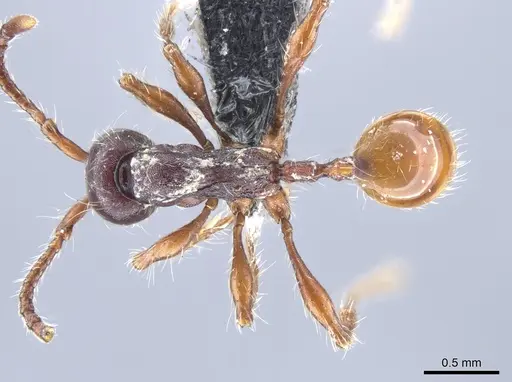
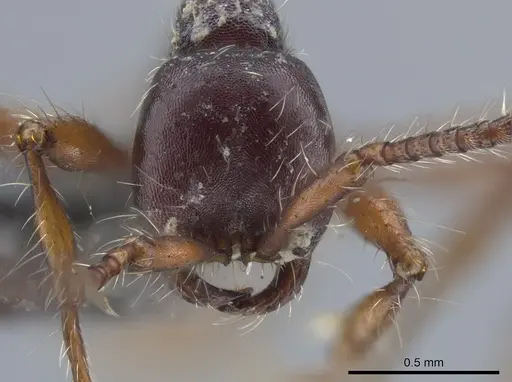
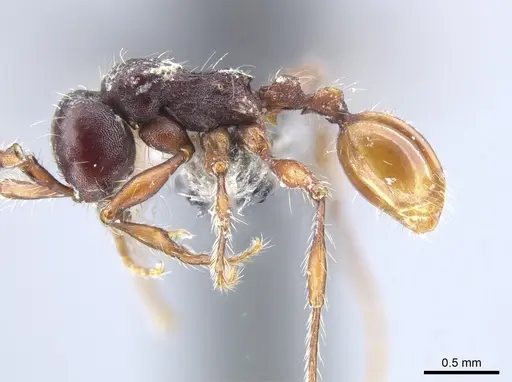
CASENT0905732
View on AntWeb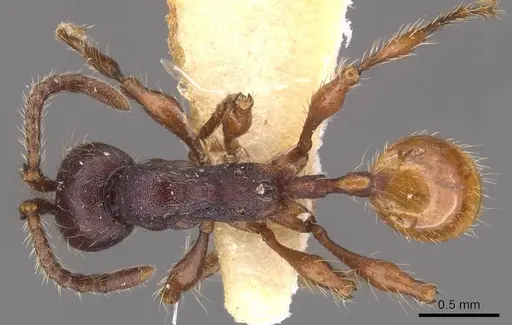
Literature
Loading...Loading products...