

Aenictus orientalis
- Scientific Name
- Aenictus orientalis
- Subfamily
- Dorylinae
- Author
- Karavaiev, 1926
- Distribution
- Found in 2 countries
Aenictus orientalis Overview
Aenictus orientalis is an ant species of the genus Aenictus. It is primarily documented in 2 countries , including Indonesia, Papua New Guinea. Detailed taxonomic data and occurrence records can be further explored via authoritative databases such as AntWeb or the Global Biodiversity Information Facility (GBIF).
Aenictus orientalis
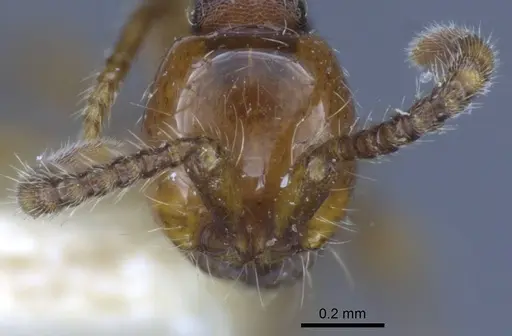
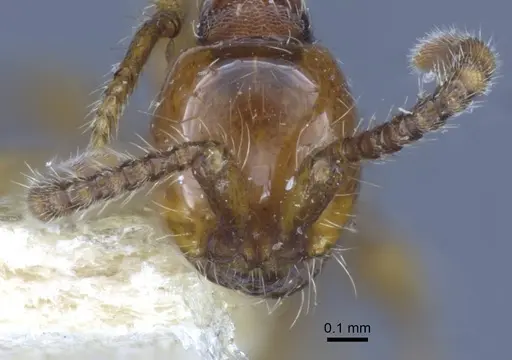
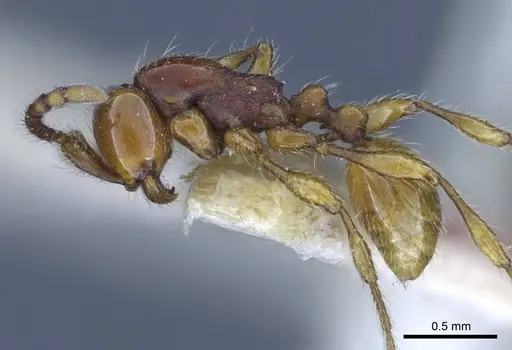
Aenictus orientalis is a tropical army ant found in eastern Indonesia and Papua New Guinea [1]. Workers have a distinctive look: their heads and legs are yellow, while their mesosoma (middle body section) is yellow-red, creating a two-tone appearance [1]. They also have sharply angled shoulders (pronotal humeral angles) that make the front of the thorax look almost vertical when viewed from the side [1].
What makes this species truly unusual is that scientists have never found a queen [2]. Every specimen ever collected has been a worker [2]. This means we know almost nothing about how colonies start or how big they grow, and it makes them practically impossible to keep in captivity using standard antkeeping methods.
Quick Summary
- Difficulty: Expert
- Origin & Habitat: Tropical rainforests of Indonesia (Aru Islands, Irian Jaya) and Papua New Guinea [1].
- Colony Type: Unknown, no queens have ever been documented [2]
- Size & Growth:
- Antkeeping:
- Temperature: Likely 24-28°C based on tropical distribution [1]. Start at 25°C and observe activity levels.
- Humidity: High humidity expected, keep nest substrate damp to wet [1].
- Diapause: No, tropical species do not hibernate [2].
- Nesting: Unknown. Army ants are typically nomadic and do not build permanent nests [2].
- Behavior: Army ant behavior inferred, likely nomadic with high predatory activity [2]. Escape risk unknown but likely high due to small size typical of the genus.
- Common Issues: no queens have ever been found, making captive colony founding impossible with current knowledge., army ants require massive amounts of live prey daily, which is difficult to maintain in captivity., nomadic lifestyle means they do not adapt well to static nest setups like formicaria or test tubes., extremely limited data means basic care requirements are unknown.
Identification and Similar Species
Aenictus orientalis belongs to the Aenictus ceylonicus species group [1]. You can tell them apart from similar species by their sharply angled shoulder plates (pronotal humeral angles). In A. orientalis, these angles are well developed, making the front of the thorax nearly vertical [1]. In contrast, similar species like A. prolixus and A. turneri have gently sloping shoulders [1].
The color pattern also helps. A. orientalis workers have yellow heads and legs that stand out against their yellow-red mesosoma [1]. A. turneri, by comparison, is essentially the same color all over [1]. You can also separate A. orientalis from A. prolixus by looking at the antennae, A. orientalis has shorter scapes (the first antenna segment) with a scape index of 65-82,while A. prolixus has longer scapes with an index of 89-96 [1].
Why These Ants Cannot Be Kept in Standard Setups
Aenictus orientalis presents a unique problem for antkeepers: we have never found a queen [2]. Without queens, you cannot start a colony from a single foundress, and without knowledge of their colony structure, we do not know if they reproduce by colony fission (splitting) or other methods [2].
Even if you could obtain a colony, Aenictus are army ants. They are nomadic, meaning they do not stay in one place like Lasius or Camponotus. They require massive amounts of space to roam and hunt, plus enormous quantities of live prey daily [2]. Standard ant farms, test tubes, and formicaria are completely unsuitable for their lifestyle. These are research specimens only, not pets.
Distribution and Type Specimens
This species was first described from Wammar Island in the Aru Archipelago, Indonesia [1][3]. The original specimens were collected in March 1913 by W. Karawajew [3]. Since then, they have also been found in Irian Jaya (Indonesia) and Papua New Guinea [1].
The species was originally described as a subspecies of Aenictus ceylonicus, but was raised to full species status by Shattuck in 2008 [1]. At the same time, two other species names (A. papuanus and A. similis) were synonymized with A. orientalis after scientists realized they were the same species [1].
Frequently Asked Questions
Can I keep Aenictus orientalis in a test tube or formicarium?
No. These ants are not suitable for standard antkeeping. They are army ants that likely require huge spaces to roam and hunt, and no queens have ever been documented, so you cannot start a colony [2].
How do I found a colony of Aenictus orientalis?
You cannot. Founding behavior is completely unknown for this species, and queens have never been collected [2]. Even related army ants typically reproduce by colony fission rather than single queens founding alone.
What do Aenictus orientalis eat?
Like other army ants, they are likely obligate predators of other arthropods such as insects and spiders [2]. They would require large amounts of live prey daily.
Do Aenictus orientalis have a queen?
We do not know. Every specimen ever collected has been a worker. Queens may exist but have never been found, or this species may reproduce through colony fission like some other army ants [2].
Are Aenictus orientalis dangerous?
They are army ants with powerful stings typical of the subfamily Dorylinae, but specific aggression levels and venom potency are unknown. Handle with caution if encountered.
What temperature do Aenictus orientalis need?
Based on their tropical distribution in Indonesia and Papua New Guinea, they likely need warm temperatures around 24-28°C [1].
Do Aenictus orientalis need to hibernate?
No, they are a tropical species and do not require diapause or winter rest [2].
How big do Aenictus orientalis colonies get?
Colony size is unknown. No studies have documented colony dimensions for this species [2].
References

This caresheet is licensed under CC BY-SA 4.0 .
CASENT0916856
View on AntWeb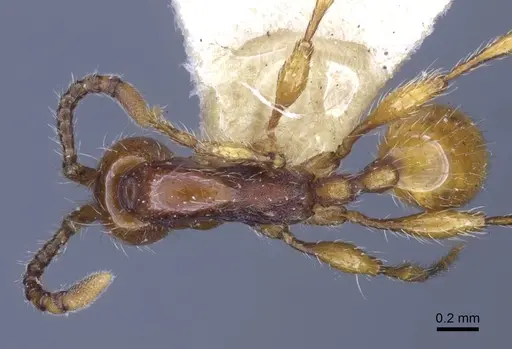
Literature
Loading...Loading products...