

Aenictus mvuvii
- Scientific Name
- Aenictus mvuvii
- Subfamily
- Dorylinae
- Author
- Gómez, 2022
- Distribution
- Found in 2 countries
Aenictus mvuvii Overview
Aenictus mvuvii is an ant species of the genus Aenictus. It is primarily documented in 2 countries , including Côte d'Ivoire, Ghana. Detailed taxonomic data and occurrence records can be further explored via authoritative databases such as AntWeb or the Global Biodiversity Information Facility (GBIF).
Aenictus mvuvii
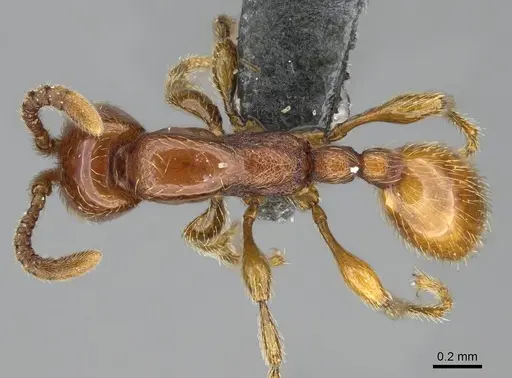
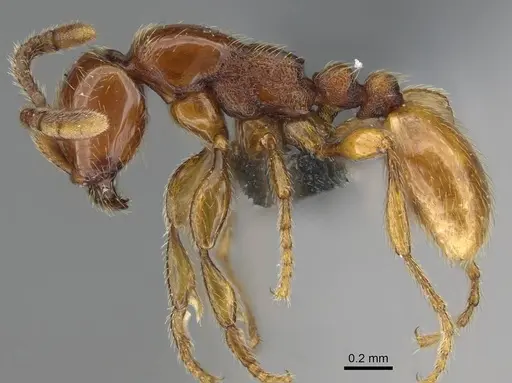
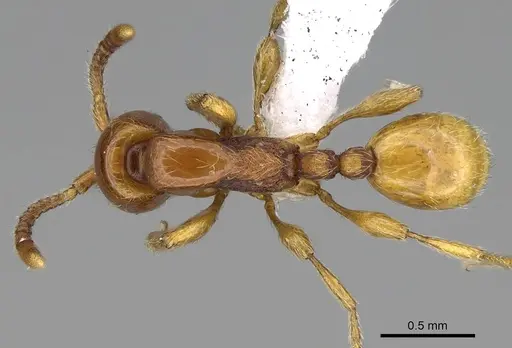
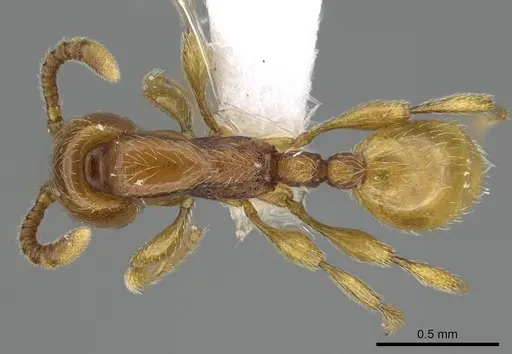
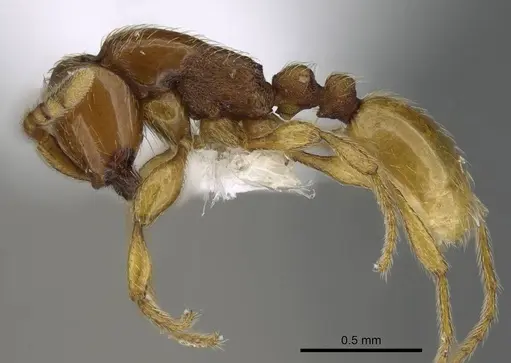
Aenictus mvuvii is a tiny army ant from the rainforests of West and Central Africa. Workers have heads less than 0.6mm wide and bodies approximately 2mm long, with reddish-brown coloration and lighter yellowish legs [1][2]. They live in soil at the base of trees in primary rainforest and cocoa plantations across Ivory Coast, Gabon, Ghana, the Central African Republic, and Uganda [1]. Unlike typical pet ant species, these are true army ants with a nomadic lifestyle that makes them virtually impossible to maintain in captivity. Only worker ants have ever been collected, no queens are known to science yet [2].
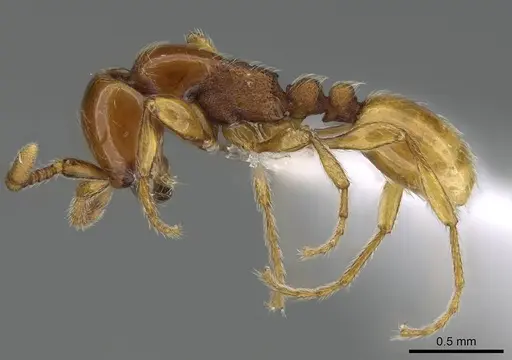
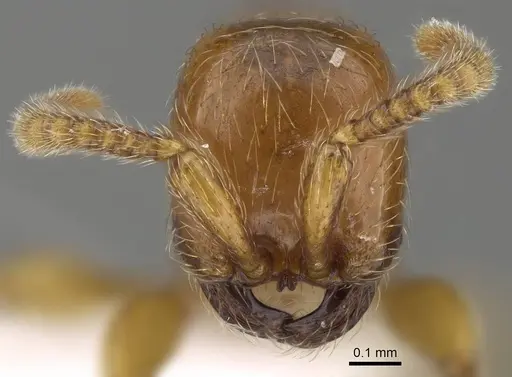
This species belongs to the Aenictus eugenii group and can be recognized by its extremely small size, shorter antennae compared to relatives, and a very large rounded subpetiolar process on the waist [1]. The head and gaster are smooth and shiny, while the middle body sections show strong network-like sculpturing [1].
Quick Summary
- Difficulty: Expert (effectively impossible for private keepers)
- Origin & Habitat: West and Central African rainforests including Ivory Coast, Gabon, Ghana, Central African Republic, and Uganda [1]
- Colony Type: Unknown, only the worker caste has been described [2]. Army ants typically maintain single-queen colonies, but this remains unconfirmed for this species.
- Size & Growth:
- Antkeeping:
- Temperature: 24-28°C estimated from tropical rainforest habitat [1]
- Humidity: High humidity required, keep nest material damp like rainforest soil
- Diapause: No, tropical species that remains active year-round
- Nesting: Not applicable, nomadic army ants cannot be housed in static formicaria
- Behavior: Nomadic army ant behavior with likely predatory habits targeting other ants or termites. Workers are extremely small and can escape through gaps smaller than 0.5mm.
- Common Issues: sub-millimeter size allows escape through any standard formicarium barrier or mesh., no captive husbandry protocols exist for this species., nomadic lifestyle requires constant relocation and massive space incompatible with standard setups., queens have never been collected, making colony founding impossible., require continuous supply of appropriate live prey likely including other ant species.
Why This Species Cannot Be Kept in Captivity
Aenictus mvuvii represents one of the most challenging groups in ant-keeping. As Old World army ants, they live a nomadic lifestyle that requires constant movement between temporary nest sites (bivouacs) and massive foraging territories [2]. Standard formicaria, even large ones, cannot accommodate the space requirements of army ant colonies, which may span meters of forest floor in the wild.
The practical barriers are insurmountable for home keepers. Workers are smaller than 3mm with heads under 0.6mm wide, allowing them to escape through the finest mesh and smallest gaps in any standard setup [1]. No queens have ever been collected for this species, meaning you cannot start a colony even if you obtained workers [2]. Army ants also require continuous access to specific live prey, often other ant species or termites, in quantities that would be impossible to maintain in a home environment.
Unlike some army ants that can be maintained temporarily in specialized lab facilities, Aenictus species have no documented captive care protocols. You should not attempt to collect or keep these ants.
Identification and Similar Species
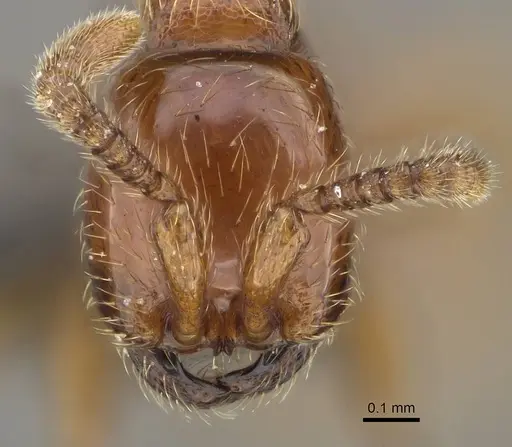
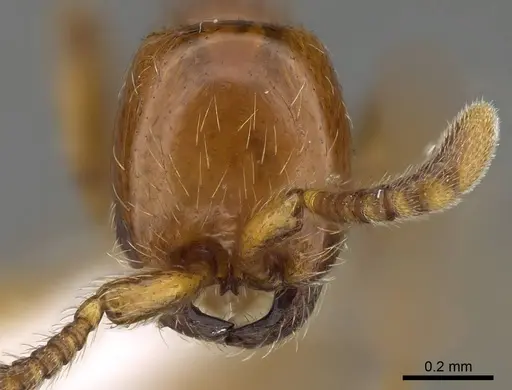
This species belongs to the Aenictus eugenii group and is unmistakable due to its extremely small size. Workers are clearly smaller than Aenictus eugenii minima, with head widths of 0.44-0.59mm compared to 0.59-0.89mm in that subspecies [1].
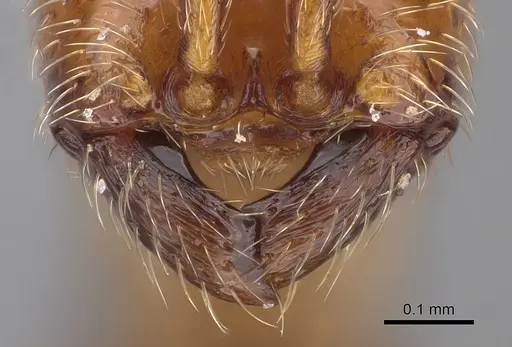
Key identifying features include relatively short antennae that barely reach the middle of the head, and fine reclinated hairs that are shorter and more regular than in related species [1]. The subpetiolar process, the little lobe underneath the waist segment, is very large, rounded, and elliptical, projecting downward prominently [1]. The body is reddish-brown with the legs and gaster appearing lighter yellowish in some individuals. The head, pronotum, and gaster are smooth and glassy, while the sides of the middle body, propodeum, and waist segments show strong network-like sculpturing [1].
Natural Habitat and Climate
Aenictus mvuvii inhabits primary rainforest and cocoa plantations in the Afrotropical region [2]. Specimens have been collected specifically from soil at the base of trees in rainforest habitats at elevations around 680 meters [1].
The climate across their range, from Ivory Coast to Uganda, remains tropical and stable year-round. Temperatures in these regions typically stay between 24-28°C with high humidity throughout all seasons. This means the species does not undergo winter rest (diapause) and requires consistent warmth and moisture in captivity. However, because they cannot be kept successfully, these requirements serve only as reference for understanding their ecology rather than practical care instructions.
Frequently Asked Questions
Can I keep Aenictus mvuvii in a test tube?
No. These are army ants that require massive space, specific prey, and nomadic movement patterns. They cannot survive in test tubes or standard formicaria.
How long until Aenictus mvuvii gets its first workers?
Unknown. No queens have ever been collected for this species, so founding behavior and development timelines remain unobserved.
Can I keep multiple Aenictus mvuvii queens together?
This cannot be answered, queens of this species are unknown to science and have never been described.
What do Aenictus mvuvii eat?
Likely other ants, termites, or small arthropods based on typical Aenictus behavior, but specific diet preferences for this species remain unconfirmed.
Do Aenictus mvuvii need hibernation?
No. They come from tropical Africa where temperatures remain stable year-round.
How big do Aenictus mvuvii colonies get?
Unknown, but related army ants maintain colonies of thousands to millions of workers.
Why are my Aenictus mvuvii workers dying?
If you obtained these ants, they are dying because this species cannot be maintained in captivity. They require specialized facilities, constant prey, and specific conditions that home setups cannot provide.
Are Aenictus mvuvii good for beginners?
No. This species is effectively impossible to keep and should not be attempted by anyone, including expert antkeepers.
References

This caresheet is licensed under CC BY-SA 4.0 .
Literature
Loading...Loading products...