

Aenictus boltoni
- Scientific Name
- Aenictus boltoni
- Subfamily
- Dorylinae
- Author
- Gómez, 2022
- Distribution
- Found in 2 countries
Aenictus boltoni Overview
Aenictus boltoni is an ant species of the genus Aenictus. It is primarily documented in 2 countries , including Ghana, Nigeria. Detailed taxonomic data and occurrence records can be further explored via authoritative databases such as AntWeb or the Global Biodiversity Information Facility (GBIF).
Aenictus boltoni
Aenictus boltoni is a tiny army ant from West Africa, first described in 2022 from specimens collected in Nigeria. Workers are monomorphic, meaning all workers are the same size, measuring only about 0.6 mm in body length with heads less than 0.4 mm wide [1]. They show a light brown to yellowish-brown coloration with smooth, shiny bodies and short antennae [1]. The species is known only from the worker caste collected in Ghana, Ivory Coast, and Nigeria [1][2]. No queens or males have ever been found, and nothing is known about their biology in the wild [2]. As a member of the army ant genus Aenictus, they likely live a nomadic lifestyle, but this remains unconfirmed for this specific species.
Quick Summary
- Difficulty: Expert, Not feasible for standard captive keeping
- Origin & Habitat: West Africa (Ghana, Ivory Coast, Nigeria), tropical forest [1][2]
- Colony Type: Unknown, no queens observed [2]
- Size & Growth:
- Antkeeping:
- Temperature: Likely 24-28°C based on West African tropical distribution, but unconfirmed
- Humidity: Likely high humidity based on tropical forest habitat, but unconfirmed
- Diapause: Unknown, likely not needed as a tropical species
- Nesting: Unknown, army ants typically do not build permanent nests
- Behavior: Biology unknown [2]. Presumed nomadic based on genus patterns. Extreme escape risk due to tiny size (0.37 mm head width) [1].
- Common Issues: biology is completely unknown, no established care protocol exists., only worker specimens are known, colony founding is currently impossible., extreme escape risk, workers measure only 0.37 mm in head width and pass through standard barriers [1]., likely army ant lifestyle requires massive foraging areas and constant food supply, unlike standard nest-building species.
Known Facts: Morphology and Distribution
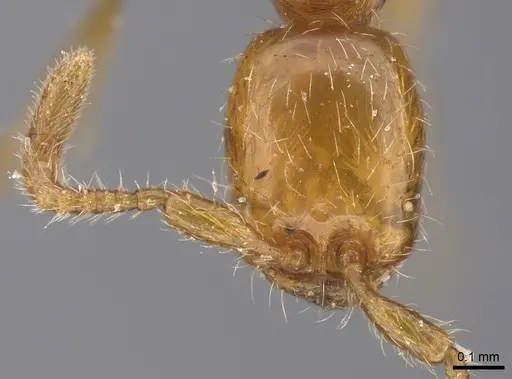
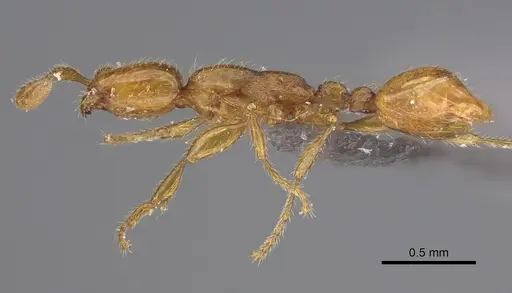
Aenictus boltoni was described by Gomez in 2022 based on twelve worker specimens. These ants are monomorphic, meaning all workers are the same size, with a cephalic size ratio (CSR) of 114 [1]. Workers have elongated heads (CI 80) with convex sides, short scapes that barely reach the middle of the head, and reduced clypeus with small denticles [1]. You can identify them by their smooth dorsopropodeum (the top of the rear body section) and low, semispherical postpetiole with a PPI of 113 [1]. They differ from similar species like Aenictus mariae by having a visible metapropodeal suture and smaller overall size [1]. The species is currently known only from West Africa, specifically Ghana, Ivory Coast, and Nigeria [1][2].
The Reality of Unknown Biology
Nothing is known about the biology of this species [2]. This presents an insurmountable problem for captive keeping. We do not know what they eat, how large their colonies grow, how they reproduce, or where they nest. Without this basic information, creating a care protocol is impossible. The species is known only from workers collected at the Cocoa Research Institute of Nigeria in 1969,with no subsequent observations of living colonies [2].
The Army Ant Challenge
While specific behavior is unconfirmed, Aenictus boltoni belongs to a genus known as Old World army ants. Army ants typically live a nomadic lifestyle, constantly moving to raid prey rather than building permanent nests. They require massive amounts of space and food compared to standard ant colonies. This lifestyle is extremely difficult to replicate in captivity and requires specialized facilities with continuous food supplies and extensive foraging areas. Combined with the lack of any biological data for this specific species, attempting to keep them would be pure speculation.
Escape Prevention at Micro Scale
If handling these specimens, be aware that at 0.37 mm head width and 0.6 mm body length, these ants can pass through gaps invisible to the naked eye [1]. Standard ant keeping barriers like Fluon or petroleum jelly may not stop them. You would need mesh with gaps smaller than 0.2 mm and completely sealed containers. This extreme escape risk makes them unsuitable for standard formicarium setups even if their biology were known.
Frequently Asked Questions
Can I keep Aenictus boltoni in a test tube?
No. This species is only known from workers, and their biology is completely unknown. Army ants typically require specialized facilities with massive foraging areas, not test tubes [2].
How do I found a colony of Aenictus boltoni?
You cannot. No queens are known for this species, and founding behavior is unconfirmed [2].
What do Aenictus boltoni eat?
Their diet is unknown. Related Aenictus species are predatory army ants that raid other insects, but this has not been observed in A. boltoni [2].
How big do Aenictus boltoni colonies get?
Colony size is unknown. Army ant colonies can contain thousands of workers, but this is unconfirmed for A. boltoni [2].
Do Aenictus boltoni need hibernation?
Probably not. They live in tropical West Africa where temperatures remain warm year-round [1].
Are Aenictus boltoni good for beginners?
No. They are not suitable for captive keeping due to unknown biology and extremely small size [2].
How do I identify Aenictus boltoni?
They are tiny light brown ants with smooth dorsopropodeum (the top of the rear body section) and a low, rounded postpetiole (the second waist segment). They differ from similar species by having a visible metapropodeal suture and lower PPI of 113 [1].
References

This caresheet is licensed under CC BY-SA 4.0 .
NHMUK012849298
View on AntWeb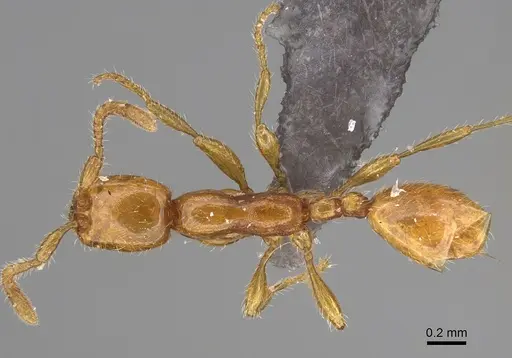
Literature
Loading...Loading products...