

Aenictus aitkenii
- Scientific Name
- Aenictus aitkenii
- Subfamily
- Dorylinae
- Author
- Forel, 1901
- Distribution
- Found in 1 countries
Aenictus aitkenii Overview
Aenictus aitkenii is an ant species of the genus Aenictus. It is primarily documented in 1 countries , including India. Detailed taxonomic data and occurrence records can be further explored via authoritative databases such as AntWeb or the Global Biodiversity Information Facility (GBIF).
Aenictus aitkenii
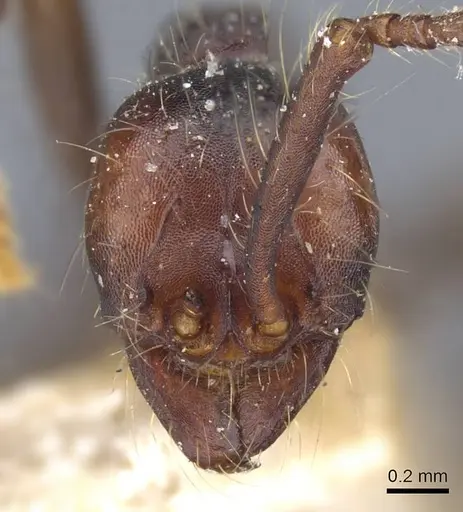
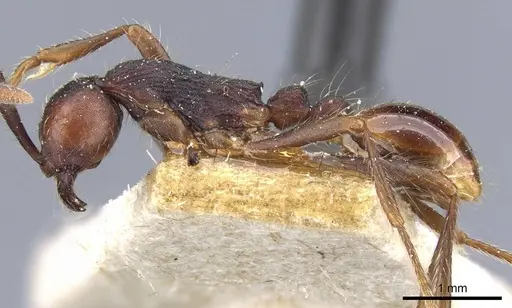
Aenictus aitkenii is a small army ant found in the tropical forests of India and Sri Lanka [1][2]. These ants belong to the Aenictus pachycerus species group, recognizable by their broad heads and bulbous, rounded waist segments compared to similar species [1][3]. Unlike most ants in the hobby, only workers have ever been collected, no queens have been described, which is typical for many army ants that reproduce by splitting their colonies rather than starting from a single queen [2]. They are ground-dwelling hunters found in tropical evergreen forests, particularly at elevations between 500 and 1000 meters in the Himalayan foothills [4].
As a true army ant, Aenictus aitkenii lives a nomadic lifestyle with no permanent nest. They hunt in groups and overwhelm prey through sheer numbers. This biology makes them extremely challenging to keep in captivity, requiring specialized housing that accommodates their wandering behavior and massive space requirements as colonies grow.
Quick Summary
- Difficulty: Expert
- Origin & Habitat: India (Karnataka, Kerala, Tamil Nadu, Himachal Pradesh) and Sri Lanka [1][5][2]. They inhabit tropical evergreen forests as ground-foraging ants [2], found at elevations from 500m to 1000m and likely lower [4].
- Colony Type: Army ant structure, reproduction likely occurs through colony fission (splitting) since only workers are known and queens have never been described [2]. This means you cannot start a colony from a single queen.
- Size & Growth:
- Queen: Unknown, queens have never been described [2]
- Worker: Likely 2-4mm (estimated from typical Aenictus genus measurements) [2]
- Colony: Unknown, but likely thousands of workers based on typical army ant biology
- Growth: Fast (army ants typically grow rapidly), but specific timeline unknown
- Development: Unknown, no development studies exist for this species (Army ants generally have rapid development, but specific timing for Aenictus aitkenii is unconfirmed)
- Antkeeping:
- Temperature: Warm tropical conditions, roughly 24-28°C. They are classified as tropical-climate specialists [4].
- Humidity: High humidity (70-80%+) with damp substrate mimicking tropical forest floor conditions.
- Diapause: No, they are tropical species and do not require winter rest [4].
- Nesting: No permanent nest. They form temporary bivouacs (living clusters of workers). You would need a massive open terrarium with deep substrate to accommodate their nomadic behavior, not a standard formicarium.
- Behavior: Highly aggressive group predators that hunt in packs. They are nomadic, constantly moving their bivouac location. Workers are small and require excellent escape prevention. They are specialized predators that cannot survive on sugar sources alone.
- Common Issues: cannot be housed in standard test tubes or formicariums due to nomadic army ant behavior., require constant supply of large amounts of live prey, starvation is a constant risk., colonies likely grow to thousands of workers, requiring massive enclosures that most keepers cannot provide., tiny worker size means they can escape through the smallest gaps in standard enclosures.
Army Ant Biology and Captive Challenges
Aenictus aitkenii is a true army ant from the subfamily Dorylinae. This means they have evolved a nomadic lifestyle with no permanent nest structure. Instead of living in a fixed location, they form temporary clusters called bivouacs using their own bodies to protect the queen and brood [2].
This biology creates immediate problems for captive care. Standard ant keeping equipment, test tubes, plaster nests, Y-tong nests, is completely unsuitable. These ants need to move constantly and require massive amounts of space as the colony grows. You cannot start a colony from a single queen because only workers are known for this species, colonies likely reproduce by fission, where a large colony splits into two smaller ones [2].
If you somehow acquire a colony fragment, you would need an enormous terrarium, think reptile-sized enclosures, not small ant farms, with deep substrate for bivouac formation and extensive open areas for their raiding behavior. Most keepers should not attempt this species.
Natural History and Identification
In the wild, Aenictus aitkenii inhabits tropical evergreen forests in India and Sri Lanka [2]. They are ground-foraging ants found from sea level up to 1000 meters elevation, with records showing presence at 500m and 1000m in the Himalayas but absent at higher elevations, confirming their preference for warm tropical conditions [4].
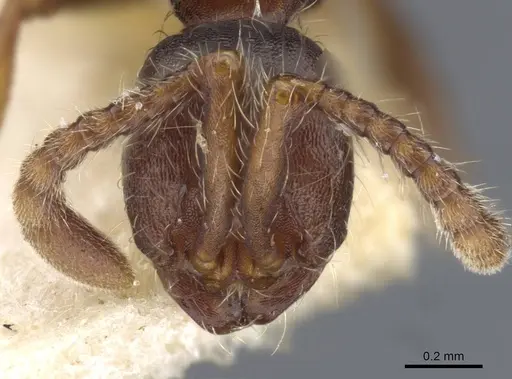
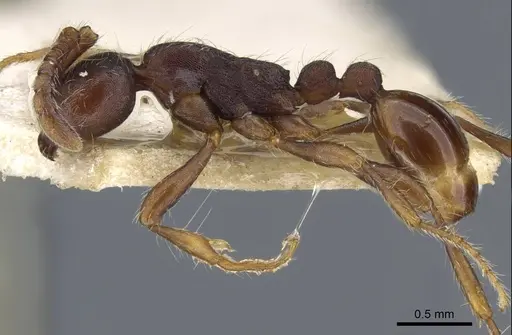
You can identify them by their broad heads (wider than similar species like Aenictus nesiotis) and their bulbous, rounded petiole and postpetiole segments [1][3]. The pronotum (the first segment of the middle body section) has a densely rough, microreticulate texture that appears opaque rather than shiny [6][3]. Their antennae are relatively long compared to related species [1].
Housing and Space Requirements
Do not attempt to keep Aenictus aitkenii in a test tube. They will die. These ants require specialized army ant housing: a large, open terrarium with at least 20-30 centimeters of substrate depth for bivouac formation, plus extensive horizontal space for raiding columns [2].
The enclosure must maintain high humidity while allowing the ants to form their living bivouac structure. You need a secure lid with extremely fine mesh, these are small ants that can squeeze through tiny gaps. The setup must also accommodate their nomadic behavior, they will eventually exhaust the food in one area and need to move, meaning you need space for them to relocate within the enclosure.
Most importantly, you cannot start with a single queen. You would need to obtain an existing colony fragment (which is ethically and practically problematic) or accept that this species is essentially unkeepable for standard hobby purposes.
Feeding and Diet
Aenictus aitkenii are specialized predators. They hunt in groups, overwhelming prey through coordinated attacks. In captivity, they require constant access to live prey, not just occasional feeding, but daily or twice-daily offerings of appropriate-sized insects [2].
Suitable prey would include termites, small crickets, fruit flies, and other soft-bodied insects. They are unlikely to accept sugar water or honey as a primary food source, though they may drink from it occasionally. The sheer volume of prey required to sustain even a modest army ant colony makes them impractical for most keepers.
If you cannot provide a constant stream of live food, the colony will starve. This is one of the main reasons army ants fail in captivity, keepers underestimate the biomass required to sustain a predatory colony.
Temperature and Humidity
As tropical-climate specialists found in evergreen forests, Aenictus aitkenii require warm, stable temperatures around 24-28°C [4]. They do not tolerate cold and will not survive room temperature if it drops below 20°C for extended periods.
Humidity should remain high, around 70-80%, mimicking the damp forest floor where they naturally forage. The substrate should feel damp to the touch but not waterlogged. You can maintain this by misting one side of the enclosure regularly and providing a water source.
They do not require diapause (winter rest) as they come from tropical regions without seasonal cold periods [4]. Attempting to hibernate them will likely kill the colony.
Frequently Asked Questions
Can I keep Aenictus aitkenii in a test tube?
No. These are army ants that require massive space, constant food, and specialized housing. They will die in a test tube setup.
How do I start an Aenictus aitkenii colony?
You cannot start from a single queen. Only workers are known for this species, and army ants typically reproduce by colony fission (splitting) rather than single-queen founding. You would need to obtain an existing colony fragment, which is not recommended for beginners and may be ethically problematic.
What do Aenictus aitkenii eat?
They are specialized predators that hunt in groups. They require constant access to live prey such as termites, small crickets, and fruit flies. They cannot survive on sugar water alone.
How big do Aenictus aitkenii colonies get?
Exact colony size is unknown, but based on typical Aenictus biology, they likely reach thousands of workers. This massive size makes them unsuitable for standard home ant keeping.
Are Aenictus aitkenii good for beginners?
Absolutely not. These are expert-only ants requiring specialized equipment, constant live food supply, and massive enclosures. They are among the most challenging ants to keep in captivity.
Do Aenictus aitkenii need hibernation?
No. They are tropical ants from India and Sri Lanka and do not require diapause or winter rest. Keep them warm year-round at 24-28°C.
Why are my Aenictus aitkenii always moving around?
This is normal army ant behavior. They are nomadic and do not build permanent nests. They form temporary bivouacs and relocate frequently to find new hunting grounds. If they are constantly moving in circles or seem distressed, they likely need more space or more food.
References

This caresheet is licensed under CC BY-SA 4.0 .
CASENT0905981
View on AntWeb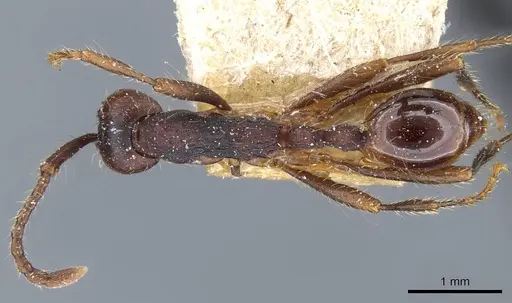
CASENT0905986
View on AntWeb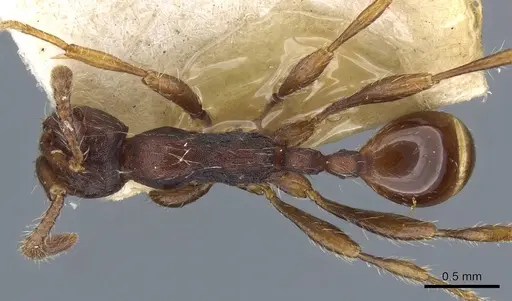
Literature
Loading...Loading products...