

Aenictus pachycerus
- Scientific Name
- Aenictus pachycerus
- Subfamily
- Dorylinae
- Author
- Smith, 1858
- Distribution
- Found in 1 countries
Aenictus pachycerus Overview
Aenictus pachycerus is an ant species of the genus Aenictus. It is primarily documented in 1 countries , including India. Detailed taxonomic data and occurrence records can be further explored via authoritative databases such as AntWeb or the Global Biodiversity Information Facility (GBIF).
Aenictus pachycerus
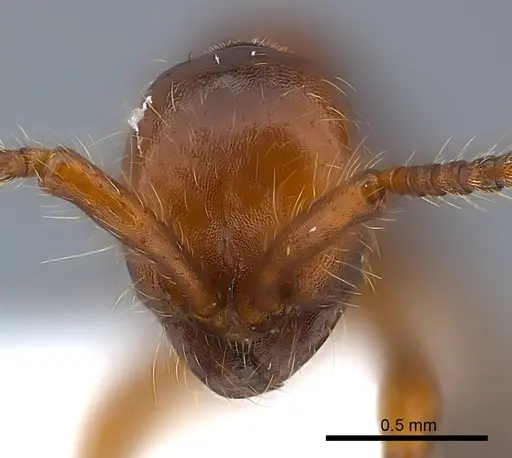
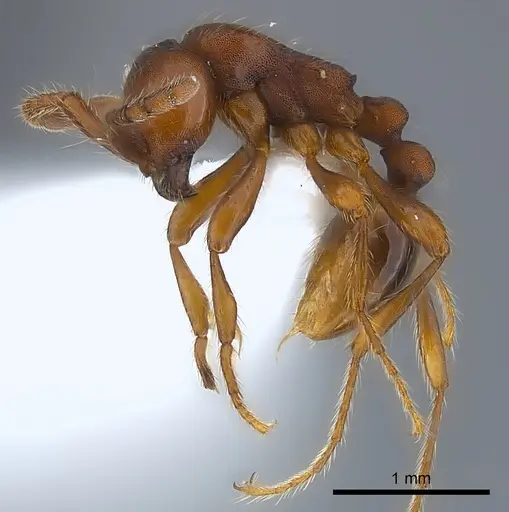
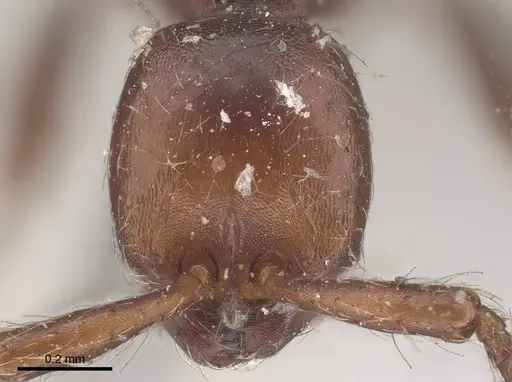
Aenictus pachycerus are tiny reddish-brown army ants found in India and Sri Lanka [1][2]. Workers measure only about 0.7 millimeters across the head, making them extremely small ants with 10-segmented antennae [1]. They have a distinctive raised ridge between their eyes called a parafrontal ridge, and their heads have a matte, textured surface rather than being smooth and shiny [1][3]. These ants belong to the subfamily Dorylinae, the true army ants, which typically live as nomadic predators without permanent nests [4]. They occur across a wide elevation range from 250 to 2200 meters above sea level in the Himalayan foothills and throughout the Indian subcontinent [5][1].
Quick Summary
- Difficulty: Expert
- Origin & Habitat: India and Sri Lanka, ranging from Himalayan foothills near Simla and Dehra Dun south to Travancore, and across Sri Lanka in both wet and dry zones at elevations of 250-2200 meters [1][6][5].
- Colony Type: Unknown. As army ants, they may reproduce by colony fission (splitting) rather than single-queen founding, but specific details for this species are unconfirmed [4].
- Size & Growth:
- Queen: Unknown, queens have been described but measurements are not provided in available research [4].
- Worker: Head width 0.71 mm, head length 0.82-0.83 mm [1].
- Colony: Unknown, likely hundreds to thousands based on army ant biology, but unconfirmed.
- Growth: Unknown.
- Development: Unknown, estimated 4-8 weeks based on tropical army ant patterns, but unconfirmed. (Development time is purely estimated from related tropical species.)
- Antkeeping:
- Temperature: Likely 20-25°C based on their occurrence in tropical regions at various elevations, but specific requirements are unconfirmed [5][7].
- Humidity: Moderate to high humidity typical of tropical forest floors, but exact needs are unknown.
- Diapause: Unknown, they appear only in Summer, Rainy, and Autumn seasons in northern India, and are absent during Winter and Spring [8][9].
- Nesting: Army ants are nomadic and do not build permanent nests [4].
- Behavior: These ants are specialized predators like other army ants. They are extremely small and will escape through the tiniest gaps in any enclosure [1]. Their behavior in captivity is completely unstudied.
- Common Issues: they are nomadic army ants and will not thrive in standard static nest setups., colony founding behavior is unknown, they may require colony fission rather than founding by single queens., extremely small worker size (0.7mm head width) means they can escape through minute gaps., seasonal absence in winter months suggests they may require specific seasonal conditions or dormancy., food requirements for army ants are typically massive and difficult to provide in captivity.
Identification and Physical Traits
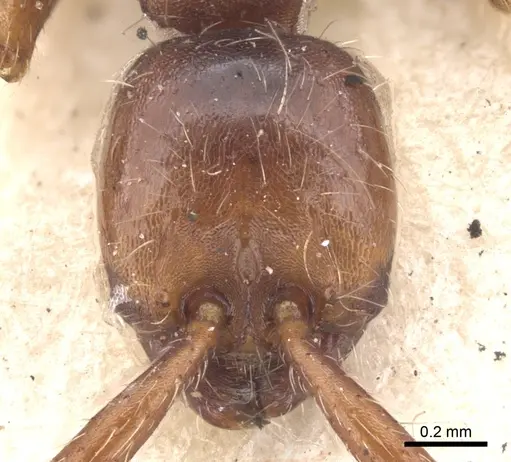
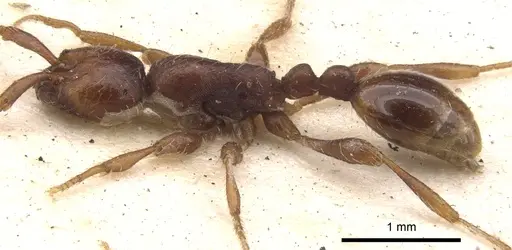
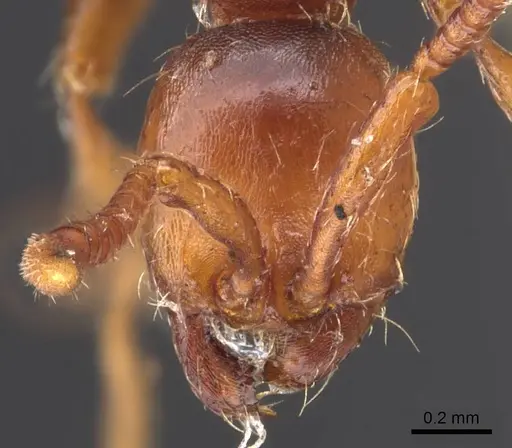
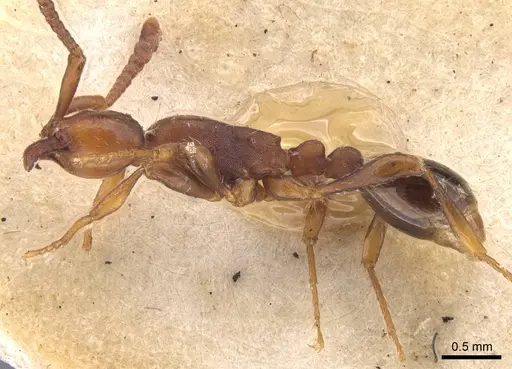
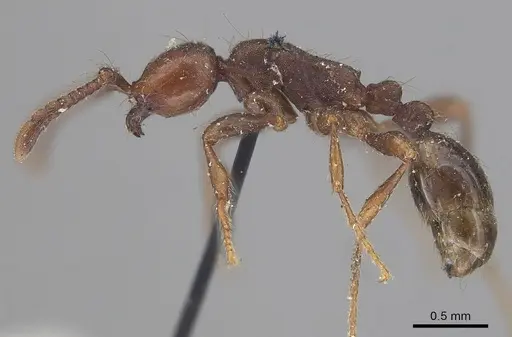
Aenictus pachycerus workers are extremely small, with a head width of only 0.71 millimeters and head length of 0.82-0.83 millimeters [1]. They are uniformly medium reddish-brown in color with a matte, non-shiny appearance [1][3]. Their heads show a fine network of microscopic lines (microreticulate) across the entire surface, making them look opaque rather than glossy [1][3]. A key identifying feature is the parafrontal ridge, a distinct raised lobe between the eyes that projects forward [1]. They have 10-segmented antennae and relatively long hairs on their bodies compared to their size [1]. Only workers and queens have been documented, males remain undescribed in the available research [4].
Distribution and Habitat
These ants occupy a vast range across the Indian subcontinent and Sri Lanka [1][2]. In India, they have been recorded from Arunachal Pradesh, Assam, Delhi, Himachal Pradesh, Jammu and Kashmir, Karnataka, Kerala, Maharashtra, Manipur, Punjab, Sikkim, Tamil Nadu, Uttar Pradesh, Uttarakhand, and West Bengal [2]. They occur from the Himalayan foothills near Simla and Dehra Dun in the north, south to Travancore in the south [1]. In Sri Lanka, they are found in both wet and dry climatic zones [6]. They show a preference for elevations between 250 and 2200 meters above sea level [5], and have been classified as tropical-climate specialists [7]. They have been found in forested areas and in lower proportions in coconut plantations [10].
Seasonal Activity Patterns
Research in the Punjab Shivalik region shows these ants follow a distinct seasonal pattern. They are active and present during Summer, Rainy, and Autumn seasons, but completely absent during Winter and Spring months [8][9]. This seasonal disappearance might indicate they move to protected microhabitats during cooler months, or that they enter a dormant phase. Whether captive colonies require cooling periods to mimic this seasonal cycle is unknown, but keepers should be aware that their activity may naturally fluctuate throughout the year.
Why These Ants Are Not Suitable for Standard Keeping
Aenictus pachycerus belongs to the true army ants (subfamily Dorylinae), and absolutely nothing is known about their biology regarding captive care [4]. Army ants are nomadic predators that do not construct permanent nests, instead, they wander continuously and bivouac in temporary shelters. This lifestyle is impossible to replicate in standard ant farms, test tubes, or formicaria. They likely require massive amounts of small prey and extensive foraging areas. Colony founding probably occurs through colony fission (splitting existing colonies) rather than by single queens starting nests, making traditional queen-keeping methods unworkable. Their extremely small size (0.7mm workers) presents additional escape risks. For these reasons, they are not recommended for ant keeping and should be considered a species for observation in the wild only.
Frequently Asked Questions
Can I keep Aenictus pachycerus in a test tube setup?
No. These are army ants that do not live in static nests. They are nomadic and require space to roam and hunt. Test tubes are completely unsuitable for their biology.
How long does Aenictus pachycerus take to develop from egg to worker?
Unknown. Based on typical patterns for tropical army ants, development might take 4-8 weeks at warm temperatures, but this is purely an estimate.
What do Aenictus pachycerus eat?
Unknown specifically for this species. As army ants, they are likely specialized predators of small soil arthropods like termites, beetle larvae, and other small insects.
Do Aenictus pachycerus need hibernation?
Unknown. They disappear during winter months in northern India, but this may be due to moving to protected microhabitats rather than true hibernation. They are tropical-climate specialists.
Are Aenictus pachycerus dangerous?
They are too small to harm humans (workers only 0.7mm wide), but as army ants they are aggressive predators of small invertebrates.
How big do Aenictus pachycerus colonies get?
Unknown. Army ant colonies can contain thousands of workers, but specific data for this species is lacking.
Can I keep multiple Aenictus pachycerus queens together?
Unknown. Army ants often have multiple queens or reproduce by colony splitting (fission), but whether unrelated queens can be combined is unstudied.
Where do Aenictus pachycerus live in the wild?
They live in India and Sri Lanka, from Himalayan foothills to coastal areas, in both wet and dry forests at elevations between 250-2200 meters.
Can I buy Aenictus pachycerus queens to start a colony?
This is not recommended. Their founding behavior is unknown, and they may not start colonies from single queens in the standard way. They are rarely available in the ant trade due to their specialized biology.
What is the best nest type for Aenictus pachycerus?
Standard nests do not work for these nomadic army ants. They require specialized facilities that allow for continuous movement and massive foraging areas, which are not practical for hobbyists.
References

This caresheet is licensed under CC BY-SA 4.0 .
CASENT0217379
View on AntWeb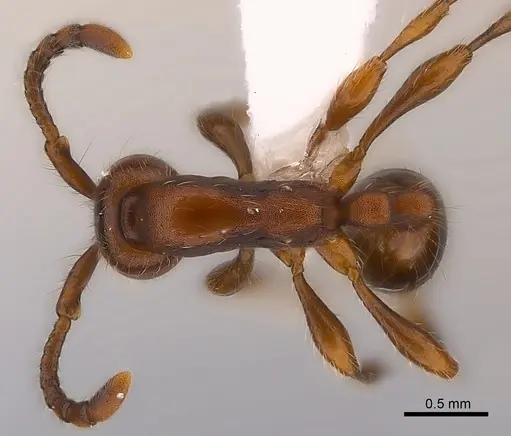
CASENT0902674
View on AntWeb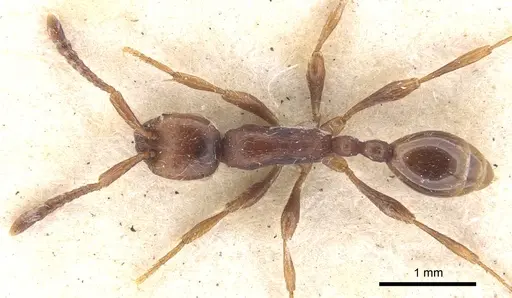
CASENT0907015
View on AntWeb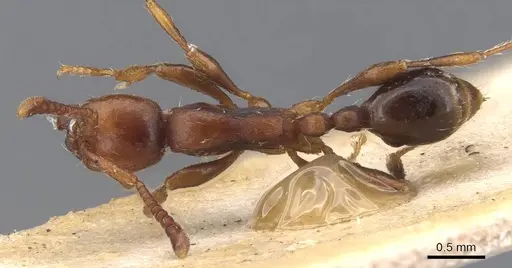
CASENT0919637
View on AntWeb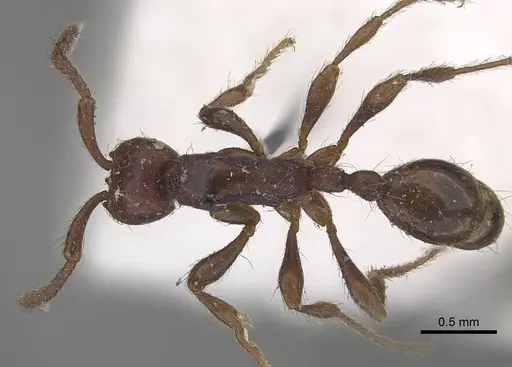
Literature
Loading...Loading products...