

Tyrannomyrmex rex
- Scientific Name
- Tyrannomyrmex rex
- Tribe
- Solenopsidini
- Subfamily
- Myrmicinae
- Author
- Fernández, 2003
- Distribution
- Found in 1 countries
Tyrannomyrmex rex Overview
Tyrannomyrmex rex is an ant species of the genus Tyrannomyrmex. It is primarily documented in 1 countries , including Singapore. Detailed taxonomic data and occurrence records can be further explored via authoritative databases such as AntWeb or the Global Biodiversity Information Facility (GBIF).
Tyrannomyrmex rex
Tyrannomyrmex rex is a tiny, enigmatic myrmicine ant native to Southeast Asia, known only from a handful of specimens collected in Malaysia and Singapore [1][2]. Workers measure just 3.75-4.52mm and are light brown in color with a heavily foveolate (pitted) body surface [1][3]. The genus possesses unique modified setae on the mandibles and has lost its functional metapleural gland, a rare trait among ants [2][3]. This species is remarkable for being one of the rarest ants in the world, with the first and only known live colony collected in 2016 in Singapore [3]. The colony contained only 13 workers, making it clear this species forms extremely small colonies [3].
Quick Summary
- Difficulty: Expert
- Origin & Habitat: Southeast Asia, specifically recorded from peninsular Malaysia (Negri Sembilan, Pasoh Forest Reserve) and Singapore (MacRitchie Reservoir, Mandai area) [1][2][4]. Found in secondary forests, selectively logged primary forest, and disturbed areas with leaf-litter at the base of trees [3][4].
- Colony Type: Unknown, queens have never been observed or described. The single known colony contained 13 workers plus brood, suggesting naturally small colony sizes [3].
- Size & Growth:
- Queen:{.size-link} Unknown, queens have never been collected or described [1]
- Worker:{.size-link} 3.75-4.52mm [3]
- Colony: Very small, approximately 30 individuals including workers and brood in the only known colony [3]
- Growth: Unknown
- Development: Unknown, development has never been observed in captivity (No data available as this species has never been successfully bred in captivity)
- Antkeeping:
- Temperature: Likely 24-28°C based on tropical forest habitat in Singapore. Provide a gentle gradient if possible.
- Humidity: High, found in moist rotting wood and damp soil beneath leaf-litter. Keep substrate consistently damp but not waterlogged [3].
- Diapause: Unlikely, being a tropical species from Singapore (1°N latitude), they probably do not require hibernation.
- Nesting: Natural nesting is in moist rotting wood under leaf-litter at tree bases [3]. In captivity, a small naturalistic setup with damp soil and small rotting wood pieces would be most appropriate. Test tubes may work if kept very humid and dark.
- Behavior: Nocturnal, workers remain clustered during daylight hours and become active at night [3]. Extremely timid, when threatened, workers curl their head and gaster underneath their body and remain motionless [3]. Stinging is rare and only occurs under significant threat [3]. Workers show no interest in offered prey items, antennating them briefly before walking away, this suggests they may be specialized predators of tiny invertebrates or scavengers [3]. Escape risk is moderate due to their small size, standard barriers should suffice.
- Common Issues: No known diet, workers consistently refuse all offered prey in studies, making feeding extremely challenging [3], Queens unknown, you cannot establish a colony as no queens have ever been found or described [1], Extremely small colony size means any colony you find will be fragile and difficult to maintain, Nocturnal and reclusive, you will rarely see activity, making it hard to assess colony health, No captive breeding success, this species has never been kept long-term in captivity
Discovery and Rarity
Tyrannomyrmex rex holds the distinction of being one of the rarest ant species in the world. The species was originally described in 2003 from a single worker collected in a leaf-litter sample in Malaysia's Pasoh Forest Reserve [1]. For nearly a decade, this single specimen was the only known example of the genus. A second specimen was discovered in 2012 in Singapore's MacRitchie Reservoir, expanding the known range by nearly 250km [2]. The breakthrough came in March 2016 when the first and only known live colony was collected in Singapore's Mandai area, this colony contained just 13 workers and represented the first opportunity for scientists to observe living specimens [3]. The genus Tyrannomyrmex remains poorly understood, with uncertain affinities to other myrmicine ants and several related species known only from single specimens [5].
Natural History and Habitat
In the wild, T. rex has been found in secondary forests, selectively logged primary forests, and even disturbed areas near former orchards [3][4]. The only known colony was discovered beneath leaf-litter at the base of a tree, with workers clustered on freshly exposed soil around a small piece of moist, fibrous rotting wood partially buried in damp soil [3]. The colony had excavated two hollow cavities in the rotting wood, which served as nest chambers [3]. This suggests the species is subterranean or ground-dwelling, living in the moist microhabitat between leaf-litter and soil [2]. The species appears to tolerate some habitat disturbance, as one collection site showed signs of regular military training activities with trampled understory plants and litter [3].
Behavior and Defense
T. rex exhibits fascinating defensive behaviors that reflect its position as a small, presumably vulnerable ant. When threatened, such as being nudged with forceps or encountering other invertebrates, workers typically curl their head and gaster inward beneath their legs and mesothorax, remaining completely motionless until the threat moves away [3]. This 'timid' defense strategy is thought to make the ants appear unappetizing or inedible to potential predators. Actual stinging was observed only once, when a millipede crawled directly into the nest and over multiple curled-up workers, one worker finally grabbed and stung the intruder [3]. The species is nocturnal, with workers remaining clustered and mostly motionless during daylight hours regardless of lighting conditions, while only 2-4 workers emerge to forage at night [3].
Feeding and Diet - The Great Unknown
This is perhaps the most challenging aspect of keeping T. rex. In laboratory observations, workers consistently showed no interest in prey items. When offered a variety of foods including millipedes, centipedes, mites, springtails, spiders, termite workers, brood and workers of other ant species, and even commercial honey, workers would briefly antennate each item and then simply walk away [3]. This consistent avoidance behavior suggests T. rex may be a specialized predator of very small invertebrates (much smaller than themselves), a scavenger of tiny organic particles, or perhaps feeds on eggs of other invertebrates [3]. The species has small, blunt mandibles with little dentition, which would be ineffective for capturing larger prey [3]. If you obtain this species, be prepared for experimental feeding trials with tiny prey items. Success with captive husbandry is entirely unproven.
Morphology and Identification
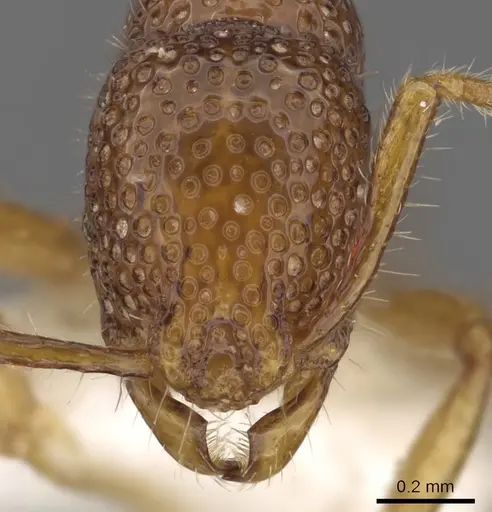
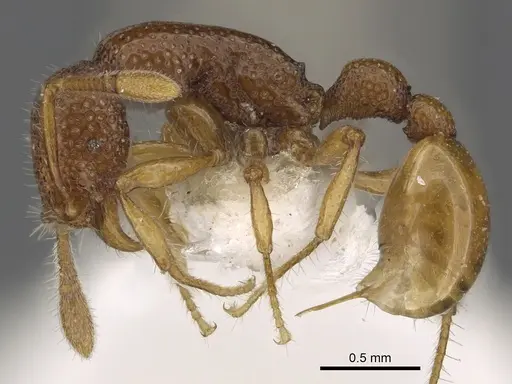
T. rex workers are distinctive under magnification. They are small (3.75-4.52mm), light brown ants with a heavily foveolate (pitted) body surface that appears shiny [1][3]. The head is longer than wide with rounded posterolateral corners [1]. The most unique feature is the row of thick, modified, cylindrical setae on the inner ventral margin of the mandibles, these are not spatulate like in similar genera but are instead cylindrical and transparent [1][5]. The mandibles have only two teeth (apical and subapical) with the rest of the masticatory border lacking teeth [1]. The antennae are 11-segmented with an ill-defined 3-segmented club [1]. Notably, T. rex lacks functional metapleural glands, this organ, which produces antibiotic secretions for colony hygiene, has been secondarily lost in this species [2][3].
Captive Care Challenges
Keeping T. rex successfully represents an extreme antkeeping challenge. The fundamental problem is that no one has ever succeeded, the only known colony was maintained briefly in laboratory conditions before the study ended, and no subsequent captive colonies have been documented. You cannot obtain a queen since none have ever been found or described [1]. Any colony would have to be wild-caught, and given the species' extreme rarity and tiny colony sizes, finding one would require extraordinary luck and careful searching. The recommended housing would be a small naturalistic setup with damp soil, leaf-litter, and small pieces of rotting wood to mimic their natural nest sites [3]. Keep the setup dark and humid, with minimal disturbance during daylight hours. Given the complete lack of captive husbandry success, any attempt to keep this species should be considered experimental documentation rather than successful pet-keeping.
Frequently Asked Questions
Can I keep Tyrannomyrmex rex as a pet ant?
This is not recommended for any antkeeper, including experts. No one has ever successfully kept this species long-term in captivity. The only known colony was maintained briefly for research and then released. Additionally, queens have never been found, so you cannot establish a colony, you would need to find a wild colony, which is extraordinarily difficult given the species' extreme rarity [3][1].
What do Tyrannomyrmex rex ants eat?
This is completely unknown. In laboratory feeding trials, workers refused all offered prey including millipedes, centipedes, springtails, spiders, termites, and even honey [3]. They would antennate items briefly and then walk away. This suggests they may be specialized predators of tiny invertebrates, egg-scavengers, or have a completely unknown diet. If you somehow obtain this species, experimental feeding with very small live prey would be necessary [3].
How big do Tyrannomyrmex rex colonies get?
Based on the only known wild colony, extremely small, approximately 30 individuals total including workers and brood. The colony contained 13 workers,2 worker pupae,1 male pupa,9 larvae, and 5 eggs [3]. This suggests T. rex naturally forms very small colonies, unlike many myrmicine ants that can reach hundreds or thousands of workers.
Do Tyrannomyrmex rex ants sting?
Yes, but rarely. In observations, workers displayed 'timid' defense behavior, curling up and remaining motionless when threatened. Actual stinging was only observed once when a millipede directly invaded the nest and crawled over multiple workers [3]. Given their tiny size, any sting would likely be very mild.
Can I find and catch a queen Tyrannomyrmex rex?
No, queens of this species have never been collected or described. The original description was based on a single worker, and despite subsequent records, no queen has ever been found [1]. The species' entire reproductive biology remains completely unknown. Even finding workers is extraordinarily difficult given the species' extreme rarity, only a handful of specimens have ever been recorded despite extensive ant surveys [2].
Are Tyrannomyrmex rex good for beginners?
Absolutely not. This species is suitable only for advanced researchers documenting new biological information, not as pets. There is no established husbandry protocol, no known diet that they accept, no captive breeding success, and the species may not survive typical captive conditions [3]. Even expert antkeepers would struggle with this species.
What temperature and humidity do Tyrannomyrmex rex need?
Based on their tropical habitat in Singapore (near the equator), aim for warm temperatures around 24-28°C with high humidity. The natural habitat is moist rotting wood and damp soil beneath leaf-litter [3]. Keep the substrate consistently damp but not waterlogged, and provide a dark, humid environment. However, these are educated guesses, no successful captive husbandry has been documented to confirm these requirements.
Report an Issue
The current care sheet is based fully on literature. See inconsistencies, or something that's incorrect? Please , it will be resolved after review from an admin. Contributing to the blogs tab also helps providing information, to make us be able to further improve the caresheets. Thank you for your support!
References

This caresheet is licensed under CC BY-SA 4.0 .
CASENT0901021
View on AntWeb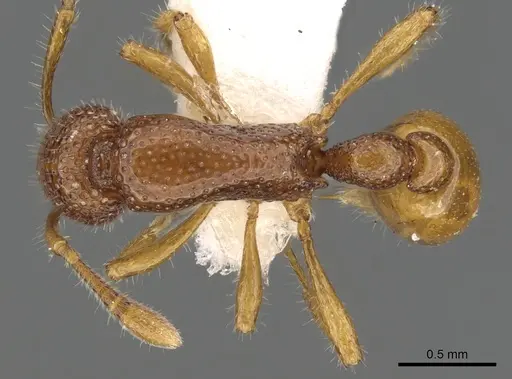
Literature
Loading...Loading products...