

Tetramorium sargina
- Scientific Name
- Tetramorium sargina
- Tribe
- Crematogastrini
- Subfamily
- Myrmicinae
- Author
- Hita Garcia & Fisher, 2012
- Distribution
- Found in 1 countries
Tetramorium sargina Overview
Tetramorium sargina is an ant species of the genus Tetramorium. It is primarily documented in 1 countries , including Madagascar. Detailed taxonomic data and occurrence records can be further explored via authoritative databases such as AntWeb or the Global Biodiversity Information Facility (GBIF).
Tetramorium sargina
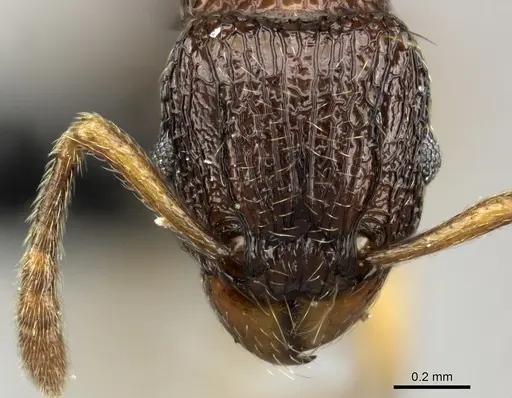
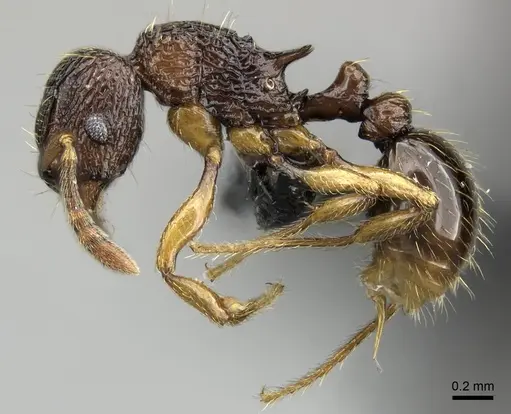
Tetramorium sargina is a tiny ant species native to Madagascar, first described in 2012. Workers measure just 0.63-0.74mm in head length, making them one of the smaller Tetramorium species you'll encounter [1]. They belong to the Tetramorium dysalum species group and can be identified by their short antennal scapes, long propodeal spines, and the distinctive long decumbent hairs on their first gastral tergite [1]. The body is dark brown with lighter brownish to yellowish appendages [1].
This species is extremely rare in captivity and known only from two widely separated montane rainforest localities in northeastern and southeastern Madagascar, Marojejy and Kalambatritra, at elevations between 1390 and 1575 meters [1]. All specimens have been collected from leaf litter in these high-elevation rainforests [2]. No captive breeding colonies are currently established in the antkeeping hobby, and this species remains one of the least-studied Malagasy Tetramorium.
Quick Summary
- Difficulty: Expert
- Origin & Habitat: Madagascar, specifically Marojejy in the northeast and Kalambatritra in the southeast, in montane rainforests at 1390-1575m elevation [1][2]
- Colony Type: Colony structure is unconfirmed, this species has only been collected from the wild a handful of times. Based on typical Tetramorium patterns, likely monogyne (single queen) but this is estimated.
- Size & Growth:
- Queen:{.size-link} Unknown, queen has not been described in the original species description [1]
- Worker:{.size-link} 0.63-0.74mm head length (approximately 2-3mm total length) [1]
- Colony: Unknown, only known from a few collected specimens [1]
- Growth: Unknown, no captive data exists
- Development: Unknown, no development data available. Based on typical Tetramorium genus patterns and their small size, estimate 6-10 weeks at optimal temperature, but this is a rough guess. (Development timeline is entirely unconfirmed. Small Tetramorium species typically develop faster than larger ones, but this is inferred from genus patterns, not species-specific research.)
- Antkeeping:
- Temperature: Unconfirmed, based on their montane rainforest origin at 1390-1575m elevation, they likely prefer cooler temperatures than typical tropical ants. Start around 18-22°C and observe colony activity. Avoid overheating.
- Humidity: High humidity required, montane rainforests are consistently damp. Keep the nest substrate moist but not waterlogged, with good ventilation to prevent mold. Think damp forest floor conditions.
- Diapause: Unknown, their high-elevation habitat suggests they may experience cooler seasonal temperatures, but specific diapause requirements are unconfirmed. Proceed with caution and consider a cool period around 15-18°C during winter months.
- Nesting: In the wild, they nest in leaf litter on the forest floor [2]. For captivity, a small test tube setup or Y-tong nest with fine chambers would suit their tiny size. Keep the nest area humid and provide a moisture gradient so ants can choose their preferred conditions.
- Behavior: Behavior is unstudied in captivity. Based on typical Tetramorium behavior, they are likely ground-nesting and forage for small prey and honeydew. Workers are tiny and may be shy. Their small size means excellent escape prevention is critical, they can squeeze through remarkably small gaps.
- Common Issues: no captive breeding colonies exist, this species is not currently available in the antkeeping hobby, escape prevention is critical due to their tiny 2-3mm size, use fine mesh barriers and tight-fitting lids, lack of any species-specific care information makes successful captive keeping highly uncertain, high elevation origin suggests they may not tolerate typical room temperatures, monitor for heat stress, extremely limited distribution makes wild collection difficult and potentially harmful to wild populations
Species Discovery and Rarity
Tetramorium sargina was only described as a distinct species in 2012 by Hita Garcia and Fisher, making it one of the newer additions to the antkeeping world, if it were available at all [1]. It belongs to the Tetramorium dysalum species group, which contains several similar-looking Malagasy species. What makes T. sargina stand out is its combination of short antennal scapes (SI 73-75), long propodeal spines (PSLI 30-32), and those distinctive decumbent hairs on the first gastral tergite [1]. The species name honors Leonard M. and Sargina T. Silvani for their support of biodiversity research [1].
This ant is extraordinarily rare, literally known from only two locations on opposite sides of Madagascar. The Marojejy population in the northeast and the Kalambatritra population in the southeast are separated by significant distance, and both are in protected areas. This limited distribution, combined with their specific montane rainforest habitat, makes them one of the most specialized and least-accessible Tetramorium species.
Natural Habitat and Implications for Care
In the wild, Tetramorium sargina lives in montane rainforests at elevations between 1390 and 1575 meters, that's quite high for Madagascar [1]. All specimens have been collected from leaf litter, meaning they are ground-dwelling ants that live in the damp, decomposing organic material on the forest floor [2]. This habitat tells us a lot about their care needs: they prefer cool, humid conditions with minimal temperature fluctuation.
The high-elevation origin is particularly important. Unlike many Madagascar ants that come from warm, lowland areas, these montane residents likely prefer temperatures closer to what you'd find in a temperate summer, think 18-22°C rather than the tropical warmth many ant species need. Their tiny size (workers are only about 2-3mm total length) also means they dry out quickly and need consistent moisture access.
Current Availability and Ethical Considerations
Tetramorium sargina is essentially unavailable in the antkeeping hobby. This is not a species you will find for sale from breeders or dealers. The reasons are straightforward: the species was only described in 2012,it is known from only two small populations in protected areas, and no one has successfully bred this species in captivity.
If you are interested in this species, the ethical path forward would be to wait for future availability from responsible breeders who may work with this species, rather than attempting to collect from the wild. The locations where they exist (Marojejy and Kalambatritra) are national parks, and removing insects from protected areas is both illegal and harmful to conservation efforts. Additionally, their extremely limited distribution means even small collection pressures could threaten wild populations. [1]
What We Don't Know
Honesty requires acknowledging how little we actually know about keeping Tetramorium sargina. We don't know: the queen size or appearance, colony structure (monogyne vs polygyne), founding behavior (claustral vs semi-claustral), development time from egg to worker, exact temperature and humidity preferences, diet in captivity, nuptial flight timing, or whether they accept sugar sources.
Everything in this caresheet is either directly from the limited scientific description or inferred from typical Tetramorium genus behavior. If you somehow obtain this species, treat it as an experimental project and document your observations carefully. Your findings could contribute genuinely new knowledge to antkeeping. [1]
Frequently Asked Questions
Can I buy Tetramorium sargina ants?
No, this species is not currently available in the antkeeping hobby. It was only described in 2012 and is known from only two small populations in Madagascar's protected areas. No captive breeding colonies exist.
How big are Tetramorium sargina workers?
Workers are tiny at approximately 2-3mm total length, with head lengths of 0.63-0.74mm [1]. They are among the smaller Tetramorium species.
Where does Tetramorium sargina live in the wild?
Only known from two locations in Madagascar: Marojejy in the northeast and Kalambatritra in the southeast, both in montane rainforests at 1390-1575m elevation [1].
What temperature do Tetramorium sargina ants need?
Unconfirmed, but their high-elevation montane rainforest origin suggests they prefer cooler conditions than typical tropical ants. Start around 18-22°C and monitor colony behavior. Avoid temperatures above 25°C.
Is Tetramorium sargina good for beginners?
No, this species is rated Expert difficulty due to the complete lack of captive care information. There are no established protocols for keeping this ant successfully. Even experienced antkeepers would be experimenting with unknown parameters.
How long do Tetramorium sargina workers live?
Unknown, no captive observations exist. Typical Tetramorium workers live several months to over a year, but this has not been studied for this specific species.
Do Tetramorium sargina ants sting?
Tetramorium belongs to the Myrmicinae subfamily, which includes species with functional stingers. However, no specific information exists about the sting or pain level of T. sargina. Given their tiny size, any sting would likely be very mild if present at all.
What do Tetramorium sargina eat?
Unknown in captivity. Based on typical Tetramorium diet, they likely accept small live prey (springtails, fruit flies) and may take sugar sources. However, this is inferred from genus patterns, not confirmed for this species.
Can I keep multiple Tetramorium sargina queens together?
Unknown, colony structure has not been documented for this species. Typical Tetramorium species are usually monogyne (single queen), but polygyny has been observed in some genus members. Do not attempt combining unrelated queens without established protocols.
Why is Tetramorium sargina so rare?
This species has an extremely limited geographic range, known only from two widely separated localities in Madagascar. Both are montane rainforest fragments, and the species was only recognized as distinct in 2012. Combined with their tiny size and specific habitat requirements, they are naturally rare and difficult to find.
How do I identify Tetramorium sargina?
Members of the T. dysalum species group can be identified by their short antennal scapes (SI 73-75), long propodeal spines (PSLI 30-32), mesosomal dorsum with longitudinally arranged rugae, and first gastral tergite with decumbent to subdecumbent long hairs [1]. They are dark brown with lighter appendages.
Will Tetramorium sargina escape from my nest?
Their tiny 2-3mm size means escape prevention is critical. Use fine mesh (at least 0.5mm or smaller), tight-fitting lids, and reliable barrier methods. These ants can squeeze through gaps that would hold back larger species.
Report an Issue
The current care sheet is based fully on literature. See inconsistencies, or something that's incorrect? Please , it will be resolved after review from an admin. Contributing to the blogs tab also helps providing information, to make us be able to further improve the caresheets. Thank you for your support!
References

This caresheet is licensed under CC BY-SA 4.0 .
CASENT0487390
View on AntWeb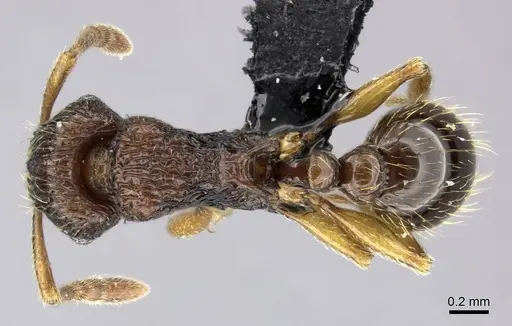
Literature
Loading...Loading products...