

Tetramorium camelliae
- Scientific Name
- Tetramorium camelliae
- Tribe
- Crematogastrini
- Subfamily
- Myrmicinae
- Author
- Hita Garcia & Fisher, 2014
- Distribution
- Found in 1 countries
Tetramorium camelliae Overview
Tetramorium camelliae is an ant species of the genus Tetramorium. It is primarily documented in 1 countries , including Madagascar. Detailed taxonomic data and occurrence records can be further explored via authoritative databases such as AntWeb or the Global Biodiversity Information Facility (GBIF).
Tetramorium camelliae
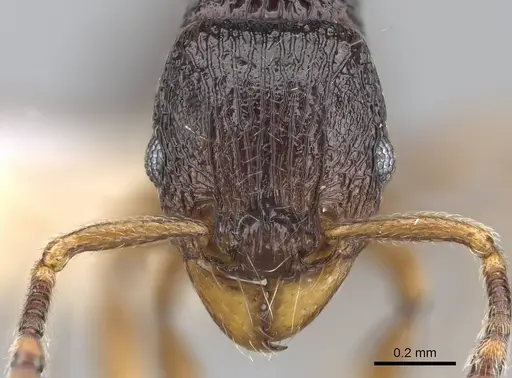
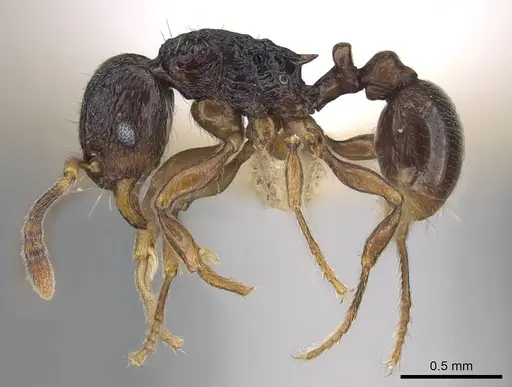
Tetramorium camelliae is a tiny, rare ant species native only to Ranomafana National Park in Madagascar, where it lives in montane rainforest leaf litter at elevations around 1100-1173m [1]. Workers are very small at just 0.5-0.6mm in head width, with a distinctive strongly squamiform (shield-like) petiolar node that makes them easily distinguishable from other Tetramorium species in the cognatum complex . They are uniformly brown to dark brown with yellowish to light brown legs and antennae . This species is part of the Tetramorium schaufussii group and was only described in 2014,making it one of the more recently discovered ant species in the hobby .
Quick Summary
- Difficulty: Unknown, insufficient data for reliable difficulty rating
- Origin & Habitat: Endemic to Ranomafana National Park, Madagascar, found only in montane rainforest leaf litter at 1100-1173m elevation [1]
- Colony Type: Colony structure unconfirmed, only worker caste has been described, queen caste unknown
- Size & Growth:
- Queen:{.size-link} Unknown, queen caste not yet described
- Worker:{.size-link} 0.50-0.57mm head width,0.56-0.63mm head length
- Colony: Unknown, only seven worker specimens have been collected
- Growth: Unknown, no colony development data exists
- Development: Unknown, estimate based on typical Tetramorium patterns: 6-10 weeks at optimal temperature (No direct development data exists for this species. Estimates based on related Tetramorium species.)
- Antkeeping:
- Temperature: Inferred from montane rainforest habitat: aim for 20-24°C with stable conditions. Avoid temperatures above 28°C. Madagascar montane species prefer cooler conditions than lowland tropical ants.
- Humidity: Inferred from leaf litter habitat: keep substrate consistently moist but not waterlogged. Montane rainforest conditions suggest 60-80% humidity with good ventilation.
- Diapause: Unknown, no data on seasonal requirements. Madagascar species may have reduced activity during cooler months but true diapause is unconfirmed.
- Nesting: Based on leaf litter habitat: prefers naturalistic setups with moist substrate, small chambers, and plenty of hiding spots. Y-tong or plaster nests with tight chambers scaled to their tiny size work well. Avoid dry conditions.
- Behavior: Temperament and behavior patterns are unconfirmed. Based on typical Tetramorium behavior, they are likely moderately active foragers that search for small prey and honeydew. Their tiny size means escape prevention is critical, they can squeeze through standard test tube barriers. Use fine mesh and tight-fitting lids.
- Common Issues: escape prevention is critical due to their very small size, standard barriers may not contain them, lack of available care information makes proper husbandry challenging, wild-caught colonies may carry parasites or diseases with no documented treatment, temperature sensitivity is unknown, start with room temperature and monitor colony response, feeding acceptance is unconfirmed, may require experimentation with small live prey
Species Discovery and Naming
Tetramorium camelliae was only described in 2014 by Hita Garcia and Fisher as part of a major taxonomic revision of Tetramorium species in Madagascar . The species name 'camelliae' honors Tracy Lynn Camellia Audisio, the first author's life partner, making this one of the few ant species named after a partner rather than a geographic location or morphological feature . The species is extremely rare, known only from seven worker specimens collected in Ranomafana National Park, one of Madagascar's most biodiverse protected areas [1]. The strongly squamiform (shield-shaped) petiolar node is the key diagnostic feature that separates this species from all others in the Tetramorium cognatum complex .
Natural Habitat and Distribution
This species is endemic to Ranomafana National Park in southeastern Madagascar, making it one of the most restricted ant species in the hobby [1]. It lives in montane rainforest at elevations between 1100 and 1173 meters, which is relatively cool and moist compared to Madagascar's lowland areas [1]. The only specimens were collected from leaf litter, meaning they are ground-nesting ants that prefer damp, shaded microhabitats . This restricted distribution means wild colonies face significant conservation concerns, and any captive colonies should be carefully managed.
Housing and Nest Setup
Based on their leaf litter habitat, a naturalistic setup with moist substrate works best. Use a small formicarium or test tube setup with chambers scaled to their tiny worker size of around 0.5mm. The substrate should remain consistently damp but never waterlogged, think forest floor conditions rather than swamp. Provide a water reservoir connected to the nest area to maintain humidity without frequent disturbance. Because of their extremely small size, escape prevention must be excellent. Standard test tube stoppers may not contain them, use fine mesh barriers and check for gaps regularly. A small outworld area allows for feeding observation.
Feeding and Diet
Feeding requirements are unconfirmed for this species, but based on typical Tetramorium behavior and their tiny size, they likely accept small live prey like springtails, fruit flies, and other micro-arthropods. They may also collect honeydew from aphids or accept sugar water. Start with offering small live prey items and observe acceptance. Remove uneaten prey after 24-48 hours to prevent mold. Because they are so small, prey items should be appropriately sized, anything larger than their head width may be ignored. Sugar sources can be offered occasionally but should not be the primary food source until acceptance is confirmed.
Temperature and Seasonal Care
Temperature requirements are not directly studied, but their montane rainforest origin suggests they prefer cooler conditions than typical tropical ants. Aim for 20-24°C as a starting point and observe colony activity. Avoid temperatures above 28°C. Room temperature (around 20-22°C) is likely suitable for this species. Temperature stability is important, avoid placing the nest near heating elements or in direct sunlight. Seasonal care is unconfirmed, but Madagascar experiences a cool dry season from May to October when activity may naturally decrease. Monitor your colony and adjust care based on observed behavior rather than fixed schedules.
Challenges and Limitations
This is one of the least-studied ant species available in the hobby, meaning significant uncertainty exists around proper care. The queen caste has never been described, so founding behavior and colony structure are unknown. Only seven worker specimens have ever been collected, giving almost no data on natural colony size or behavior . What this means for you: expect to do some experimentation with care conditions and be prepared to adjust based on your colony's response. Document your observations carefully, captive breeding of this species could contribute valuable knowledge to the antkeeping community. Consider this an expert-level species where your success helps build care knowledge for future keepers.
Frequently Asked Questions
How do I care for Tetramorium camelliae ants?
Care is largely unconfirmed due to limited research. Based on their montane rainforest leaf litter habitat, provide a naturalistic setup with consistently moist substrate at 20-24°C. Their tiny size requires excellent escape prevention with fine mesh barriers. Start with small live prey and sugar water, adjusting based on acceptance.
What do Tetramorium camelliae eat?
Diet is unconfirmed, but likely similar to other Tetramorium species. Offer small live prey like springtails or fruit flies, and occasionally sugar water or honey. Remove uneaten food within 48 hours to prevent mold issues.
How big do Tetramorium camelliae colonies get?
Colony size is unknown, only seven workers have ever been collected in the wild . Based on related Tetramorium species, colonies likely reach dozens to a few hundred workers, but this is an estimate.
Do Tetramorium camelliae ants sting?
Tetramorium belongs to the Myrmicinae subfamily, which includes species with functional stingers. However, most Tetramorium species are not aggressive and their sting is mild. This species is too small to cause any significant discomfort if it does sting.
Are Tetramorium camelliae good for beginners?
No, this species is not recommended for beginners. It is extremely rare with almost no available care information, the queen caste has never been described, and proper husbandry protocols are essentially unknown. Consider this an expert-level species for experienced antkeepers willing to experiment and document their findings.
What temperature do Tetramorium camelliae need?
Temperature is not directly studied. Based on their montane rainforest origin, aim for 20-24°C and avoid temperatures above 28°C. Room temperature is likely appropriate. Monitor your colony's activity to find the ideal range.
Where is Tetramorium camelliae found?
This species is endemic to Ranomafana National Park in Madagascar, found only in montane rainforest leaf litter at 1100-1173m elevation [1]. It is one of the rarest ant species in the hobby.
How long does it take for Tetramorium camelliae to develop from egg to worker?
Development time is unconfirmed. Based on typical Tetramorium patterns, expect approximately 6-10 weeks from egg to first worker at optimal temperature. This is an estimate only.
Can I keep multiple Tetramorium camelliae queens together?
Queen behavior is unknown, the queen caste has never been described . Combining unrelated queens is not recommended without understanding their natural colony structure. Do not attempt pleometrosis without research data.
Why is Tetramorium camelliae so rare?
This species is known only from seven worker specimens collected in Ranomafana National Park . It has an extremely restricted distribution in montane rainforest leaf litter, making it naturally uncommon. Its discovery in 2014 also means it is one of the more recently described ant species available.

This caresheet is licensed under CC BY-SA 4.0 .
CASENT0247496
View on AntWeb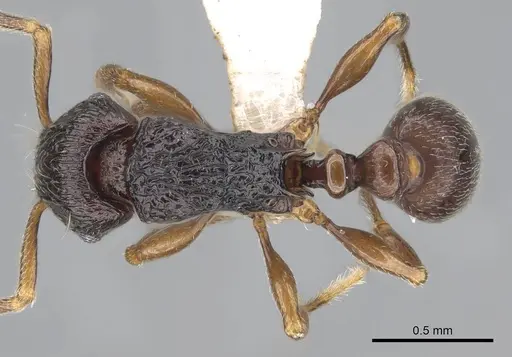
Literature
Loading...Loading products...