

Temnothorax oxynodis
- Scientific Name
- Temnothorax oxynodis
- Tribe
- Crematogastrini
- Subfamily
- Myrmicinae
- Author
- Mackay, 2000
- Distribution
- Found in 1 countries
Temnothorax oxynodis Overview
Temnothorax oxynodis is an ant species of the genus Temnothorax. It is primarily documented in 1 countries , including United States of America. Detailed taxonomic data and occurrence records can be further explored via authoritative databases such as AntWeb or the Global Biodiversity Information Facility (GBIF).
Temnothorax oxynodis
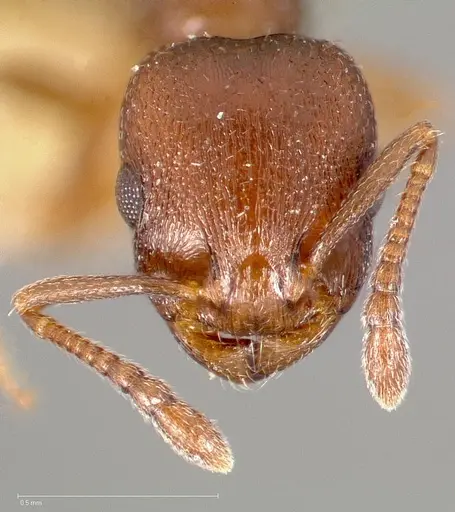
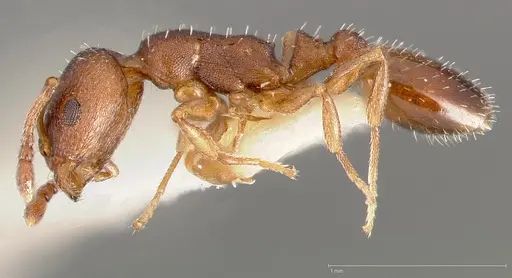
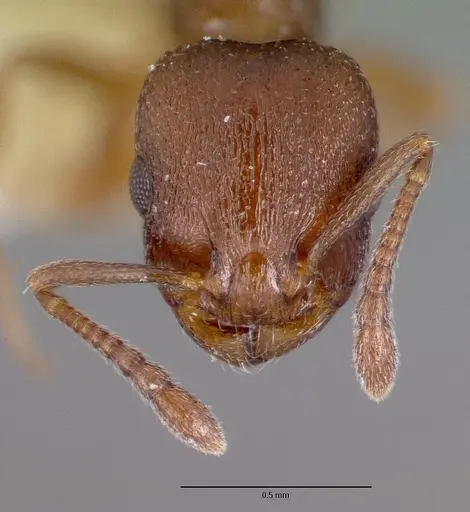
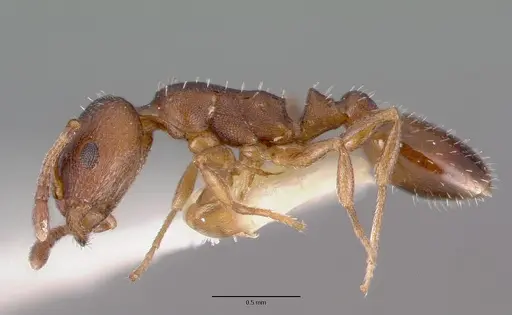
Temnothorax oxynodis is an exceptionally rare ant species native to California. Workers are tiny at just 0.76mm head length, with a distinctive sharply-pointed petiolar node that gives them their name (from Greek 'oxys' meaning sharp). They have an 11-segmented antenna, which is unusual among North American Temnothorax. Their body is medium brown with a darker gaster, and they have blunt-tipped hairs scattered across their body. This species is only known from a handful of collections in Santa Cruz County, making it one of the rarest ants in the United States [1][2].
This species is part of the initens-group and is closely associated with pine forests, particularly Pinus attenuata (knobcone pine) habitats. The few specimens ever collected were extracted from pine needle litter, suggesting they nest in very small cavities among forest debris. Because so little is known about this species in the wild, all care recommendations are based on what we know about related California Temnothorax species.
Quick Summary
- Difficulty: Hard
- Origin & Habitat: Endemic to California, specifically Santa Cruz County near Big Basin. Workers have been collected in Pinus attenuata (knobcone pine) forests from pine needle litter [2][1].
- Colony Type: Unknown, no queen or male specimens have ever been described. Based on related species, likely single-queen colonies [2].
- Size & Growth:
- Queen: Unknown, queens have not been described for this species
- Worker: 0.76mm head length,0.83mm Weber's length [2]
- Colony: Unknown, only a few workers have ever been collected
- Growth: Unknown, likely slow given limited colony samples
- Development: Unknown, estimate 6-10 weeks based on related Temnothorax species (No direct development data exists. Related California Temnothorax species typically develop in 6-10 weeks at warm room temperature.)
- Antkeeping:
- Temperature: Keep at room temperature, roughly 20-24°C. No specific thermal studies exist, but related species do well at standard room temperature [2].
- Humidity: Moderate humidity preferred. In nature they live in forest floor litter which dries out periodically but retains moisture in small cavities. Mist the outworld occasionally and provide a water tube [2].
- Diapause: Likely unnecessary, California species from a mild climate don't typically require formal hibernation. Keep at room temperature year-round [2].
- Nesting: Tiny colonies mean tiny nests. Related species nest in small cavities like hollow acorns, twigs, or under loose bark. A Y-tong (AAC) nest with very small chambers or a small test tube setup works well. Keep the nest dark as they prefer dim conditions [2].
- Behavior: These ants are extremely small and very passive. Workers are slow-moving and likely forage individually among leaf litter. They are not aggressive and have no functional stinger. Escape prevention is critical, their tiny size means they can squeeze through standard barrier setups. Use fine mesh and fluon on all openings [2].
- Common Issues: this species is known from so few specimens that even basic biology remains unstudied, expect challenges with established care protocols, escape prevention is critical due to their minute size, standard barriers will not contain them, no established captive breeding exists, all colonies would be wild-caught which carries high mortality risk, slow growth and tiny colony size means colonies are fragile and vulnerable to stress, lack of species-specific information means keepers must adapt protocols from related species
Rarity and Collection History
Temnothorax oxynodis is one of the rarest ant species in North America, known only from three collections ever made. The holotype worker was collected near Big Basin in Santa Cruz County, California in September 1957. Additional workers were collected in 1958 from knobcone pine litter, and a few more by Phil Ward and Brian Fisher in Pinus attenuata forest [1][2].
This extreme rarity means virtually no biological studies have been conducted on the species. We don't know colony size, queen morphology, male morphology, nuptial flight timing, or any aspect of their social structure. All care recommendations must be extrapolated from related California Temnothorax species, which adds significant uncertainty to captive care protocols [1].
Identification and Distinguishing Features
This species has several features that make it distinctive among North American Temnothorax. The most notable is the sharply acute (pointed) petiolar node, this is where the species gets its name 'oxynodis' from Greek 'oxys' meaning sharp or acute [2].
Workers have an 11-segmented antenna, which is unusual as many Temnothorax have 12 segments. The head is finely rugose (wrinkled) and the mesosoma is densely punctate (dotted). Propodeal spines are tiny, blunt angles rather than prominent spines. The mesosoma has a visible depression at the mesopropodeal suture. Workers are medium brown with a darker (infuscated) gaster, and black eyes [2].
Housing and Nest Setup
Given their tiny size and association with pine forest litter, these ants need a very carefully scaled setup. A Y-tong (AAC) nest with the smallest available chambers works well, or you can use a small test tube setup with a tight cotton plug. The nest should be kept dark, Temnothorax typically prefer dim conditions and will nest in small cavities like hollow acorns, twigs, or under loose bark and stones [2].
Because they are so small, escape prevention is absolutely critical. Standard fluon barriers may not work, their minute size allows them to squeeze through gaps that would contain larger ants. Use fine mesh on any ventilation holes and ensure all connections are tight. Even a tiny gap will result in colony loss [2].
Feeding and Diet
Like most Temnothorax, they likely accept a generalist diet. Offer sugar water or honey diluted with water at all times. For protein, provide tiny prey items like fruit flies, pinhead crickets, or other small insects. Given their minute size, prey items should be appropriately scaled, even small mealworms may be too large [2].
Feed small amounts every few days and remove any uneaten prey to prevent mold. The outworld should be kept clean. Because colony sizes are likely very small, overfeeding is a common mistake that leads to mold and colony death [2].
Temperature and Seasonal Care
No specific temperature studies exist for this species. However, being from California's mild Santa Cruz County mountains, they likely do well at standard room temperature (20-24°C). Related California Temnothorax species don't require formal hibernation, keeping them at room temperature year-round is appropriate [2].
Avoid temperature extremes. Don't place the nest near heating elements that could cause overheating, and keep them away from cold drafts. Stable, moderate temperatures are best. If your room is consistently below 18°C in winter, a small heat mat on one side of the nest (never directly on it) can help maintain warmth [2].
Frequently Asked Questions
How do I keep Temnothorax oxynodis ants?
This is an extremely difficult species to keep due to its rarity and lack of biological data. Use a tiny nest (Y-tong with small chambers or small test tube), keep at room temperature (20-24°C), provide constant sugar water and tiny protein prey, and use excellent escape prevention due to their minute size. Expect to adapt protocols from related species [2].
What do Temnothorax oxynodis eat?
Like other Temnothorax, they likely accept sugar sources (honey water, sugar water) and tiny protein prey (fruit flies, small insects). Prey items must be very small due to their minute worker size. Feed small amounts every few days and remove uneaten food [2].
How big do Temnothorax oxynodis colonies get?
Unknown, this species has only been collected a few times and colony size in the wild is unstudied. Based on related species, colonies likely reach under 100 workers. They are among the smallest ants in North America [1][2].
Do Temnothorax oxynodis ants need hibernation?
Probably not. This species comes from California's mild Santa Cruz County mountains. Related California Temnothorax do well at room temperature year-round without formal hibernation [2].
Can I keep Temnothorax oxynodis in a test tube?
Yes, a small test tube setup should work well. Use a very small diameter tube (like a standard 9mm or 12mm test tube) with a tight cotton plug. Keep the tube dark and provide a separate outworld for feeding. Escape prevention is critical, their tiny size means they can squeeze through standard barriers [2].
Are Temnothorax oxynodis good for beginners?
No, this species is not recommended for beginners. It is one of the rarest ant species in North America with virtually no established captive care protocols. The extreme rarity means all colonies would be wild-caught, and their tiny size makes them very fragile. Related, more common Temnothorax species are better choices for learning the genus [2].
How long does it take for Temnothorax oxynodis to develop from egg to worker?
Unknown, no development studies exist for this species. Based on related California Temnothorax, estimate 6-10 weeks at room temperature. Expect significant uncertainty given the lack of species-specific data [2].
Do Temnothorax oxynodis ants sting?
No, Temnothorax are in the subfamily Myrmicinae but most species have minimal defensive capabilities. They are not known to sting and are generally very passive, slow-moving ants. Their tiny size also means any sting would be negligible [2].
Where is Temnothorax oxynodis found in the wild?
Only known from Santa Cruz County, California, near Big Basin. Workers have been collected from Pinus attenuata (knobcone pine) forests in pine needle litter. This is an extremely restricted range, one of the rarest ant species in the United States [1][2].
Why is Temnothorax oxynodis so rare?
This species is only known from a handful of collections made decades ago. It may genuinely be rare in the wild, or it may simply be overlooked due to its tiny size and cryptic lifestyle among forest litter. California pine forests have not been thoroughly surveyed for tiny ant species, so the true distribution is unknown [1][2].
References

This caresheet is licensed under CC BY-SA 4.0 .
CASENT0005443
View on AntWeb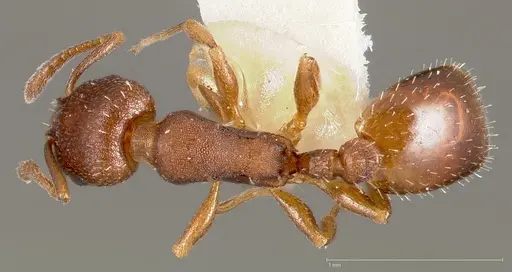
CASTYPE17706
View on AntWeb
Literature
Loading...Loading products...