

Tapinoma sahohime
- Scientific Name
- Tapinoma sahohime
- Tribe
- Tapinomini
- Subfamily
- Dolichoderinae
- Author
- Terayama, 2013
- Distribution
- Found in 2 countries
Tapinoma sahohime Overview
Tapinoma sahohime is an ant species of the genus Tapinoma. It is primarily documented in 2 countries , including Japan, Korea, Republic of. Detailed taxonomic data and occurrence records can be further explored via authoritative databases such as AntWeb or the Global Biodiversity Information Facility (GBIF).
Tapinoma sahohime
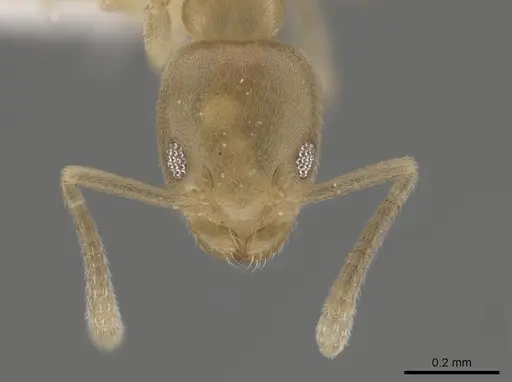
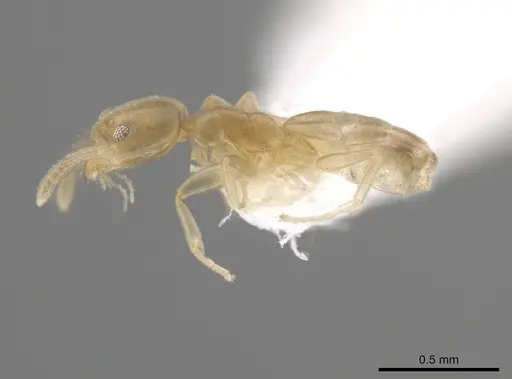
Tapinoma sahohime is a tiny yellow ant native to Japan and South Korea, measuring just 1.3mm in total length [1]. This species belongs to the Dolichoderinae subfamily and was only recently separated from the similar-looking Ravavy indicus, which it was formerly misidentified as in Japan [1]. The workers are pale yellow with a relatively long head (1.14 times longer than wide), very small eyes, and short antennal scapes that just reach the back of the head [1]. Unlike many ants, they have no erect hairs on their head or mesosoma [1].
This species has an unusual colonial structure, it is polygynous (multiple queens) and polydomous (nests spread across multiple locations), with colonies found in multiple branches of a single tree [2]. Workers are often found nesting near other arboreal ant species, though they don't appear to interact aggressively with them [2]. This is the only yellow Tapinoma species found in South Korea, and their very small eyes help distinguish them from the similar ghost ant (T. melanocephalum) [2].
Quick Summary
- Difficulty: Medium
- Origin & Habitat: Native to Japan (Amami Islands) and South Korea, found in southern coastal forests [2]. Nests in dead branches of evergreen trees or in soil and hollow twigs [1][2].
- Colony Type: Polygynous (multiple queens) and polydomous (multiple nests in multiple branches of a single tree) [2]. Queens can be fully winged or brachypterous (short-winged), with the latter likely mating near the colony and budding to form new polydomous nests [2].
- Colony: Optionally polygyne
- Size & Growth:
- Queen: Unconfirmed, likely similar to other Tapinoma species at 2-3mm. Signal as estimated.
- Worker: 1.3mm total length (HL 0.39mm, HW 0.35mm) [1]
- Colony: Unknown for this species specifically, related species typically reach a few hundred workers
- Growth: Moderate, based on typical Tapinoma patterns
- Development: Estimated 5-8 weeks at optimal temperature based on genus-level data for related species (Direct development data unavailable for this species, estimates based on typical Tapinoma development patterns)
- Antkeeping:
- Temperature: Keep at 22-26°C, they inhabit warm coastal regions [2]. A gentle gradient is recommended.
- Humidity: Moderate humidity around 50-70%. They prefer arboreal nesting in dead wood, so allow some drying between waterings.
- Diapause: Likely required, South Korean populations experience cold winters. Provide 2-3 months of cool storage (10-15°C) during winter.
- Nesting: Best kept in naturalistic setups with dead wood/branches or Y-tong/plaster nests. They naturally nest in hollow twigs and dead branches [1][2].
- Behavior: Workers are small and fast-moving. They are not aggressive and lack a functional stinger (Dolichoderinae spray formic acid instead). They are arboreal and likely forage on trees. Escape prevention is critical due to their tiny 1.3mm size, they can squeeze through standard test tube cotton. Colonies are polydomous meaning they may establish secondary nests.
- Common Issues: tiny size means escapes are likely without fine mesh barriers, polydomous colonies may try to establish secondary nests outside the primary setup, slow founding means colonies take time to establish, brachypterous queens may have limited dispersal, making colony division different from typical species, limited availability in the antkeeping hobby
Housing and Nest Setup
Tapinoma sahohime naturally nests in dead branches, hollow twigs, and soil [1][2]. For captive care, a naturalistic setup with cork, dead wood, or a Y-tong/plaster nest works well. Because they are arboreal by nature, providing vertical space and branches for them to explore is beneficial. The colony is polydomous, meaning they may establish secondary chambers or satellite nests, this is normal behavior and you should not try to prevent it if it occurs. Use a well-secured outworld as they will explore and may attempt to establish additional nest sites.
Given their tiny 1.3mm size, escape prevention is critical. Standard test tube cotton may not be sufficient, consider using tight-fitting lids, fluon barriers, and fine mesh on any openings. They can squeeze through gaps that seem impossibly small for their body size.
Feeding and Diet
Like other Tapinoma species, T. sahohime likely feeds on honeydew, nectar, and small insects. Offer sugar water or honey regularly as a carbohydrate source. For protein, provide small live prey such as fruit flies, pinhead crickets, or other tiny insects. Given their small size, prey items should be appropriately sized, even small mealworms may be too large.
In their natural habitat in southern coastal forests, they foraged in trees and likely tended aphids or collected honeydew [2]. A varied diet including both sugar and protein sources is recommended. Remove uneaten prey after 24-48 hours to prevent mold.
Temperature and Seasonal Care
Keep colonies at 22-26°C, reflecting their native warm coastal habitat in Japan and South Korea [2]. A slight temperature gradient allows the colony to regulate its own conditions. During summer months, room temperature in most homes should be suitable.
For winter, South Korean populations experience cold winters requiring a diapause period. Provide 2-3 months of cool storage at 10-15°C during winter months. This mimics their natural seasonal cycle and helps maintain colony health long-term. Reduce feeding during this period and ensure the nest remains slightly moist but not wet.
Colony Structure and Reproduction
This species has an unusual and interesting colony structure. Colonies are polygynous (multiple queens) and polydomous (multiple nests spread across different branches of a single tree) [2]. This means a single colony can have several egg-laying queens spread across multiple nest sites.
Alates (reproductives) emerge in July in South Korea [2]. Queens can be either fully winged or brachypterous (having short wings). Brachypterous queens are thought to mate near or inside the colony and then bud off to form new polydomous nest sites rather than dispersing far away through nuptial flights [2]. This explains the polydomous structure where multiple nests belong to the same colony.
For keepers, this means your colony may naturally split into multiple nest sites. This is not a sign of colony failure, it's normal behavior for this species.
Identification and Similar Species
Tapinoma sahohime is the only yellow Tapinoma species found in South Korea, which helps with identification there [2]. It was formerly identified as T. indicum in Japan but can be separated by its smaller size and yellow coloration [1]. The workers are extremely small at just 1.3mm total length, with very small eyes (0.03mm diameter with only 6 facets in the longest row) [1].
The small eyes are a key identification feature, they are always shorter than the distance between the eyes and the anterior clypeal margin, which helps distinguish this species from the ghost ant (T. melanocephalum) [2]. The head is relatively long (1.14 times longer than wide) and the antennal scape is short, just reaching the posterior margin of the head [1].
Frequently Asked Questions
How long does it take for Tapinoma sahohime to produce first workers?
Exact development time is unconfirmed for this species. Based on typical Tapinoma genus patterns, expect 5-8 weeks from egg to first worker at optimal temperature (22-26°C). Founding colonies grow slowly at first, so patience is needed.
Can I keep multiple queens together in Tapinoma sahohime?
Yes, this is normal for the species. T. sahohime is polygynous, meaning colonies naturally have multiple queens. Unlike many species where multiple queens fight, this species is adapted to multi-queen colonies. You can introduce additional queens to a founding colony without typical aggression concerns.
What do Tapinoma sahohime eat?
Offer sugar sources (honey, sugar water) regularly and small live prey (fruit flies, tiny crickets, springtails) for protein. They are small predators that likely hunt tiny arthropods in nature. Remove uneaten prey after a day or two.
Are Tapinoma sahohime good for beginners?
This species is rated as medium difficulty. While not the most challenging species, their tiny size and polydomous colony structure require attention to escape prevention and nest setup. They are also rarely available in the hobby. Some experience with small ant species is helpful.
Do Tapinoma sahohime need hibernation?
Yes, likely required. South Korean populations experience cold winters. Provide 2-3 months of cool storage at 10-15°C during winter. This mimics their natural seasonal cycle and supports long-term colony health.
Why is my Tapinoma sahohime colony establishing nests in multiple locations?
This is normal behavior. T. sahohime is polydomous, meaning colonies naturally spread across multiple connected nest sites. If your setup allows, this is natural and healthy behavior, do not try to force them into a single nest.
How big do Tapinoma sahohime colonies get?
Exact colony size is unconfirmed for this species. Based on related Tapinoma species, colonies likely reach a few hundred workers. Their polydomous structure means workers may be spread across multiple nest sites.
What makes Tapinoma sahohime different from other Tapinoma species?
This species is unique among Korean Tapinoma for being the only yellow species. It also has an unusual colony structure being both polygynous (multiple queens) and polydomous (multiple nests). Queens can be brachypterous (short-winged), which is rare and affects how colonies spread.
References

This caresheet is licensed under CC BY-SA 4.0 .
OKENT0002258
View on AntWeb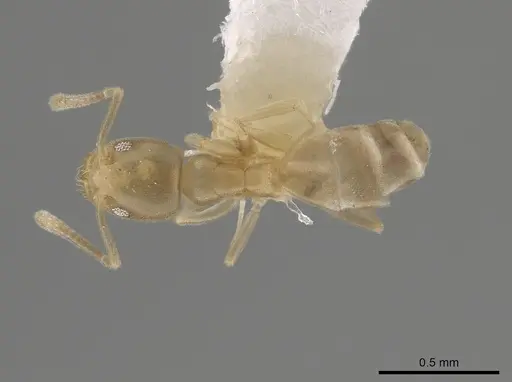
Literature
Loading...Loading products...