

Syscia ticomontana
- Scientific Name
- Syscia ticomontana
- Subfamily
- Dorylinae
- Author
- Longino & Branstetter, 2021
- Distribution
- Found in 1 countries
Syscia ticomontana Overview
Syscia ticomontana is an ant species of the genus Syscia. It is primarily documented in 1 countries , including Costa Rica. Detailed taxonomic data and occurrence records can be further explored via authoritative databases such as AntWeb or the Global Biodiversity Information Facility (GBIF).
Syscia ticomontana
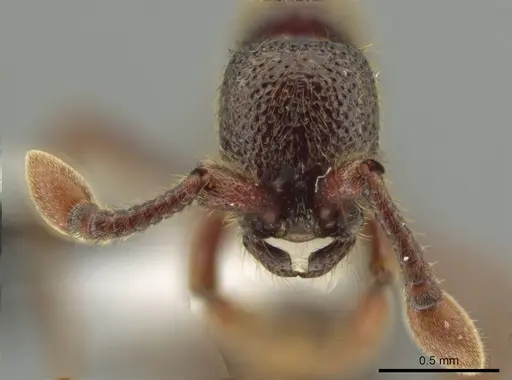
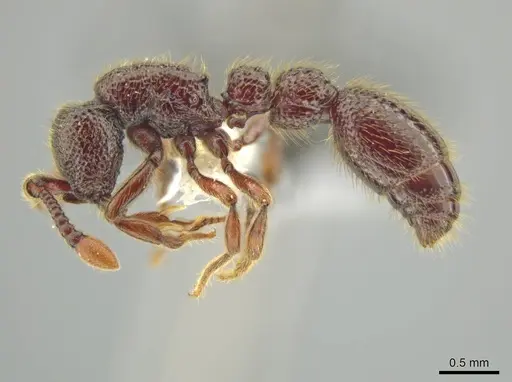
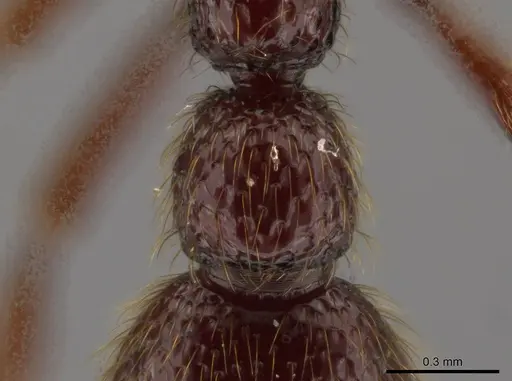
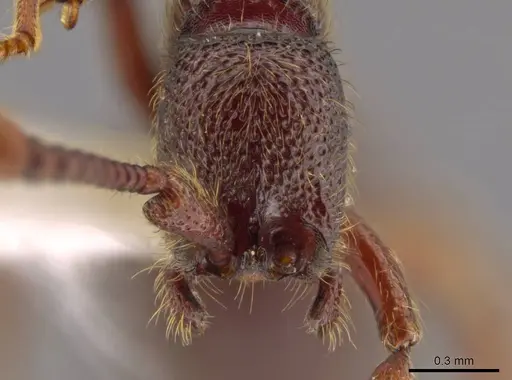
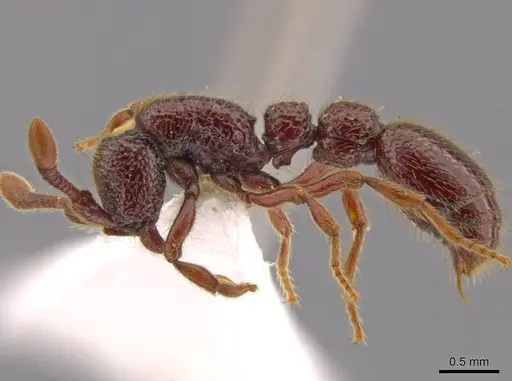
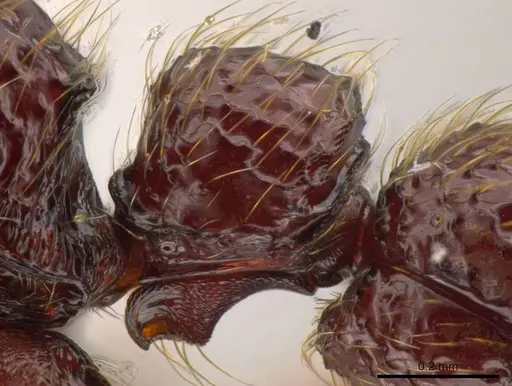
Syscia ticomontana is an exceptionally tiny ant species native to the cloud forests of Costa Rica. Workers measure just 0.62-0.70mm in head width, making them among the smallest ants in the Dorylinae subfamily [1]. They are dark brown with distinctive long, coarse hairs standing upright on their bodies. This species was only recently described in 2021 and is known only from the Tapantí National Park region in Costa Rica's central mountains [1].
As a Dorylinae species, these ants are predatory, hunting small invertebrates in the forest floor litter. They inhabit montane wet forests at elevations between 1340-1590 meters, where they live among decomposing leaves and rotting wood [1]. Only worker castes have been documented, no queens have been observed or described in the scientific literature. This species appears to be endemic to Costa Rica's mountain forests, likely evolved from a small lowland ancestor [1].
Quick Summary
- Difficulty: Expert
- Origin & Habitat: Endemic to the mountains of Costa Rica, specifically the Tapantí National Park region in Cartago province. They live in montane cloud forests at 1340-1590m elevation, found in sifted leaf litter and rotten wood on the forest floor [1].
- Colony Type: Unknown colony structure, only workers have been documented in scientific literature. No queens or reproductive forms have been described [1].
- Size & Growth:
- Queen: Unknown, no queens have been documented in scientific literature [1]
- Worker: 0.62-0.70mm head width,0.78-0.86mm head length,0.47-0.55mm scape length,0.98-1.09mm mesosoma length [1]
- Colony: Unknown, only workers have been collected, typically in small numbers from leaf litter samples [1]
- Growth: Unknown, no development data available
- Development: Unknown, no development studies exist for this species (Based on related Dorylinae and the species' tiny size, development may be relatively rapid, but this is entirely speculative)
- Antkeeping:
- Temperature: Cool conditions around 18-22°C, these are montane cloud forest ants from high elevation Costa Rica. Avoid warm conditions [1]
- Humidity: High humidity required, think damp forest floor conditions. Keep substrate consistently moist but not waterlogged [1]
- Diapause: Unknown, no studies on overwintering behavior. As a tropical montane species, they may not require traditional hibernation but may have seasonal activity patterns
- Nesting: Litter-dwelling species, they live in decomposing leaves and rotting wood on the forest floor. In captivity, provide a naturalistic setup with multiple layers of substrate, leaf litter, and small crevices. A plaster or acrylic nest with fine chambers would work, but this species is too poorly known for confident recommendations
- Behavior: These are tiny predatory ants that hunt small invertebrates in leaf litter. As Dorylinae, they likely use chemical trails to coordinate raids on micro-prey like springtails, mites, and tiny insects. Workers have long standing hairs which may help with detecting vibrations and chemical signals. Their extremely small size means escape prevention is critical, they can squeeze through impossibly tiny gaps. No documented aggression toward humans, their tiny mandibles would struggle to penetrate skin. Temperament is likely shy and secretive, avoiding confrontation. They are probably nocturnal or crepuscular, more active in the dim understory of the forest floor.
- Common Issues: no documented queens means captive breeding from wild colonies may be impossible, extreme tiny size makes escape prevention extremely difficult, standard barriers may fail, virtually no captive care information exists, all recommendations are speculative, difficulty obtaining wild colonies due to limited distribution and tiny size, high humidity requirements can lead to mold problems in captivity if ventilation is poor
Discovery and Taxonomy
Syscia ticomontana was only described in 2021 by Longino and Branstetter as part of a major taxonomic revision of New World Syscia species using advanced phylogenomic methods [1]. The holotype worker was collected from Tapantí National Park in Costa Rica's Cartago province, with paratypes from the same location. The species is morphologically distinctive, it is larger and darker than its relatives S. minuta and S. pollula. Genetic analysis shows it sits on a very long evolutionary branch, suggesting strong evolutionary differentiation from its closest relatives [1]. This species represents a rare example of a Syscia species adapted to montane cloud forest conditions rather than the lowland habitats where most Syscia species are found.
Natural History and Habitat
This species is known only from montane wet forests in Costa Rica's central mountain range at elevations between 1340-1590 meters [1]. All specimens have been collected using Winkler extractors from sifted leaf litter and rotten wood samples, standard methods for collecting tiny forest floor ants. The habitat is described as cloud forest with old second growth and riparian areas. The species appears to be endemic to this limited mountain region, likely derived from a small lowland ancestor that adapted to cooler, wetter conditions at higher elevations [1]. The combination of high elevation, constant cloud cover, and dense leaf litter creates a unique microhabitat with stable, cool temperatures and high humidity.
Keeping a Recently Described Species
Syscia ticomontana presents unique challenges for antkeepers because it was only recently described and virtually no captive care information exists. This is not a species for beginners, the lack of documented queens means you cannot establish a colony from wild-caught foundresses. The only option would be to locate an established colony through specialized researchers or collectors, which is extremely unlikely. If you somehow obtain workers, their care would need to be based on inference from related Dorylinae species and the species' known habitat preferences: cool temperatures around 18-22°C, high humidity mimicking cloud forest conditions, and access to tiny live prey. The extreme small size (workers are barely visible to the naked eye) means escape prevention must be exceptional, even standard fine mesh may not contain them. This species is best appreciated through scientific literature rather than attempted captive keeping. [1]
Related Species and Comparison
Syscia is a genus of tiny army ants (Dorylinae) that are distinct from the more famous army ants like Eciton. While typical army ants form large colonies with massive raids, Syscia species are small litter-dwelling predators that hunt individually or in small groups. The genus S. ticomontana belongs to is closely related to other tiny Dorylinae genera. Within Syscia, S. ticomontana is notably larger and darker than its relatives S. minuta and S. pollula [1]. The species shows strong evolutionary differentiation, it sits on a very long genetic branch suggesting it has been evolving separately from its closest relatives for a long time. This makes it a scientifically interesting species for studying ant evolution in montane cloud forest environments.
Frequently Asked Questions
Can I keep Syscia ticomontana ants as a pet?
This species is not recommended for captive keeping. No queens have ever been documented in scientific literature, meaning you cannot establish a colony from wild-caught queens. Additionally, this species was only described in 2021 and has never been kept in captivity, there is no care information available. The extremely tiny size and specialized habitat requirements make successful captive keeping extremely unlikely even if you could obtain workers [1].
Where does Syscia ticomontana live?
Syscia ticomontana is endemic to the mountains of Costa Rica, specifically found only in Tapantí National Park in Cartago province. They live at elevations between 1340-1590 meters in montane cloud forest habitats [1].
How big are Syscia ticomontana workers?
Workers are exceptionally tiny, head width is only 0.62-0.70mm, making them among the smallest ants in the Dorylinae subfamily. For comparison, they are small enough to potentially walk through the gaps in standard ant escape barriers [1].
What do Syscia ticomontana ants eat?
As Dorylinae (army ants), they are predatory on small invertebrates. In their natural habitat of forest floor leaf litter, they likely hunt tiny prey like springtails, mites, small insects, and other micro-arthropods. No specific diet studies exist for this species [1].
Are Syscia ticomontana queens known?
No, only worker castes have been documented in scientific literature. The species was described in 2021 and no queens or reproductive forms have ever been observed or described [1]. This makes captive breeding currently impossible.
How many workers are in a Syscia ticomontana colony?
The colony size is unknown. Only small numbers of workers have been collected from leaf litter samples using Winkler extractors. Unlike typical army ants that form large colonies, Syscia species are litter-dwelling and likely have smaller colony sizes [1].
Do Syscia ticomontana need hibernation?
Unknown, no studies exist on their seasonal behavior. As a tropical montane species from Costa Rica, they may not require traditional hibernation but could have seasonal activity patterns related to wet/dry seasons rather than temperature [1].
Is Syscia ticomontana endangered?
The conservation status has not been assessed. However, the species has a very limited range (only known from one location in Costa Rica) and lives in a protected area (Tapantí National Park). Climate change and habitat disturbance could pose threats to this montane species [1].
Why is Syscia ticomontana important scientifically?
This species is scientifically significant because it represents a rare adaptation to montane cloud forest conditions within a genus typically found in lowlands. Genetic analysis shows it has been evolving independently for a long time, making it important for understanding ant evolution in tropical mountain habitats [1].
References

This caresheet is licensed under CC BY-SA 4.0 .
CASENT0644376
View on AntWeb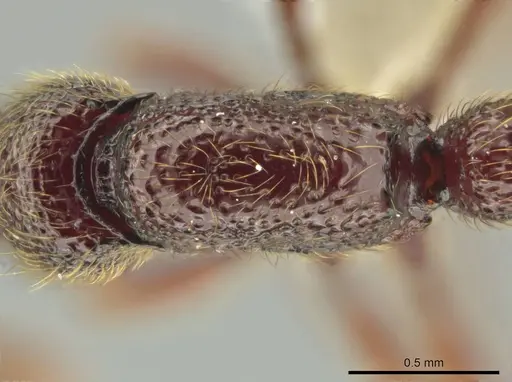
INB0003668201
View on AntWeb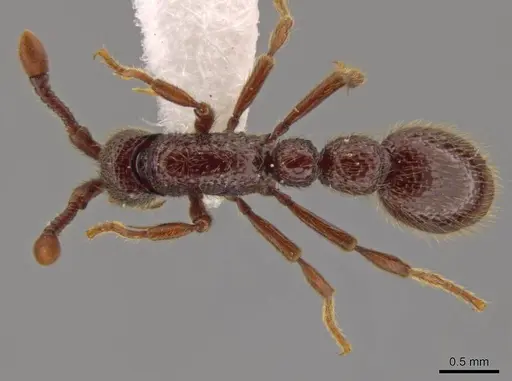
Literature
Loading...Loading products...