

Syscia borowieci
- Scientific Name
- Syscia borowieci
- Subfamily
- Dorylinae
- Author
- Longino & Branstetter, 2021
- Distribution
- Found in 1 countries
Syscia borowieci Overview
Syscia borowieci is an ant species of the genus Syscia. It is primarily documented in 1 countries , including Honduras. Detailed taxonomic data and occurrence records can be further explored via authoritative databases such as AntWeb or the Global Biodiversity Information Facility (GBIF).
Syscia borowieci
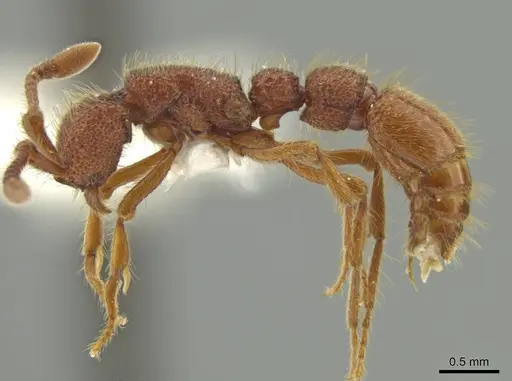
Syscia borowieci is a tiny army ant species recently described in 2021,found only in the mountains of Honduras. Workers are small at just over 1mm total body length, with a reddish-brown coloration and distinctive long coarse hairs standing upright on their bodies. This species inhabits lower montane forest ravines at around 1040m elevation, where it nests in rotting wood. As a member of the Dorylinae subfamily (army ants), these ants are predatory hunters, though Syscia represents a more generalized group within the army ant lineage. The species remains poorly studied in the wild, with only the type collection providing biological information.
Quick Summary
- Difficulty: Unknown, Insufficient data for difficulty rating
- Origin & Habitat: Honduras, Santa Barbara region at approximately 1040m elevation in lower montane forest ravines. The type locality was collected from rotting wood in a shaded forest ravine environment [1].
- Colony Type: Unknown colony structure. Only single workers have been collected, with no data on queen number or colony size in the wild.
- Size & Growth:
- Queen: Undescribed, no queen specimens have been collected or described [1]
- Worker: Workers measure approximately 1.13mm in total length (MSL), with head width (HW) of 0.69mm and head length (HL) of 0.82mm [1]
- Colony: Unknown, no colony collections have been documented [1]
- Growth: Unknown, no development data exists for this species
- Development: Unknown, no direct observations of colony development exist. Related Dorylinae species typically develop from egg to worker in 3-8 weeks depending on temperature, but this is a rough estimate for this species [1] (Development timeline is unconfirmed. Dorylinae ants are generally fast-growing compared to other ant subfamilies, but specific data for Syscia is lacking.)
- Antkeeping:
- Temperature: Based on the lower montane Honduras habitat (1040m elevation), aim for moderate temperatures in the range of 20-25°C. Avoid extreme heat. The mountain forest environment suggests they prefer stable, moderate conditions rather than tropical warmth [1].
- Humidity: Forest ravine habitat indicates moderate to high humidity needs. Keep the nesting substrate consistently moist but not waterlogged. Provide a gradient with slightly drier areas so ants can self-regulate [1].
- Diapause: Unknown, no seasonal data exists for this species. The Honduras range experiences minimal temperature variation year-round, so true hibernation may not be required. Consider a slight reduction in activity during winter months rather than full diapause.
- Nesting: In the wild, this species nests in rotting wood. In captivity, a naturalistic setup with moist substrate (soil or a soil-sand mix) and small pieces of wood or bark would best replicate their natural conditions. A Y-tong or plaster nest with added wood fragments could also work [1].
- Behavior: As a Dorylinae species, Syscia borowieci is likely a predatory hunter that pursues small invertebrates. Army ants are typically aggressive foragers with raiding behavior, though Syscia represents a more basal group within the subfamily. Workers are tiny at just over 1mm body length, making escape prevention critical, they can easily slip through standard barrier setups. No data exists on stingers for this specific species, but Dorylinae generally have functional stingers for subjugating prey.
- Common Issues: escape prevention is critical due to their tiny size, use fine mesh barriers and tight-fitting lids, no captive husbandry data exists, this is an experimental species with no established keeping protocols, predatory diet requirements may be challenging, likely needs small live prey items, humidity balance is uncertain, forest ravine habitat suggests moisture needs but exact requirements unknown, no established feeding protocols, keepers must experiment with small live prey acceptance
Discovery and Taxonomy
Syscia borowieci was only described in 2021 by ant specialists John Longino and Michael Branstetter, making it one of the most recently described ant species available to hobbyists. The species was named in honor of an ant researcher (borowieci) and was discovered in the Santa Barbara mountain region of Honduras. The holotype worker was collected in 1979 from a forest ravine at 1040m elevation, but remained undescribed for over four decades before being formally named. This species belongs to the Dorylinae subfamily, commonly known as army ants, though Syscia represents a more generalized branch of this group rather than the highly specialized nomadic army ants like Eciton [1].
Natural Habitat
This species is known only from the lower montane forests of Honduras at approximately 1040 meters above sea level. The type locality was a forest ravine, a shaded, humid valley environment where moisture collects and temperatures remain moderate. Workers were collected from rotting wood, indicating this species nests in decaying wood rather than in soil or under stones like many other ants. The combination of high elevation, forest shade, and rotting wood suggests they prefer cool, damp, shaded conditions. Honduras has a tropical climate, but the mountain elevation and forest cover create a much milder environment than lowland areas [1].
Identification and Appearance
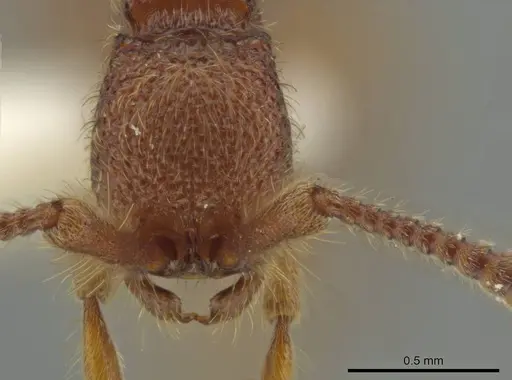
Syscia borowieci workers are tiny ants measuring just over 1mm in total body length. They have a distinctive reddish-brown coloration. The most notable physical features are the abundant long coarse hairs standing upright across their body, a trait called standing pilosity. The head is slightly longer than wide, and the antennae are relatively short (SI 93,meaning the scape is 93% of head width). The abdomen has a trapezoidal shape when viewed from above. These are small ants that would be easily overlooked in the wild, which explains why this species was only recently discovered despite being described from a collection made in 1979 [1].
Keeping Considerations
This is an experimental species for antkeepers. No captive husbandry protocols exist because the species was only recently described and has never been kept in captivity. Based on the natural habitat (rotting wood in humid forest ravines), a naturalistic setup with moist substrate and small wood fragments would be the best starting point. Temperature should be moderate (20-25°C), avoiding both extremes of heat and cold. As a likely predatory species, you should expect to offer small live prey such as springtails, fruit flies, or other tiny arthropods. The tiny size of workers means escape prevention must be excellent, standard barrier methods may not be sufficient. Start with a small test tube setup and observe behavior before scaling up [1].
Frequently Asked Questions
How big do Syscia borowieci ants get?
Workers are tiny at just over 1mm in total body length (MSL 1.13mm). The head width is approximately 0.69mm, making these among the smallest ants available in the antkeeping hobby [1].
Where does Syscia borowieci come from?
This species is only known from Honduras, specifically the Santa Barbara mountain region at approximately 1040m elevation. It was discovered in a forest ravine environment [1].
What do Syscia borowieci ants eat?
As a Dorylinae (army ant) species, they are likely predatory hunters. No direct feeding observations exist, but you should expect to offer small live prey such as springtails, fruit flies, tiny crickets, or other micro-arthropods. Sugar sources may or may not be accepted, experiment cautiously [1].
Is Syscia borowieci good for beginners?
No. This species has never been kept in captivity and no established husbandry protocols exist. The species was only described in 2021,meaning there is no captive breeding history or accumulated keeper experience. This is an experimental species for experienced antkeepers willing to pioneer new keeping methods [1].
What temperature do Syscia borowieci ants need?
Based on their lower montane forest habitat in Honduras, aim for moderate temperatures in the range of 20-25°C. The mountain elevation (1040m) suggests they prefer cooler conditions than typical tropical ants. Avoid temperatures above 28°C [1].
Do Syscia borowieci ants need hibernation?
Unknown. The Honduras range experiences minimal seasonal temperature variation, so true hibernation may not be required. However, you might consider a slight reduction in temperature or activity during winter months. No data exists on their seasonal biology [1].
What type of nest should I use for Syscia borowieci?
Based on the natural nesting in rotting wood, a naturalistic setup with moist soil substrate and small wood fragments would best replicate their habitat. A Y-tong or plaster nest with added wood material could also work. The key is providing consistently moist, shaded conditions [1].
Can I keep multiple Syscia borowieci queens together?
Unknown. No data exists on colony structure or queen behavior for this species. Only single workers have been collected, providing no information on whether they are single-queen or multi-queen colonies. Do not attempt combining unrelated queens without data [1].
How long does it take for Syscia borowieci to develop from egg to worker?
Unknown. No direct observations of colony development exist for this species. Related Dorylinae species typically develop faster than many other ants, possibly 3-8 weeks from egg to worker at optimal temperatures, but this is a rough estimate rather than confirmed data [1].
Why are my Syscia borowieci dying?
Without established protocols, colony failure is likely. Common issues likely include: escape through tiny gaps due to their minute size, improper humidity (too dry or too wet), inappropriate temperature (too hot or too cold), and starvation if predatory diet requirements are not met. This species requires experienced keepers willing to experiment carefully [1].
Are Syscia borowieci ants aggressive?
Unknown in captivity. As army ant descendants, they are likely more aggressive and active than typical ants when foraging, but no behavioral observations exist for this species. Army ants are known for coordinated raiding behavior, but this trait varies among Dorylinae groups [1].
References

This caresheet is licensed under CC BY-SA 4.0 .
MCZ-ENT00511558
View on AntWeb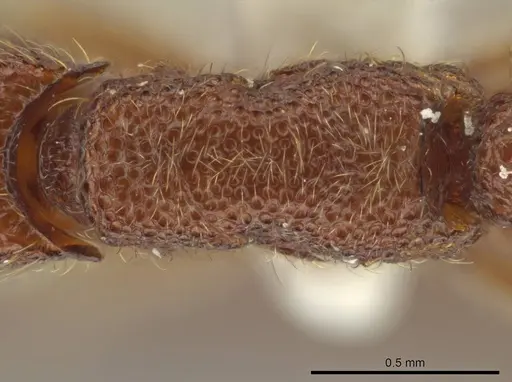
Literature
Loading...Loading products...