

Strumigenys inopina
- Scientific Name
- Strumigenys inopina
- Tribe
- Attini
- Subfamily
- Myrmicinae
- Author
- Deyrup & Cover, 1998
- Distribution
- Found in 1 countries
Strumigenys inopina Overview
Strumigenys inopina is an ant species of the genus Strumigenys. It is primarily documented in 1 countries , including United States of America. Detailed taxonomic data and occurrence records can be further explored via authoritative databases such as AntWeb or the Global Biodiversity Information Facility (GBIF).
Strumigenys inopina
Strumigenys inopina is an extremely rare North American ant known only from Florida, described from just three queen specimens collected in pine litter . This species is distinctive for being one of the few Strumigenys in the United States known only from queens, workers have never been observed. The queens are tiny at just 2.4mm total length, with a yellowish-brown coloration and a uniquely simplified morphology lacking the elaborate features typical of most Strumigenys species . The name 'inopina' means 'unexpected' in Latin, referring to this surprising combination of character states .
What makes S. inopina particularly fascinating is the strong evidence that it may be a workerless social parasite, a queen that invades the nests of related Strumigenys species and relies on the host workers to raise her brood . This hypothesis is supported by several factors: only dealate females have been found, the species is exceptionally rare, and it lacks the specialized morphological features (enlarged mandibles, spongiform tissue, antennal scrobes) that other Strumigenys use for prey capture and defense [1]. If parasitic, it would represent one of the few known cases of social parasitism within the Strumigenys genus itself.
Quick Summary
- Difficulty: Expert
- Origin & Habitat: Florida, United States, found in thick pine litter in various habitats including wet open flatwoods with Myrica and Quercus, and xeric sand pine scrub with dense scrub oaks .
- Colony Type: Unknown, only queens have been collected. Strongly suspected to be a workerless social parasite targeting other Strumigenys species [1].
- Queen: Socially parasitic
- Size & Growth:
- Queen: 2.4mm total length (head 0.62mm, mesosoma 0.56mm, head width 0.36mm)
- Worker: Unknown, workers have never been documented
- Colony: Unknown if colonies exist in the traditional sense
- Growth: Unknown
- Development: Unknown, likely dependent on host colony if parasitic (If confirmed as a social parasite, this species would not produce its own workers but would rely on host Strumigenys to raise its brood)
- Antkeeping:
- Temperature: Unknown, no captive data available. Based on Florida habitat, likely tolerates warm, humid conditions
- Humidity: Likely requires high humidity similar to other Florida Strumigenys species that inhabit pine litter
- Diapause: Unknown, no captive observations available
- Nesting: No captive keeping data exists. In the wild, found in thick pine litter samples extracted by Berlese funnel
- Behavior: Behavior in captivity is completely unknown. If the social parasite hypothesis is correct, this species would require a host colony of another Strumigenys species to survive. The queen would need to infiltrate a host nest and manipulate the host workers into raising her offspring .
- Common Issues: This species is virtually unknown in captivity, no established care protocols exist, Workers have never been documented, suggesting the species may be obligately parasitic and cannot found colonies independently, The suspected parasitic lifestyle means it would require a host colony to survive, making captive keeping extremely difficult if not impossible, Extremely rare in the wild, only three specimens have ever been collected despite extensive sampling, Identification is difficult and requires expert morphological examination of the queen
Identification and Morphology
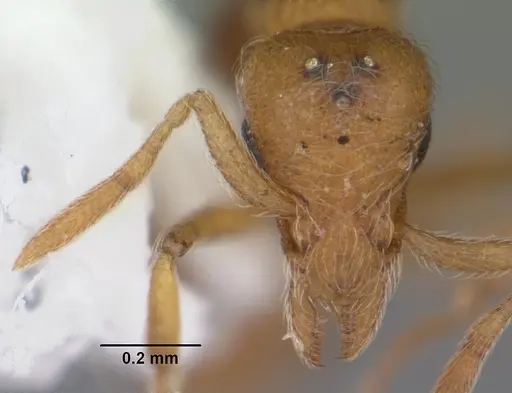
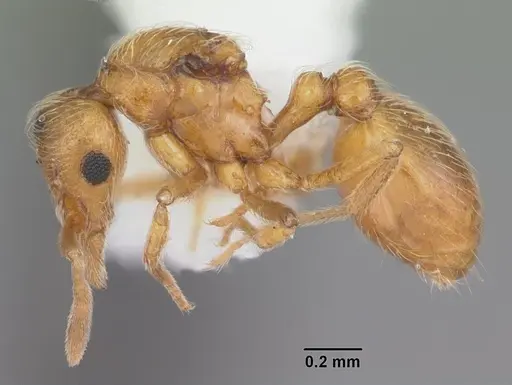
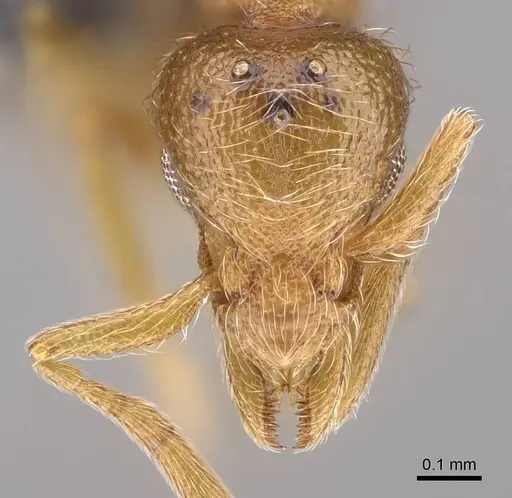
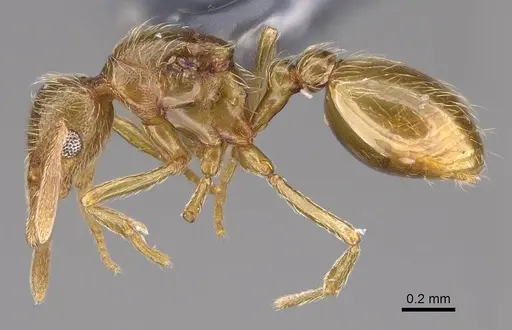
Strumigenys inopina queens are tiny at just 2.4mm total length, making them one of the smallest Strumigenys in North America . They have a distinctive yellowish-brown coloration and a uniquely simplified body plan compared to other Strumigenys. The most notable features are the complete absence of antennal scrobes (grooves along the head that house the antennae) and the complete lack of spongiform tissue on both the petiole and postpetiole, structures that most Strumigenys use for various functions . The mandibles are narrowly triangular with small teeth, and the body has sparse, curved, tapering hairs rising from conspicuous punctures . These queens can be distinguished from all other U.S. Strumigenys queens by this combination of features: no antennal scrobes, no spongiform appendages, compact short-high alitrunk profile, and no basigastral costulae .
Distribution and Habitat
This species is known only from northern Florida in the United States [1]. The three known specimens come from three different counties: Putnam County (holotype from Ocala National Forest wet flatwoods at the base of Pinus elliottii), Marion County (paratype from xeric sand pine scrub under Pinus clausa), and Alachua County (paratype from flatwoods habitat) . All specimens were collected from thick pine litter using Berlese funnel extraction, a method that sifts through leaf litter to collect tiny arthropods . The fact that all specimens were found in samples that also contained other Strumigenys species (S. clypeata, S. dietrichi, S. talpa) supports the social parasite hypothesis .
The Social Parasite Hypothesis
Researchers strongly suspect S. inopina is a workerless social parasite based on multiple lines of evidence . First, only dealate (wingless) females have ever been found, no workers exist in any collection. Second, the species is exceptionally rare despite extensive ant surveys in Florida. Third, all known specimens were collected alongside other Strumigenys species, which would be the most likely hosts under 'Emery's rule', the tendency for social parasites to target close relatives . Fourth, and most tellingly, S. inopina lacks all the elaborate morphological features that typical Strumigenys use for hunting prey and defense, their enlarged spongiform tissues, specialized mandibles, and antennal scrobes . This simplification suggests the species may have 'outsourced' these functions to host workers. If confirmed, S. inopina would be one of the few known cases of social parasitism within the Strumigenys genus itself [1].
Captive Keeping Status
Strumigenys inopina is NOT a species that can be kept in captivity. No workers have ever been documented, and the suspected social parasitic lifestyle means this ant would require a host colony of another Strumigenys species to survive, something that has never been achieved or documented in ant keeping . Even if you could obtain a queen, there would be no established protocol for introducing her to a host colony, and success would be extremely unlikely. For these reasons, S. inopina remains a species of scientific interest rather than an ant keeping target. Those interested in keeping Strumigenys should consider more commonly available species like Strumigenys clypeata or Strumigenys dietrichi, which are known to have functional colonies with workers .
Frequently Asked Questions
Can I keep Strumigenys inopina in captivity?
No. This species is not suitable for ant keeping. Only queens have ever been documented, workers have never been found. The suspected social parasitic lifestyle means it would require a host colony to survive, making captive keeping effectively impossible [1].
Why have workers never been found for Strumigenys inopina?
Researchers believe this species is likely a workerless social parasite. Instead of building its own colony, a parasitic queen invades the nest of another Strumigenys species and uses host workers to raise her offspring. This would explain why only queens (prospecting for nest sites) are found, but no workers (which would be raised by the host colony) .
What does Strumigenys inopina look like?
Queens are tiny at just 2.4mm total length with a yellowish-brown color. They have a simplified morphology lacking the elaborate features typical of most Strumigenys, no antennal scrobes, no spongiform tissue on the petiole or postpetiole, and small triangular mandibles .
Is Strumigenys inopina a parasite?
Yes, it is strongly suspected to be a social parasite. The evidence includes: only queens are known (no workers), the species is extremely rare, it lacks typical Strumigenys hunting adaptations, and it was always found alongside other Strumigenys species that could serve as hosts [1].
What species might host Strumigenys inopina?
Based on 'Emery's rule' (parasites target close relatives), likely hosts would be other Florida Strumigenys species found in the same samples, such as Strumigenys clypeata, Strumigenys dietrichi, or Strumigenys talpa .
How rare is Strumigenys inopina?
Extremely rare, only three queen specimens have ever been collected despite extensive ant surveys in Florida involving thousands of samples . This rarity is consistent with the social parasite hypothesis, as parasitic ants are frequently difficult to find .
What does 'inopina' mean?
The species name 'inopina' is Latin for 'unexpected.' It was chosen because the species displays a surprising combination of character states that differed from what researchers expected to find in Strumigenys .
Are there similar ants I can keep instead?
Yes. Other Florida Strumigenys species like Strumigenys clypeata and Strumigenys dietrichi have normal colonies with workers and can be kept in captivity. These species are predatory, feeding on small soil arthropods like springtails .
Can I find Strumigenys inopina in the wild?
It would be extremely unlikely. Despite targeted surveys, only three specimens have ever been collected across decades of sampling in Florida . The species appears to be genuinely rare and possibly restricted to protected areas within Ocala National Forest .
References

This caresheet is licensed under CC BY-SA 4.0 .
CASENT0103838
View on AntWeb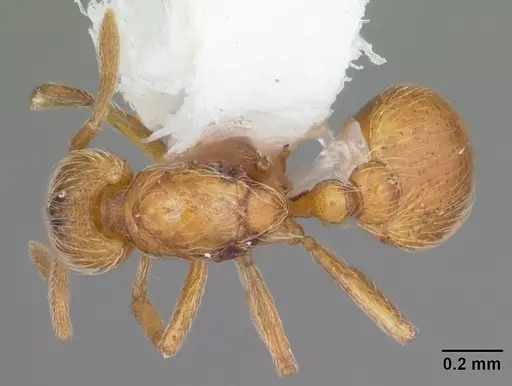
MEM86434
View on AntWeb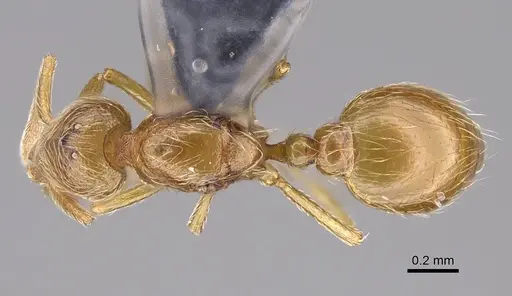
Literature
Loading...Loading products...