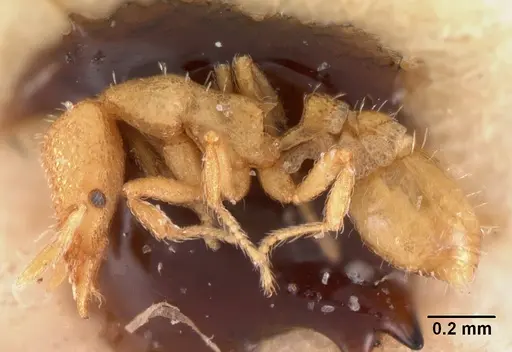
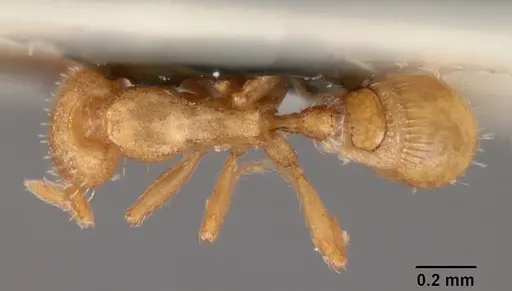
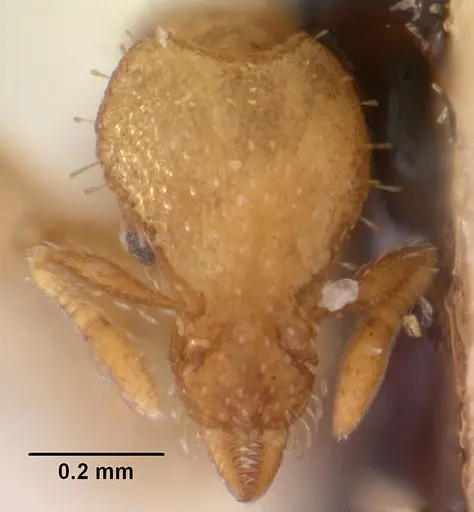
Strumigenys hensekta - "Trap-Jaw Ant (General for Strumigenys)"
Strumigenys hensekta is a tiny, cryptic ant species belonging to the diverse Strumigenys genus, known for its specialized trap-jaw mandibles. Workers are small, typically around 2.0-2.2 mm in total length, with a dull yellow coloration. Their unique mandibles are used for rapidly snapping shut on small prey. These ants are slow-moving and tend to freeze when disturbed, making them quite difficult to spot in their natural environment. They are primarily found in moist, warm habitats, often within leaf litter and decaying wood. Strumigenys hensekta workers have specific features like a transverse anterior clypeal margin and distinct pilosity (hair patterns) on their head and body, which help distinguish them from other similar species.
- Difficulty: Medium
- Origin & Habitat: Afrotropical Region (Angola, Cameroon, Democratic Republic of Congo, Gabon, Ghana, Ivory Coast, Kenya, Uganda) in Moist warm habitats, specifically wet forest habitats, soil, leaf litter, decaying wood, and opportunistic cavities on or under the soil..
- Colony Type: Monogyne, though some Strumigenys species can be polygyne., semi-claustral founding.
- Size & Growth:
- Queen: Not specified
- Worker: 2.0-2.2mm
- Colony: Small (typically less than 100 individuals, but can reach many hundreds in some Strumigenys species). Slow growth.
- Antkeeping:
- Temperature: Maintain a warm environment, ideally between 24-28°C, reflecting their tropical origin..
- Humidity: High humidity is crucial, around 70-90%, to mimic their moist leaf litter habitat..
- Diapause: Not required. Not specified at Not specified.
- Nesting: Prefer nests that retain high humidity, such as naturalistic setups with ample substrate, small Ytong nests, or acrylic nests with good hydration systems. They often live in soil, leaf litter, and decaying wood in the wild..
- Behavior: Low (towards handler, primarily defensive if handled) aggressiveness.
- Common Issues: Lack of appropriate live prey, Humidity fluctuations, Mold in nest, Mites, Colony stalling due to stress.
Strumigenys hensekta are highly specialized predators, primarily preying on tiny soil arthropods like Collembola (springtails). Their trap-jaw mandibles are an incredible adaptation for this, snapping shut rapidly to seize their fast-moving prey. Providing a consistent supply of appropriately sized live springtails or other minute invertebrates is absolutely essential for their survival in captivity. They won't thrive on sugars alone.
These ants are quite secretive and often forage within the substrate, rarely venturing into open areas. This cryptic behavior means they are not as active or visible as some other ant species, which can be a consideration for keepers who prefer to observe their colonies frequently. Setting up their outworld with plenty of leaf litter and small pieces of decaying wood will encourage more natural foraging behaviors.
Unlike many ant species, Strumigenys larvae feed directly on insect prey brought to them by the workers. Trophallaxis, the sharing of food through regurgitation, is rarely observed in this genus. This unique feeding habit highlights the critical need for a continuous supply of live prey for the developing brood. Ensure prey items are small enough for workers to handle and transport back to the brood chamber.
Colony sizes for Strumigenys species are typically small, often under 100 individuals, though some can reach several hundred. Their slow growth rate also means patience is key when keeping these fascinating ants. Don't expect rapid expansion; focus on maintaining stable conditions and a consistent food supply to support healthy, gradual growth.
When disturbed, Strumigenys ants tend to freeze and remain motionless, a unique defense mechanism. This can make observing them a bit challenging if you're not patient. Creating a stable, undisturbed environment will help them feel secure and exhibit more natural behaviors over time. Avoid frequent disturbances or vibrations to their nest.
User blogs will be displayed here.