

Simopone grandidieri
- Scientific Name
- Simopone grandidieri
- Subfamily
- Dorylinae
- Author
- Forel, 1891
- Distribution
- Found in 1 countries
Simopone grandidieri Overview
Simopone grandidieri is an ant species of the genus Simopone. It is primarily documented in 1 countries , including Madagascar. Detailed taxonomic data and occurrence records can be further explored via authoritative databases such as AntWeb or the Global Biodiversity Information Facility (GBIF).
Simopone grandidieri
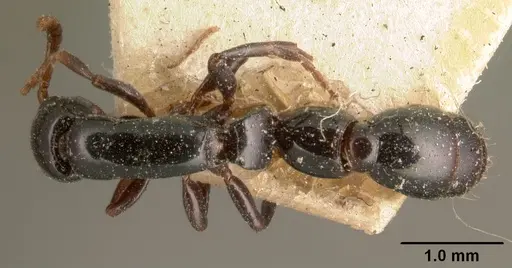
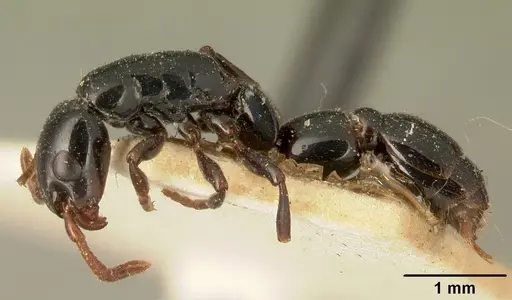
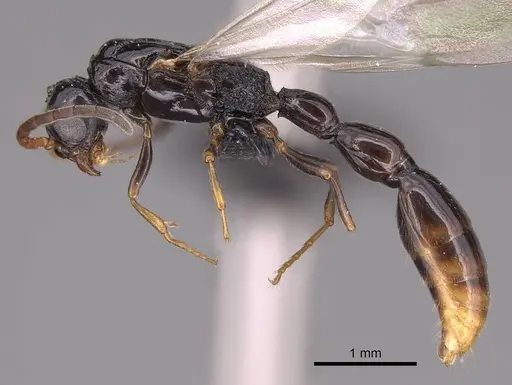
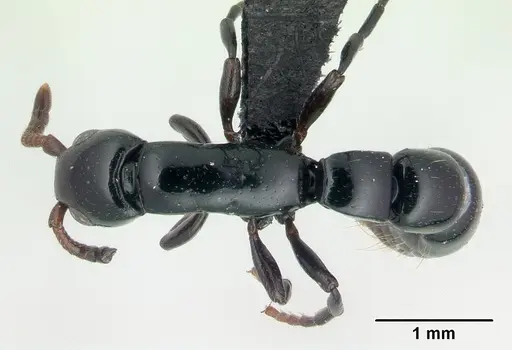
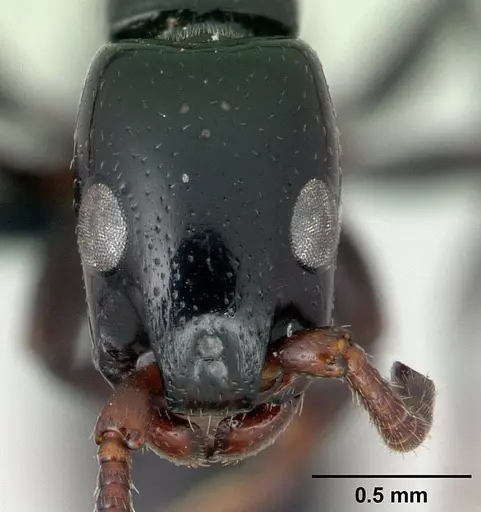
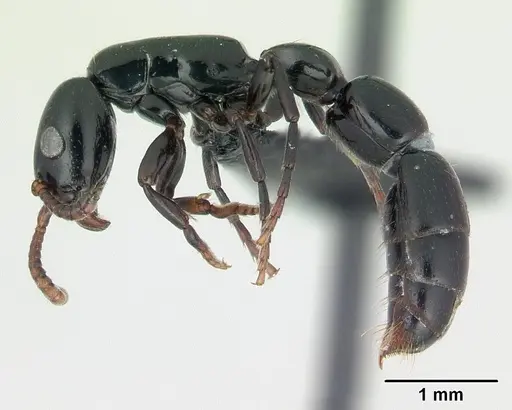
Simopone grandidieri is a small predatory ant endemic to Madagascar, belonging to the Dorylinae subfamily (the army ant group). Workers measure 0.53-0.92mm in head width with body lengths reaching 1.60mm, making them relatively small ants [1]. They are uniformly black in color, sometimes showing weak bluish reflections, and display notable size-related variation where smaller workers develop relatively longer, narrower heads [1]. This species was the first described in the genus Simopone and remains one of the better-known species within the grandidieri species group, having been collected across multiple locations in Madagascar [1]. Workers forage on the ground, on low vegetation, and in dead woody structures above ground, indicating they are generalist predators typical of the Dorylinae [2].
Quick Summary
- Difficulty: Expert
- Origin & Habitat: Madagascar, specifically the central region (Imerina) and surrounding forest habitats [3][2]. This species is endemic to Madagascar and has been collected in various forest situations.
- Colony Type: Colony structure is unconfirmed. As a Dorylinae species, they likely form colonies with a single queen, but specific colony organization has not been documented in scientific literature.
- Size & Growth:
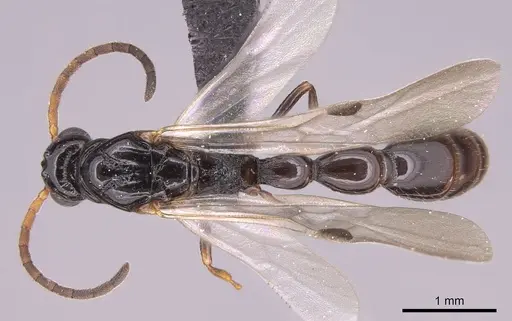
- Queen: Undocumented, queen measurements have not been published [1][2].
- Worker: Workers measure 0.53-0.92mm head width (HW) with body lengths (WL) of 1.00-1.60mm [1].
- Colony: Unknown, no colony size data has been documented in scientific literature.
- Growth: Unknown, development times have not been studied for this species.
- Development: Unconfirmed, no direct measurements exist. Based on typical Dorylinae patterns, development likely takes 4-8 weeks at optimal temperature, but this is an estimate. (Development timeline is unconfirmed for this species. Related Dorylinae typically have relatively fast development compared to other ant subfamilies.)
- Antkeeping:
- Temperature: Based on Madagascar's tropical climate, aim for 24-28°C with a slight gradient. This is an estimate based on habitat inference.
- Humidity: Maintain moderate to high humidity (60-80%) similar to forest floor conditions in Madagascar. Keep the substrate consistently moist but not waterlogged.
- Diapause: Unknown, no specific studies on overwintering requirements. Madagascar has a mild climate, so a true diapause may not be necessary, but a slight cooling period during cooler months may be beneficial.
- Nesting: No specific nesting data exists for this species. In captivity, a naturalistic setup with moist substrate and small prey feeding areas would be appropriate. Y-tong nests or plaster nests with good humidity retention may work well.
- Behavior: These ants are predatory, foraging on the ground and vegetation for small arthropods. As Dorylinae, they likely have efficient recruitment systems and may exhibit group hunting behaviors. Workers are small (under 2mm total length), so escape prevention must be excellent, they can easily slip through standard barriers. Temperament is not well documented but related Dorylinae are typically non-aggressive toward humans, focusing their predation on small invertebrates.
- Common Issues: very limited availability, this species is rarely kept in captivity and may be impossible to acquire, no established captive breeding protocols exist, keeping success stories are extremely rare, escape prevention is critical due to their tiny worker size, predatory diet requirements make them difficult to feed, need constant access to small live prey, lack of species-specific care information means keepers must rely on inference from related species, humidity management is challenging, too dry causes desiccation, too wet causes mold
Species Overview and Identification
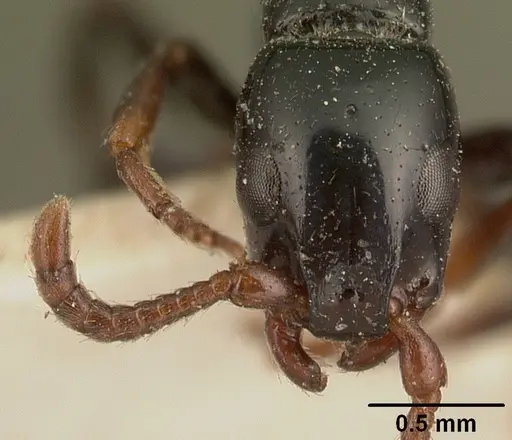
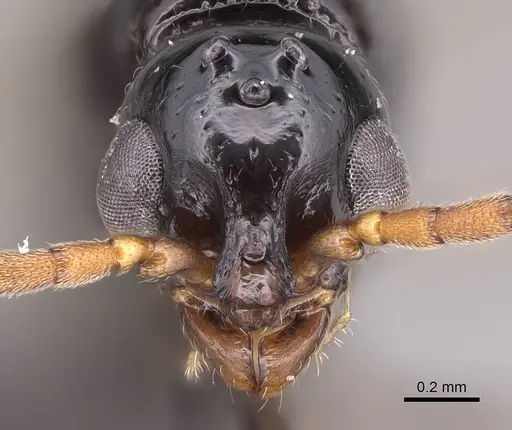
Simopone grandidieri is a fascinating Dorylinae ant from Madagascar, one of the first species ever described in its genus back in 1891 [1]. Workers are small and uniformly black, sometimes showing subtle bluish reflections under certain lighting. The species shows interesting size-related variation, larger workers have broader heads while smaller workers develop relatively longer, narrower heads [1]. This is one of only two species in the grandidieri species group known from Madagascar, making it relatively distinctive within its range. The workers can be identified by their single pair of standing setae on the head, located near the posterior margin of the eye, and by the eyes being positioned at or just in front of the head's midlength [1]. The antennae have no projecting setae on the leading edge of the scape, which helps distinguish them from similar species [4].
Natural History and Foraging
In the wild, Simopone grandidieri workers have been observed foraging in multiple situations, on the ground, on low vegetation, and in dead woody structures above ground [2]. This suggests they are generalist predators that hunt across different microhabitats. As members of the Dorylinae subfamily, they are related to army ants but do not exhibit the massive swarm-raiding behavior typical of true army ants (Eciton). Instead, they likely operate as small-scale predators, hunting individual prey or small groups. The broad ecological niches they occupy (ground, vegetation, woody debris) indicates adaptability to different conditions within Madagascar's forests. Their prey consists of small arthropods, likely including springtails, mites, and other micro-invertebrates found in forest floor habitats.
Housing and Nesting in Captivity
Since no captive care protocols exist for this species, housing recommendations must be inferred from related Dorylinae and the ant's natural habitat. A naturalistic setup with moist substrate (like a mixture of soil and sand) would best replicate their forest floor environment. The nest area should maintain high humidity while allowing for some drier areas where ants can self-regulate. Given their small size, any formicarium or nest setup should have excellent escape prevention, standard test tube setups may work but require careful sealing. Plaster or Y-tong nests that retain moisture well are likely the best options. The outworld should include plenty of hiding places and hunting surfaces where workers can search for prey.
Feeding Requirements
Simopone grandidieri is a predatory ant requiring a diet of small live invertebrates. Based on their small size and foraging behavior, their natural prey likely consists of springtails, mites, tiny beetles, and other micro-arthropods found in decaying wood and leaf litter. In captivity, you should provide a constant supply of small live prey such as springtails, fruit flies, and other tiny insects. They will likely accept small crickets or mealworm pieces, but live prey is essential for triggering their hunting behaviors. Sugar sources may be accepted occasionally, but protein from prey should form the majority of their diet. Feed small amounts every few days, adjusting based on colony consumption.
Temperature and Humidity
As a Madagascar endemic, Simopone grandidieri likely prefers warm, humid conditions similar to tropical forest interiors. Target temperatures in the range of 24-28°C, with a slight gradient allowing ants to choose their preferred zone. Room temperature may be suitable if your home stays in this range, otherwise a gentle heating cable on one side of the nest can provide additional warmth. Humidity should be maintained at 60-80%, keeping the substrate consistently moist but never waterlogged. Mist the nest occasionally and monitor for condensation, some moisture is good, but excessive standing water should be avoided. Good ventilation is essential to prevent mold while maintaining humidity.
Challenges and Why This Species Is Expert-Only
Simopone grandidieri is not a species for beginners. The primary challenge is simply acquiring them, they are extremely rare in the ant-keeping hobby and may not be available from any commercial source. Beyond availability, there is essentially no captive breeding information available, meaning you will be pioneering all aspects of their care. Their small size makes them prone to escaping and difficult to house in standard setups. Their predatory diet requires a constant supply of live small prey, which is more demanding than feeding sugar water or seed mixes. Without species-specific information, keepers must constantly experiment and adjust, making this an expert-only project that requires significant experience with difficult ant species.
Frequently Asked Questions
Is Simopone grandidieri available for purchase?
This species is extremely rare in the ant-keeping hobby and is not commonly available from commercial breeders. It is endemic to Madagascar and has rarely, if ever, been exported for the hobby trade.
How do I care for Simopone grandidieri?
Specific captive care protocols do not exist for this species. Based on related Dorylinae, they likely need warm (24-28°C), humid conditions with constant access to small live prey. This is an expert-only species with no established keeping protocols.
What do Simopone grandidieri ants eat?
As predatory Dorylinae ants, they require live small invertebrates. Their natural prey likely includes springtails, mites, and tiny arthropods. In captivity, offer springtails, fruit flies, and other small live prey regularly.
How big do Simopone grandidieri colonies get?
Colony size is unknown, no scientific data exists on maximum colony sizes for this species. Based on related Dorylinae, colonies likely reach several hundred workers at most.
Do Simopone grandidieri need hibernation?
Diapause requirements are unconfirmed. Madagascar has a mild tropical climate without harsh winters, so a true hibernation period is likely not necessary. A slight cooling during cooler months may be beneficial but is not required.
Can beginners keep Simopone grandidieri?
No, this is an expert-only species. There are no established care protocols, they are nearly impossible to acquire, and their small size and predatory diet make them extremely challenging to keep successfully.
What is the egg to worker development time for Simopone grandidieri?
Development timeline is unconfirmed, no scientific measurements exist for this species. Based on typical Dorylinae patterns, development likely takes 4-8 weeks at optimal temperature, but this is purely an estimate.
Where is Simopone grandidieri found?
This species is endemic to Madagascar, specifically the central region (Imerina). It has been collected in various forest habitats across the island.
How do I set up a nest for Simopone grandidieri?
No species-specific nest recommendations exist. A naturalistic setup with moist substrate and good humidity retention (plaster or Y-tong nest) would be appropriate. Escape prevention must be excellent due to their tiny worker size.
References

This caresheet is licensed under CC BY-SA 4.0 .
Literature
Loading...Loading products...